


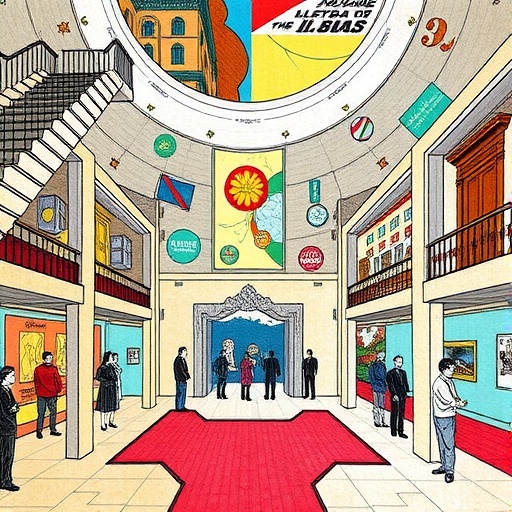
A pioneering scientific project spearheaded by researchers at Universidad Carlos III de Madrid (UC3M) has cast light on the profound urban and social transformations undergone by the municipality of Leganés, located in the metropolitan orbit of southern Madrid. Supported by the Spanish Foundation for Science and Technology (FECYT) and conducted collaboratively with the Leganés City Council, this interdisciplinary study adopts innovative citizen science methodologies to reconstruct the collective memory of the city while analyzing its shift from an agricultural and tight-knit neighborhood framework into a sprawling urban landscape dominated by commercial complexes and housing developments.
This comprehensive research integrates surveys administered by high school students from the local IES Siglo XXI institution, qualitative interviews with community experts, and an extensive review of historical archives. The deliberate engagement of youth as field researchers injects a novel dimension into urban historiography, merging social science rigour with grassroots participation. The result is a layered and textured portrait of Leganés that juxtaposes official records with lived experiences, highlighting the intrinsic value of oral histories in complementing traditional archival evidence.
Leganés’ urban evolution reveals a stark departure from its past character: where once open-air plazas, neighborhood cinemas, and vibrant social meeting places flourished, the current urban fabric exhibits a dominance of large-scale commercial malls such as the Parquesur shopping center. This shift encapsulates broader sociocultural trends affecting suburban peripheries of major global cities, where privatization of public spaces and retail centralization erode local traditions and identities.
A meticulous comparison drawn between historical and present-day social hubs exposes a demolition of communal leisure environments integral to the “pepinera” identity—the affectionate nickname for Leganés residents. Cinemas like Cine Avenida and Capitol, cultural pillars between the 1960s and 1990s, have vanished, supplanted by residential and commercial infrastructures. Additionally, nightlife venues pivotal to generational identities in the 1980s and 1990s now serve as sites for supermarkets or betting shops, evidencing a commercial reconfiguration of urban leisure spaces.
The disappearance of children’s recreational venues—once abundant with arcades, newsstands, and cinemas—is particularly telling. From 24 such neighborhood leisure facilities recorded in the past, only a handful survive today, a decline that mirrors the concurrent replacement of traditional local commerce by supermarket chains and real estate expansion. The study documents the eradication of boutiques, artisanal shops, and food markets like the Río Jarama Market, replaced by homogenized retail environments threatening the municipality’s socioeconomic heterogeneity.
Beyond commercial and leisure transformations, the study sheds light on notable spatial repurposing reflected in the conversion of former vegetable gardens and dairy farms of the 1970s into urban plazas, courthouses, and educational institutions. These changes symbolize the rapid urbanization and land-use modifications driven by demographic pressures and market forces, contributing to the ongoing redefinition of the city’s physical and sociocultural landscapes.
The research team employed triangulation techniques to cross-validate data obtained from citizen testimonies, expert interviews, and documentary archives housed in the Historical Archive of Leganés. This triangulated methodological approach enhances data reliability and reveals a more nuanced narrative of urban change, one that acknowledges the complexity of memory practices and the multiplicity of historical voices. The incorporation of citizen science emerges as a powerful tool to democratize historical knowledge production and facilitate intergenerational dialogue.
One of the underlying themes illuminated by this scientific investigation is the role of memory and identity in urban settings facing rapid socioeconomic shifts. The gradual disappearance of culturally significant venues and the homogenization of public spaces signify not only a tangible loss of heritage but also a threat to communal cohesion and identity preservation. The study urges the need for urban planning policies sensitive to cultural memory and the social value of public spaces.
The study further discusses the socio-technical dynamics of urban transformation, underscoring how economic globalization, real estate development strategies, and consumer culture trajectories converge to reshape cityscapes. It presents Leganés as a microcosm of wider post-industrial urban trends, where public space privatization aligns with neoliberal urban governance frameworks, and where grassroots memory initiatives counterbalance top-down narratives.
A substantial outcome of the project is a public photographic exhibition, “Milestones, Places and Personalities of Leganés through Photographs from the Municipal Archive,” hosted at the UC3M Getafe Campus. This exhibition operates as both a scientific dissemination tool and a participatory cultural event, reaffirming the intersection between academic research, community engagement, and heritage education.
In synthesizing these findings, the researchers advocate for the integration of citizen science and oral history in urban research methodologies. This dual approach not only enriches empirical datasets but also empowers communities as co-producers of knowledge, intensifying the societal relevance and impact of academic inquiry. The methodology adopted in Leganés holds promise for replication in similar urban peripheries globally, particularly in contexts undergoing rapid sociocultural transitions.
The project evidences that urban histories are living constructs, continually negotiated through collective memory and lived experience rather than static archival documents alone. By embracing this paradigm, the study transcends conventional historiographical boundaries, offering a dynamic canvas on which the evolving social fabric of suburban Spain is vividly rendered with scientific precision and empathetic nuance.
Cite Scienmag News
Gavin Prescott. (June 8, 2026). UC3M Research Project Unveils the Collective Memory and Urban Evolution of Leganés. Scienmag. https://scienmag.com/uc3m-research-project-unveils-the-collective-memory-and-urban-evolution-of-leganes/
Gavin Prescott. "UC3M Research Project Unveils the Collective Memory and Urban Evolution of Leganés." Scienmag, 8 June 2026, https://scienmag.com/uc3m-research-project-unveils-the-collective-memory-and-urban-evolution-of-leganes/. Accessed 4 September 2026.
Gavin Prescott. "UC3M Research Project Unveils the Collective Memory and Urban Evolution of Leganés." Scienmag. June 8, 2026. https://scienmag.com/uc3m-research-project-unveils-the-collective-memory-and-urban-evolution-of-leganes/


