


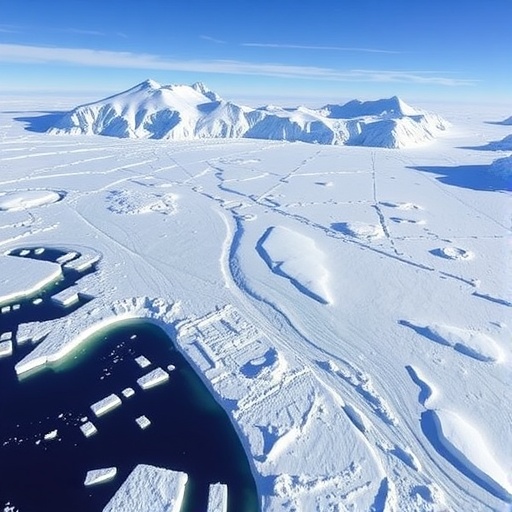
The longstanding narrative in glaciology has often revolved around temperature thresholds and ice-sheet volume, positioning these as primary indicators for ice-sheet responses to environmental forcing. Yet, a groundbreaking study published in Nature Geoscience challenges this traditional framework, illuminating a more nuanced portrait of ice-sheet dynamics. Researchers Golledge, Naish, Lowry, and colleagues employ a coupled ice sheet–ice shelf model to reveal distinct behavioral regimes of ice sheets that transcend mere considerations of ice volume. Their findings underscore the intricate interplay between ice-sheet stability, ice shelf viability, and atmospheric conditions, with profound implications for predicting future sea-level rise and Earth system feedbacks.
Central to this study is the identification of three unique ice-sheet regimes that emerge from the model simulations. Unlike previous approaches which primarily linked ice-sheet behavior linearly to volume loss or gain, these regimes encapsulate complex, path-dependent dynamics, highlighting that ice-sheet response is not only a function of how much ice exists but also how it is configured and how it fluctuates over time. The significance of these regimes lies in their distinct characteristics, especially in relation to mass loss variability and predictability, which are quantified through an innovative application of Shannon entropy—a measure often used in information theory to assess uncertainty and complexity.
At the extremes of the climatic spectrum, the model reveals ice sheets residing in low-entropy, highly predictable states. In colder conditions, ice sheets tend to be stable, with extensive ice shelves buttressing the grounded ice and minimizing mass loss variability. Conversely, under warmer extremes, ice sheets exhibit a different form of stability characterized by reduced ice volume but similarly low variability in mass loss. These findings suggest that ice-sheet responses to extreme climates are more deterministic and less susceptible to abrupt transitions, a conclusion that overturns earlier assumptions about the inherent volatility of ice systems under extreme warming or cooling.
However, the true novelty of the study emerges at intermediate climate conditions, where ice sheets enter a bistable regime marked by high entropy and unpredictability. This regime, residing between the cold-stable and warm-stable extremes, is characterized by increased variability in mass loss, making ice-sheet dynamics inherently more chaotic and less predictable. The existence of such a bistable state challenges the conventional wisdom that ice-sheet responses to warming follow smooth, monotonic trajectories, instead emphasizing the potential for sudden regime shifts driven by subtle climate perturbations.
Such regime shifts are critically tied to the atmospheric temperature range, with transitions between states occurring within a strikingly narrow band of less than 2 Kelvin. This fine margin highlights the extraordinary sensitivity of ice shelves and their feedback mechanisms to relatively minor changes in temperature. Crucially, the presence and viability of ice shelves serve as a pivotal control on the mechanical stability of ice sheets. Ice shelf collapse or growth can thus serve as tipping points, precipitating abrupt shifts between vastly different ice-sheet regimes.
The implications of these findings extend beyond academic insight, carrying significant weight for forecasting future sea-level rise. Traditional models that focus exclusively on ice volume may underestimate the complexity of ice-sheet evolution and the possibility of rapid, nonlinear changes. Incorporating regime behavior characterized by entropy measures shifts the focus toward predicting not just mean responses but also the variability and potential abruptness of ice mass loss. This paradigm offers a framework better aligned with the realities of observed ice-sheet behavior in regions like West Antarctica, where rapid retreats and collapses have challenged modelers for decades.
Underlying this study is the deployment of advanced coupling between ice sheet and ice shelf models, enabling a more holistic simulation of the dynamic interactions between grounded and floating ice. By integrating these components and analyzing the resultant multivariate mass loss, the researchers can discern patterns that were previously obscured by more simplistic modeling approaches. The methodological advancement here—combining physical ice dynamics with information-theoretic metrics—presents a powerful new way to interrogate complex climate-cryosphere interactions.
Moreover, the use of Shannon entropy in this context is revolutionary. Traditionally applied in fields such as computer science and physics to quantify uncertainty, entropy here serves as a diagnostic tool that captures changes in variability and predictability. This metric effectively translates complex temporal fluctuations in ice mass loss into a single scalar quantity, providing a quantitative lens to distinguish between stable, bistable, and unstable regimes. Such interdisciplinary methodological sophistication represents an important trend in Earth system science, where tools from information theory and complexity science are increasingly deployed to unlock new insights.
The path-dependency of ice-sheet states, a concept reinforced by this work, posits that the historical trajectory of environmental forcing and ice-sheet configuration influences current and future behavior. This means that the same climatic conditions can yield different ice-sheet responses depending on prior states, challenging the notion of a straightforward cause-effect relationship. Consequently, predictions must carefully account for the temporal sequence of warming and cooling events, as well as the legacy effects embedded within ice-sheet and shelf structures.
In this context, feedback mechanisms involving ice shelves play a crucial role. Ice shelves act as buttresses, restraining the flow of ice from the grounded sheet into the ocean. Their thinning or collapse reduces this restraint, accelerating mass loss. Conversely, ice shelf expansion or thickening enhances stability. The bistable regime identified by the authors reflects the precarious balance of these mechanisms at intermediate temperatures, where small shifts can flip the system from a buttressed to an unbuttressed state, with massive implications for downstream ice-sheet dynamics.
The abrupt transitions highlighted by this study underscore the urgency for monitoring ice shelves and their environmental controls with high temporal and spatial resolution. Climate models and observation networks must prioritize capturing the fine-scale changes in temperature and ice shelf integrity that precede regime shifts. This newfound appreciation for sensitivity to sub-2 Kelvin changes challenges the adequacy of existing climate targets and policy frameworks that often rely on more coarse assessments of climatic thresholds.
Additionally, the highly predictable nature of ice-sheet states under extreme climate conditions offers an intriguing window for paleoclimate reconstructions. By linking sedimentary and ice core records to modeled entropy regimes, scientists may refine their interpretations of past ice-sheet behavior during glacial and interglacial periods. This can clarify how ice sheets adapted or transformed in response to climatic shifts that are recorded in geological archives.
The study also paves the way for future research directions that integrate observational data, physical models, and machine learning techniques to identify early warning signals of regime shifts. The entropy-based framework can be adapted to real-time monitoring data, potentially providing a predictive tool to anticipate destabilization events before they culminate in irreversible mass loss.
Ultimately, the work by Golledge and colleagues marks a paradigm shift in how scientists conceptualize ice-sheet vulnerability under climate warming. Moving beyond simplistic volume thresholds to embrace complex, multivariate dynamical states redefines our understanding of the cryosphere’s role in the Earth system. It asserts that subtle climate changes, mediated through ice shelf feedbacks, can trigger disproportionate and rapid ice-sheet responses, thereby complicating predictions of future sea-level rise but simultaneously opening new avenues to anticipate and possibly mitigate such outcomes.
As sea levels continue to rise, reshaping coastlines and impacting millions of lives worldwide, advancing our grasp of ice-sheet dynamics is more crucial than ever. This study provides a sophisticated lens, blending climate science, glaciology, and information theory, to unravel the enigmatic behaviors of ice sheets. Its insights compel the scientific community, policymakers, and global society to reconsider the thresholds of risk in a warming world, where the next tipping point might be closer—and more volatile—than previously imagined.
Cite Scienmag News
Violet Maxwell. (June 5, 2026). Ice Sheet Regime Shifts Driven by Climate Warming. Scienmag. https://scienmag.com/ice-sheet-regime-shifts-driven-by-climate-warming/
Violet Maxwell. "Ice Sheet Regime Shifts Driven by Climate Warming." Scienmag, 5 June 2026, https://scienmag.com/ice-sheet-regime-shifts-driven-by-climate-warming/. Accessed 4 September 2026.
Violet Maxwell. "Ice Sheet Regime Shifts Driven by Climate Warming." Scienmag. June 5, 2026. https://scienmag.com/ice-sheet-regime-shifts-driven-by-climate-warming/


