


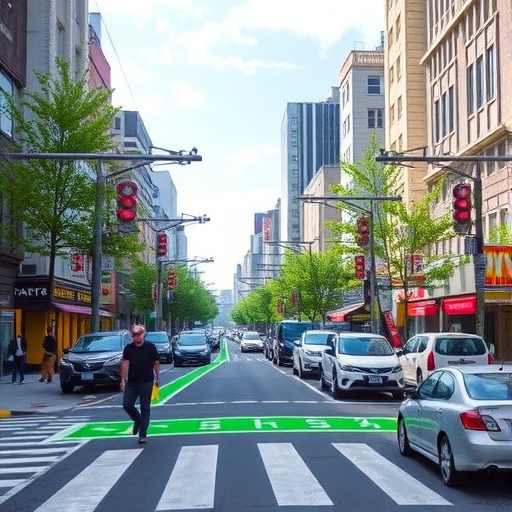
In the sprawling metropolis of Tokyo, the pulse of urban life beats with a rhythm as complex and dynamic as the city itself. As one of the world’s leading global cities, Tokyo continually grapples with challenges common to modern urban environments—challenges of sustainability, equity, and effective governance. A groundbreaking study set to be published in npj Urban Sustainability in 2026 by Sun, Huang, Zhao, and collaborators undertakes an unprecedented exploration into Tokyo’s streetscape using a novel technological lens. This research leverages advanced street view diagnostics to unveil the subtle yet telling disparities ingrained in inclusion and street quality, offering actionable insights to reimagine urban governance in one of the world’s most densely populated cities.
The core innovation of this study lies in its application of street-level imagery paired with sophisticated computer vision algorithms to analyze urban inclusion and street conditions comprehensively. Street view diagnostics harness the vast repository of real-world images captured throughout Tokyo’s neighborhoods, transforming them into data-rich sources for quantitative analysis. This method transcends traditional surveys or census data, which can be infrequent or limited in scope, offering a dynamic and fine-grained understanding of physical street attributes and social indicators embedded in the urban fabric.
Tokyo’s urban environment is marked by striking contrasts—gleaming skyscrapers and subdued residential blocks, bustling hubs and quiet alleyways. This study seeks to quantify how these spatial disparities mirror broader patterns of social inclusion and exclusion. By systematically evaluating street quality elements such as sidewalk continuity, lighting, greenery, cleanliness, and accessibility, the researchers paint a detailed map of infrastructure disparities. Crucially, their diagnostic approach also infers social inclusion indicators by analyzing the accessibility and street-level amenities catered towards diverse demographics, including elderly populations, children, and persons with disabilities.
One of the key technical breakthroughs in this research is the deployment of machine learning models trained to interpret the street view imagery automatically. These models identify and classify infrastructure features with remarkable precision, reducing the need for labor-intensive human annotations. They also incorporate multi-modal data fusion, integrating street view images with geographic information system (GIS) layers and demographic datasets. This synergy between visual data and socioeconomic profiles allows for a nuanced interpretation of street quality’s impact on social cohesion.
The rich dataset generated revealed surprising patterns of inequality. Although Tokyo is generally perceived as a well-planned and orderly city, certain neighborhoods exhibited significant gaps in street quality and inclusivity measures. Lower-income districts, often on the periphery or overshadowed by commercial corridors, faced inadequacies in sidewalk maintenance, street lighting, and accessible public spaces. These infrastructural deficiencies contribute to an environment where vulnerable groups experience restricted mobility and diminished sense of community belonging, further entrenching social divides.
In parallel, the study underscores positive examples where intentional urban design and governance have fostered inclusive street environments. Districts with active civic participation and targeted municipal policies demonstrate how equitable infrastructure investments yield benefits in social inclusion, particularly in creating safe pedestrian pathways and integrating accessible street furniture. These pockets of success provide a blueprint for scaling interventions across Tokyo to address systemic inequalities.
Importantly, the researchers emphasize that street quality is not merely an aesthetic or functional concern but a fundamental determinant of urban governance efficacy. Quality streetscapes facilitate economic vitality, public safety, and community interaction, all keystones of resilient cities. By correlating their findings with governance metrics, the study pinpoints areas where local authorities can optimize resource allocation to balance urban development with inclusivity goals.
Technically, this research sets a precedent for urban diagnostics globally by showcasing a scalable, data-driven framework adaptable to diverse cities. The fusion of street view imagery and AI-enabled analytics offers a timely tool for continuously monitoring urban conditions in real time, allowing dynamic governance responses rather than static, one-off assessments. Such methodologies can democratize urban data, empowering policymakers, citizens, and planners with transparent and actionable information.
The implications for Tokyo specifically are profound. With its aging population and growing socio-economic complexities, Tokyo needs governance strategies that are both forward-thinking and sensitive to grassroots realities. This study’s street-level insights highlight pathways to improve urban walkability and safety, promote social equity, and enhance livability across all wards. Pursuing these goals can also significantly contribute to achieving Tokyo’s commitments under global sustainability agendas, including the United Nations’ Sustainable Development Goals (SDGs).
Furthermore, the research punctuates the urgency of integrating technological innovation in urban planning processes. The confluence of AI, big data analytics, and traditional urban studies heralds a new frontier in understanding cities not just through numbers or isolated metrics but through vivid, continuous snapshots of lived urban experience. This paradigm shift encourages governance that is reflective, adaptive, and citizen-centered.
Given the rapid urban transformations occurring worldwide, this pioneering approach in Tokyo offers a replicable model for cities intent on bridging the material and social gaps in their streetscapes. By focusing attention on micro-level infrastructure and inclusion disparities, urban planners can design interventions that align more closely with the lived realities of residents, particularly marginalized populations often neglected in broad-brush approaches.
In conclusion, Sun, Huang, Zhao and colleagues have advanced an essential frontier in urban sustainability research by enabling a granular understanding of street quality and social inclusion through cutting-edge street view analysis. Their findings serve as both a diagnostic tool and a governance compass, illuminating the pathways toward a more inclusive, equitable, and resilient Tokyo. As cities worldwide grapple with the dual imperatives of modernization and social justice, such innovative studies provide critical blueprints for transforming urban spaces into thriving habitats for all.
Cite Scienmag News
Courtney Benton. (June 4, 2026). Street View Diagnostics Reveal Tokyo’s Urban Inclusion Gaps. Scienmag. https://scienmag.com/street-view-diagnostics-reveal-tokyos-urban-inclusion-gaps/
Courtney Benton. "Street View Diagnostics Reveal Tokyo’s Urban Inclusion Gaps." Scienmag, 4 June 2026, https://scienmag.com/street-view-diagnostics-reveal-tokyos-urban-inclusion-gaps/. Accessed 4 September 2026.
Courtney Benton. "Street View Diagnostics Reveal Tokyo’s Urban Inclusion Gaps." Scienmag. June 4, 2026. https://scienmag.com/street-view-diagnostics-reveal-tokyos-urban-inclusion-gaps/


