


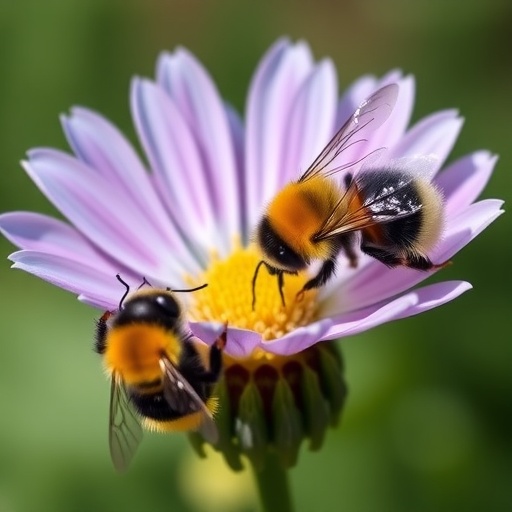
A groundbreaking study published in Science on June 4, 2026, provides compelling evidence that bumble bees possess a level of cognitive flexibility that enables them to solve complex problems involving tool use and spatial awareness. This research challenges long-held assumptions that such advanced problem-solving capabilities are exclusive to vertebrates with large brains, such as primates and certain bird species. Instead, it sheds new light on the remarkable cognitive prowess of invertebrates, specifically bumble bees, broadening our understanding of animal intelligence.
The study, conducted by Akshaye Bhambore and colleagues, focused on the ability of bumble bees to manipulate objects purposefully to achieve a goal. The researchers designed a series of experiments in which bees had to push or roll a small Styrofoam ball beneath a suspended artificial “flower” to access a sugary reward. This task required the bees to understand spatial relationships and demonstrate goal-directed behavior, as the artificial flower was positioned out of their immediate reach, compelling the bees to use the ball as a tool to elevate themselves.
Prior to testing problem-solving abilities, the bees underwent a pretraining phase where they learned to associate a blue ring—which symbolized the flower—with a sugar reward. Simultaneously, the bees became familiarized with the movable Styrofoam ball in the experimental arena, although they had not previously experienced the concept of using the ball to reach the flower-like reward. This careful design allowed the researchers to isolate spontaneous problem-solving behavior from learned instructions or conditioning.
One of the pivotal findings was that bees with prior experience involving both the flower proxy and the movable ball displayed significantly higher success rates in solving the task compared to control groups that had partial or no experience with either object. This indicated that having contextual knowledge and familiarity with the elements involved was crucial, but the actual problem-solving was spontaneous rather than the result of explicit training on the task itself.
To further test the cognitive capabilities of the bumble bees, the researchers introduced barriers within the arena to visually obscure the flower. Despite the flower’s invisibility, many bees continued to successfully roll the ball to the correct location, demonstrating that their actions were not dependent on real-time perceptual feedback. Instead, this behavior suggested an internalized goal representation and the ability to plan or anticipate outcomes, rather than mere trial-and-error learning.
Moreover, an experimental setup allowed the bees to initially explore the arena freely, then select between several locations for rolling the ball. The majority of successful bees directed the ball to the correct location on their first attempt, bypassing incorrect options entirely. This finding provided strong evidence against the notion that their problem-solving involved random or exploratory manipulations, but rather an informed decision-making process indicative of higher cognitive function.
Interestingly, some bees displayed motivation to interact with the ball even in the absence of an immediate reward, pointing to an intrinsic exploratory drive or curiosity. Such behavior hints at underlying cognitive mechanisms that encourage innovation and experimentation, traits typically associated with more complex brains. This discovery opens further avenues for exploring the evolution and neurobiology of cognition in insects, a taxonomic group often underestimated for intellectual capacity.
The implications of this study are profound. Demonstrating spontaneous problem-solving in bumble bees confronts entrenched biases concerning brain size and intelligence. Whereas vertebrates like primates have long been the focus of tool use research, invertebrates’ cognitive faculties are now being revealed as surprisingly sophisticated, potentially driven by ecological pressures demanding flexible behavioral adaptations.
Bhambore and colleagues emphasize that their results necessitate a reevaluation of cognitive research paradigms across species. Tools such as the ball in these experiments act as proxies for natural problem-solving scenarios encountered by bees, such as manipulating environmental objects to maximize resource access. The bees’ ability to plan and execute such tasks without prior explicit training suggests an advanced neural architecture capable of integrating sensory information, memory, and motor control within goal-oriented frameworks.
This investigation also raises intriguing questions about the neurological substrates supporting such behavior in bees, whose brains are orders of magnitude smaller than those of vertebrates. Understanding how compact neural circuits generate complex decision-making could provide insights into efficient computational models of intelligence and inspire bio-inspired robotics or artificial intelligence systems.
Future research, as suggested by the authors, should aim to dissect the precise cognitive and neural mechanisms underpinning this problem-solving aptitude. Techniques such as electrophysiological recordings, high-resolution behavioral tracking, and neuroimaging may clarify how bees represent goals mentally and plan multi-step actions. Additionally, expanding the scope to other invertebrates may reveal whether these abilities are widely distributed or specialize within certain evolutionary lineages.
These pioneering findings underscore the richness of insect cognition and its potential to reshape how science views the animal mind. By revealing that bumble bees can engage in spontaneous and flexible problem-solving independent of direct sensory cues, the study broadens horizons for comparative cognition and challenges simplistic correlations between brain size and intelligence.
The scientific community eagerly anticipates follow-up investigations that could explore how environmental factors, social dynamics, or genetic predispositions influence such behaviors. Ultimately, this research may pave the way for deeper appreciation of the cognitive lives of animals previously dismissed as simple creatures, highlighting the complex interplay between ecology, evolution, and brain function.
Spontaneous problem-solving in bumble bees marks a significant milestone in cognitive ethology by establishing that smaller-brained invertebrates not only interact actively with their environment but also operate with a degree of intentionality and foresight once thought exclusive to larger animals. This discovery invites a paradigm shift, encouraging scientists to democratize the study of intelligence across the animal kingdom and to embrace a more nuanced view of animal minds.
News Publication Date: 4-Jun-2026
Web References: 10.1126/science.ady1618
Cite Scienmag News
Gavin Prescott. (June 4, 2026). Bumblebees Demonstrate Tool Use to Solve Tasks Without Prior Training. Scienmag. https://scienmag.com/bumblebees-demonstrate-tool-use-to-solve-tasks-without-prior-training/
Gavin Prescott. "Bumblebees Demonstrate Tool Use to Solve Tasks Without Prior Training." Scienmag, 4 June 2026, https://scienmag.com/bumblebees-demonstrate-tool-use-to-solve-tasks-without-prior-training/. Accessed 4 September 2026.
Gavin Prescott. "Bumblebees Demonstrate Tool Use to Solve Tasks Without Prior Training." Scienmag. June 4, 2026. https://scienmag.com/bumblebees-demonstrate-tool-use-to-solve-tasks-without-prior-training/


