


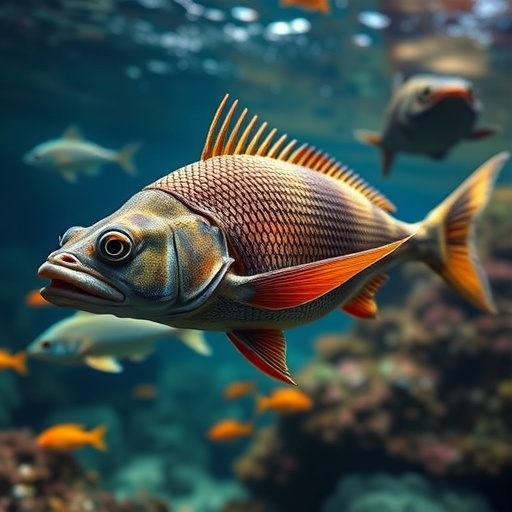
The mass extinction event that marked the close of the Age of Dinosaurs has long been recognized as a pivotal moment in Earth’s biological history, heralding the ascendancy of mammals on terrestrial landscapes. However, the profound effects of this cataclysmic transition beneath the waves have remained veiled in uncertainty, primarily owing to scant fossil evidence bridging the gap between the ancient marine ecosystems of the Mesozoic and the modern oceanic faunas that dominate today. A groundbreaking discovery from Egypt’s Eastern Desert now illuminates this mysterious interval, revealing that marine fish communities with striking parallels to those of contemporary oceans were already forming less than five million years after the demise of the non-avian dinosaurs.
Researchers from the Mansoura University Vertebrate Paleontology Center (MUVP) in Egypt, in collaboration with colleagues from the University of Michigan and KU Leuven in Belgium, have unveiled the Qreiya 3 Lagerstätte, an exceptionally rich fossil locality dated to approximately 62.2 million years ago, situated within the Danian Age of the Paleocene epoch. This site remarkably preserves a diverse assemblage of offshore marine fish fossils that surpasses all previously known Danian fish communities in both diversity and stratigraphic certainty. With over twenty types of ray-finned fishes documented, Qreiya 3 provides an unprecedented window into early Paleocene marine biodiversity.
What astonishes paleontologists about Qreiya 3 is not merely the sheer number of fossils, but the ecological composition they represent. Contrary to earlier assumptions that post-extinction marine faunas might be dominated by lingering Cretaceous holdovers, this assemblage reveals a community structurally similar to the modern marine ecosystems we observe today. The dominance of percomorph fishes—a vast clade encompassing familiar families like tunas, flounders, and jacks—suggests that foundational components of today’s oceanic fish diversity were already well established during the earliest Paleocene.
The presence of key modern lineages extends beyond percomorphs. Detailed osteological comparisons reveal that several ecologically distinct groups, including early representatives of tunas, mackerels, snake mackerels, moonfishes, and pipefishes, are present in the fossil record here for the earliest time yet observed. By enabling bone-for-bone comparisons with extant species, the Qreiya 3 fossils confirm that critical diversification within the teleost fish tree had occurred by the Danian, thus recalibrating the timeline of marine evolutionary history.
Intriguingly, the fossil assemblage also offers insights into what was lost during the mass extinction. Groups of predatory fishes that were prevalent in Cretaceous marine ecosystems are conspicuously absent despite the exceptional preservation and sampling effort at Qreiya 3. This absence strongly implies that the K–Pg extinction not only eradicated numerous lineages but also facilitated a rapid ecological reorganization that saw modern fish groups exploiting niches vacated by their extinct predecessors.
Environmental context further enriches the significance of the Qreiya 3 site. Unlike many other Danian fossil fish localities, which are typically from shallower waters, Qreiya 3 was deposited in an offshore marine environment with an estimated paleodepth of 150 to 250 meters. It coincides with the Latest Danian Event, a transient global warming phase, and was likely characterized by low-oxygen bottom water conditions that promoted exceptional fossilization. Such depositional settings are rare for this interval and provide critical paleoecological data that deepen understanding of early Paleocene marine dynamics.
This discovery also opens new avenues for investigating biogeographic patterns in post-extinction marine ecosystems. Situated in what was then a tropical region during the Paleocene, the Qreiya 3 fauna hints that tropical marine environments may have been crucibles for the early development and radiation of modern fish faunas. This could imply a spatial heterogeneity in recovery rates and evolutionary processes following the mass extinction, an area ripe for further research pending additional fossil discoveries.
The implications of the Qreiya 3 find resonate beyond biostratigraphy and paleobiology; they also reshape prevailing narratives about oceanic resilience and innovation after mass extinction events. By documenting a rapid establishment of modern marine fish communities within just four million years of the K–Pg boundary, these fossils underscore the capacity of marine ecosystems for swift reorganization and adaptation in the wake of catastrophic upheaval.
Principal investigator Hesham Sallam emphasizes that the current report captures only an initial glimpse of what this site can reveal. Ongoing preparation and detailed studies of the extensive collections from Qreiya 3 promise to unravel further complexities regarding the evolutionary pathways and ecological transformations that shaped today’s oceans immediately following one of Earth’s most profound extinction events.
Collectively, this research represents a major step forward in paleontological science, providing a robust chronological anchor and detailed taxonomic framework that elucidate the tempo and mode of marine recovery after the end-Cretaceous disaster. The findings indicate that the oceanic fisheries and ecosystems recognizable in modern times have deep roots extending back to the earliest Paleocene, challenging models that posited prolonged or staggered faunal turnovers.
Moreover, the Qreiya 3 Lagerstätte sets a new standard for the quality and completeness of early Paleocene marine fossil records, enabling nuanced analyses of anatomical, ecological, and environmental parameters that have hitherto been elusive. Such comprehensive insights will augment understanding of evolutionary mechanisms, from speciation rates to ecosystem resilience, in the context of one of Earth’s pivotal biotic turnovers.
As scientists continue to probe the depth and breadth of this extraordinary fossil site, the hope is that further revelations will emerge, enriching the broader understanding of how present-day marine biodiversity was forged through the crucible of deep time. The rapid establishment of modern marine faunas evidenced by Qreiya 3 not only enhances scientific comprehension of past life but also informs predictions about how contemporary ocean ecosystems might respond to future environmental challenges.
This landmark discovery from Egypt’s Eastern Desert is set to redefine early Paleocene paleontology and inspires renewed exploration of underrepresented fossil horizons worldwide, showcasing the unparalleled potential of sedimentary Lagerstätten in reconstructing the evolutionary heritage and ecological history of marine life.
News Publication Date: 3-Jun-2026.
Web References: DOI: 10.1126/sciadv.aec8978.
Cite Scienmag News
Violet Maxwell. (June 3, 2026). The Emergence of Modern Ocean Fish Species. Scienmag. https://scienmag.com/the-emergence-of-modern-ocean-fish-species/
Violet Maxwell. "The Emergence of Modern Ocean Fish Species." Scienmag, 3 June 2026, https://scienmag.com/the-emergence-of-modern-ocean-fish-species/. Accessed 4 September 2026.
Violet Maxwell. "The Emergence of Modern Ocean Fish Species." Scienmag. June 3, 2026. https://scienmag.com/the-emergence-of-modern-ocean-fish-species/


