


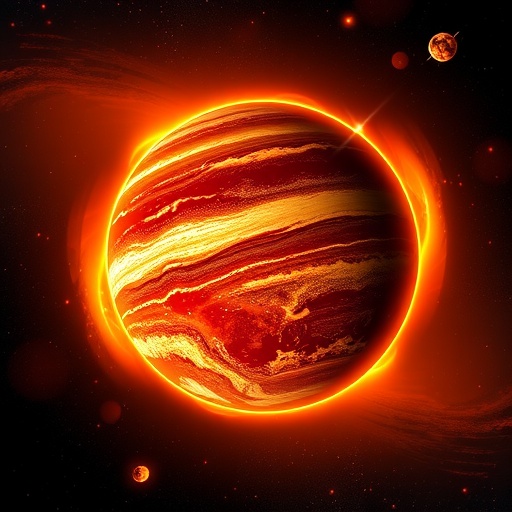
The magnetic fields enveloping planets have long been recognized as crucial determinants in their atmospheric dynamics and overall evolution. Despite their acknowledged importance, these planetary magnetic fields remain elusive in the realm of exoplanets, primarily due to the stringent observational challenges they entail. Traditional methods of detecting planetary magnetic fields, often reliant on radio emissions or auroral signatures, have so far yielded limited success beyond our Solar System. This scientific impasse has recently witnessed a promising breakthrough through the innovative examination of ultra-hot Jupiters—gas giants whose blistering atmospheres are exceptionally ionized, offering a novel diagnostic window into magnetic phenomena.
Ultra-hot Jupiters, characterized by temperatures exceeding 2000 K, possess highly ionized upper atmospheres that render them unique laboratories for studying magnetic effects directly influencing atmospheric circulation. Unlike cooler exoplanets, the intense thermal conditions in such worlds ionize atomic species, creating a partially conductive plasma environment that interacts intimately with magnetic fields. This coupling is theorized to modulate atmospheric dynamics significantly, potentially inducing magnetic drag that slows equatorial jet streams otherwise driven by hydrodynamic processes.
In a pioneering study led by Seidel et al., cutting-edge high-resolution spectroscopic observations have been employed to scrutinize the Doppler shifts in iron absorption lines within the atmospheres of seven transiting ultra-hot Jupiters. This technique offers a direct measure of atmospheric wind speeds by detecting velocity-induced changes in spectral line positions. The data reveal a compelling and consistent trend: atmospheric wind velocities diminish as the planetary equilibrium temperature increases. Such a correlation is difficult to reconcile under purely hydrodynamic models, which would predict higher wind speeds under intensified stellar irradiation due to enhanced pressure gradients.
Instead, the observed wind speed suppression aligns naturally with theoretical expectations of magnetically induced drag forces. As ionization fractions increase with temperature, the magnetic coupling strengthens, inducing Lorentz forces that oppose the atmospheric flow and extract kinetic energy. This mechanism effectively brakes the atmospheric winds, attenuating their velocity in a temperature-dependent fashion. The study’s findings thus provide the first empirical evidence that magnetic fields exert a dominant regulatory influence on ultra-hot Jupiter atmospheric dynamics, dismantling previous assumptions that ignored magnetohydrodynamic effects.
Perhaps most strikingly, from the observed relationship between wind speed and temperature, the researchers estimated the planetary magnetic field strengths, concluding that these are on the order of a few gauss—values intriguingly comparable to those observed in the magnetic fields of Jupiter within our own Solar System. This unexpected parity implies that despite their extreme environmental contrasts, hot giant exoplanets may share magnetic characteristics with familiar giant planets, providing a valuable benchmark for comparative planetology.
The implications of this discovery extend far beyond atmospheric physics. Clarifying the magnetic field strengths of exoplanets informs models of planetary interior structures and dynamo generation mechanisms. In gas giants, magnetic fields emerge from convective motions within metallic hydrogen layers, and the confirmation of moderate field strengths supports the notion of persistent, Jupiter-like dynamos operating under varied evolutionary contexts. Furthermore, magnetic braking influences atmospheric escape rates and could thus indirectly shape planetary atmospheres’ longevity and composition, which directly affects habitability prospects for planets orbiting closer to their stars.
Additionally, these results herald a new epoch in exoplanet characterization techniques. Correlating high-resolution spectroscopic measurements with theoretical magnetohydrodynamic models enables a non-invasive probe into the invisible magnetic realms enveloping distant worlds. This methodology circumvents the limitations of traditional radio searches and may be expanded to a broader range of exoplanets, including smaller rocky bodies, potentially unlocking magnetic field constraints where none existed before.
The study also highlights the critical interplay between observational astronomy and theoretical modeling. By leveraging the detailed spectral profiles of iron absorption lines—a particularly robust tracer given iron’s prominence in ultra-hot Jupiter atmospheres—the researchers harness fine-grained data to refine magnetohydrodynamic simulations. Such synergy between empirical evidence and theoretical constructs exemplifies the frontier of exoplanetary science, pushing the boundaries of our understanding of planetary atmospheres under extreme conditions.
In the context of ultra-hot Jupiters, this new paradigm reshapes our comprehension of atmospheric circulation. Previous models often depicted equatorial jet streams achieving supersonic velocities to redistribute heat from the intensely irradiated daysides to cooler nightsides. The demonstrated magnetic drag, however, imposes tangible limits on such flows, altering expected temperature distributions and potentially explaining observed anomalies in phase curve measurements from space telescopes.
Moreover, these insights pave the way for upcoming observational campaigns, especially with next-generation instruments capable of even higher spectral resolution and sensitivity. Detection of magnetic influences through atmospheric dynamics could be integrated with direct magnetic field measurements when feasible, fostering multidimensional assessments of exoplanetary magnetism. Such strides will drastically refine our ability to model exoplanetary climates and magnetospheric environments.
Looking ahead, understanding magnetic field evolution across a spectrum of exoplanets may unlock clues about planetary formation and migration histories. Magnetic fields interact with stellar winds and circumstellar disks during early planetary life, sculpting orbital architectures and possibly imprinting detectable signatures. Hence, these findings foreshadow an integrative framework where magnetism not only governs atmospheric physics but also planetary system evolution.
The confirmation of few-gauss magnetic fields on ultra-hot Jupiters as akin to Jovian values firmly reorients any extrapolations regarding terrestrial exoplanets. Scaling magnetic field strengths from giant to rocky planets underlines the versatility and universality of dynamo processes, albeit with substantial variations rooted in planetary composition and rotational regimes. Establishing an empirical baseline for magnetic fields informs the search for Earth analogues with protective magnetospheres vital to sustaining atmospheres against stellar irradiation.
This seminal work by Seidel and colleagues thus represents a landmark in exoplanetary magnetism research. It bridges longstanding observational gaps and substantiates the role of magnetic fields as key modulators in the behavior of distant worlds’ atmospheres. The dramatic influence of magnetic drag on wind speeds opens new interpretative paradigms that will undoubtedly inspire further observational, theoretical, and experimental investigations in the field.
As exoplanet science accelerates towards characterizing diverse planetary properties, the inclusion of magnetic fields emerges as a non-negotiable dimension for holistic understanding. With the combined might of spectral diagnostics, sophisticated simulations, and next-gen telescopes, a new era beckons where exoplanetary magnetism is no longer speculative but quantifiable, fundamentally enriching our cosmic perspective.
In summary, this breakthrough elucidates that ultra-hot Jupiters possess magnetic field strengths akin to those of our own Jupiter, directly measurable through their suppression of ionized atmospheric winds. The fusion of high-resolution spectroscopy and magnetohydrodynamic theory not only validates magnetic field impacts on atmospheric dynamics but also establishes a vital scaling law for planetary magnetism across the galaxy. These insights will shape future quests to unravel the magnetic mysteries of planets both giant and terrestrial, expanding our grasp on the forces governing planetary environments.
Cite Scienmag News
Grant Pearson. (June 2, 2026). Hot Giant Exoplanet Magnetic Fields Mirror Solar System. Scienmag. https://scienmag.com/hot-giant-exoplanet-magnetic-fields-mirror-solar-system/
Grant Pearson. "Hot Giant Exoplanet Magnetic Fields Mirror Solar System." Scienmag, 2 June 2026, https://scienmag.com/hot-giant-exoplanet-magnetic-fields-mirror-solar-system/. Accessed 5 September 2026.
Grant Pearson. "Hot Giant Exoplanet Magnetic Fields Mirror Solar System." Scienmag. June 2, 2026. https://scienmag.com/hot-giant-exoplanet-magnetic-fields-mirror-solar-system/


