


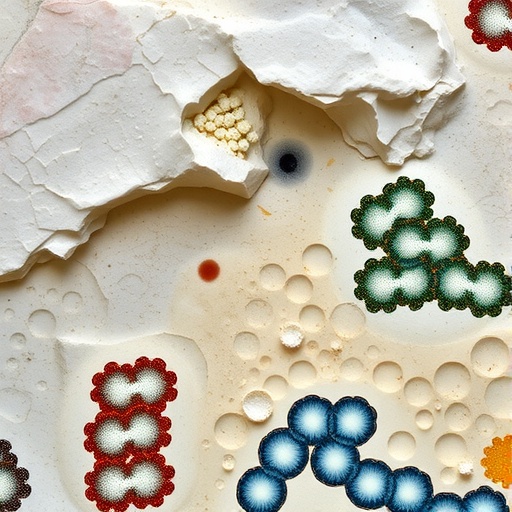
In an unprecedented leap forward in the field of marine biogeochemistry, a new study published in Nature Communications unveils the intricate interplay between environmental variables and the physiological traits of coccolithophores—microscopic algae pivotal to the global carbon cycle. By meticulously analyzing sediment cores from the Atlantic Ocean, researchers have shed light on the nuanced mechanisms governing calcite production in these key marine organisms, revealing a complex narrative informed both by nature and nurture within the ocean’s depths.
Coccolithophores, though minuscule, wield immense influence over Earth’s climate dynamics. These photosynthetic protists manufacture elaborate calcium carbonate plates known as coccoliths, which aggregate and eventually sink, sequestering carbon from the atmosphere to deep-sea sediments. Despite their outsized ecological impact, the factors controlling coccolith calcite production have remained elusive due to the challenges inherent in disentangling environmental forcing from intrinsic physiological responses.
This latest research harnesses sedimentary archives to decode historic variations in coccolith production, providing a temporal lens often missing in contemporary observational studies. By extracting and characterizing calcite from sediments spanning vast stretches of the Atlantic basin, the investigators were able to correlate sediment composition with past environmental conditions meticulously reconstructed through complementary proxy data.
A key discovery from the study is the recognition that coccolith calcification operates at the intersection of external chemical, physical ocean parameters, and the organisms’ internal biological machinery. These interactions manifest variably through time, modulated by factors such as changes in seawater temperature, carbonate chemistry, nutrient availability, and light regimes. Notably, the data reveal that physiological adaptation within coccolithophore populations plays a non-trivial role, sometimes counteracting direct environmental pressures.
The meticulous chemical analyses showed variations in calcite mass and morphology that corresponded with shifts in ocean acidity and temperature fluctuations. During intervals of elevated atmospheric CO2, for instance, the coccolithophore calcite production did not always diminish as previously anticipated. Instead, physiological acclimatization mechanisms allowed these algae to sustain or even enhance calcification under certain stress regimes, challenging conventional paradigms about ocean acidification impacts on calcifying phytoplankton.
By utilizing stable isotope measurements along with elemental ratios, the researchers differentiated between changes induced by external seawater chemistry and those stemming from internal physiological controls. The ability to decouple these two influences marks a breakthrough in paleoceanographic interpretation, offering a robust framework to predict future coccolithophore responses under rapidly changing ocean conditions.
Moreover, this study illuminates the feedback loops linking coccolithophore biology to broader climate processes. Enhanced calcite production influences the alkalinity of surface waters, potentially modulating CO2 uptake and thus climate regulation. Understanding the complex modulation of calcification rates by intertwined environmental and biological factors is essential for refining global carbon cycle models.
The research team employed cutting-edge microscopy techniques and geochemical proxies to evaluate the coccolith calcite’s physical and chemical characteristics preserved in the sediment record. Their approach represents one of the first comprehensive attempts to integrate multiproxy datasets in service of decoding biogenic calcite production at such a fine scale.
Importantly, this work underscores that projections of marine biogenic calcification cannot rely solely on environmental parameters or assumptions about organismal responses in isolation. Instead, the symbiotic relationship between physiology and environment must be recognized as a dynamic, context-dependent system shaping oceanic carbon sinks.
The implications extend beyond academic curiosity, as coccolithophores are foundational to marine food webs and biogeochemical cycling. Alterations in their calcification can cascade through ecosystems, affecting nutrient cycling, ocean optics, and atmospheric CO2 levels. Improved predictive capabilities about their calcification behavior will enhance our capacity to forecast marine ecosystem resilience and global climate trajectories.
This interdisciplinary effort also exemplifies the potential of paleoenvironmental archives to serve as natural laboratories, offering windows into past biosphere-ocean interactions unattainable in contemporary observational timescales. By decoding sediment records, scientists can reconstruct scenarios that help disentangle complex cause-and-effect relationships influencing marine calcifiers.
Ultimately, this study challenges simplistic narratives about how ocean acidification and warming threaten calcifying phytoplankton by revealing a more textured story where physiological plasticity and evolving environmental contexts intersect. The findings advocate for refined models embracing organism-environment feedbacks to accurately anticipate marine biocalcification pathways in the Anthropocene.
As the oceans continue to absorb anthropogenic CO2 emissions, understanding these processes gains urgency. This pioneering work elevates our comprehension of the fundamental factors underpinning one of the planet’s primary biological carbon pumps, offering hope that marine systems may possess adaptive capacities not fully appreciated until now.
While the investigation opens many new doors, it also suggests fresh avenues for research. Future studies could focus on species-specific responses, genomic underpinnings of calcification plasticity, and the interaction of coccolithophores with other marine organisms under multifaceted stressors, providing holistic insights into ocean resilience.
By integrating paleoceanographic data with cutting-edge biological research, this study bridges the divide between historical climate records and living marine ecosystems. This union offers a promising frontier for understanding and ultimately safeguarding the ocean’s role in stabilizing Earth’s climate.
In sum, the revelations from Atlantic sediments offer a compelling narrative: the story of coccolithophore calcite production is written not by environment or biology alone, but through their intricate dialogue—a dialogue etched indelibly into the fossil record and essential to predicting our planet’s climatic future.
Cite Scienmag News
Violet Maxwell. (May 28, 2026). Atlantic Sediments Unveil Controls on Coccolith Calcite. Scienmag. https://scienmag.com/atlantic-sediments-unveil-controls-on-coccolith-calcite/
Violet Maxwell. "Atlantic Sediments Unveil Controls on Coccolith Calcite." Scienmag, 28 May 2026, https://scienmag.com/atlantic-sediments-unveil-controls-on-coccolith-calcite/. Accessed 4 September 2026.
Violet Maxwell. "Atlantic Sediments Unveil Controls on Coccolith Calcite." Scienmag. May 28, 2026. https://scienmag.com/atlantic-sediments-unveil-controls-on-coccolith-calcite/


