


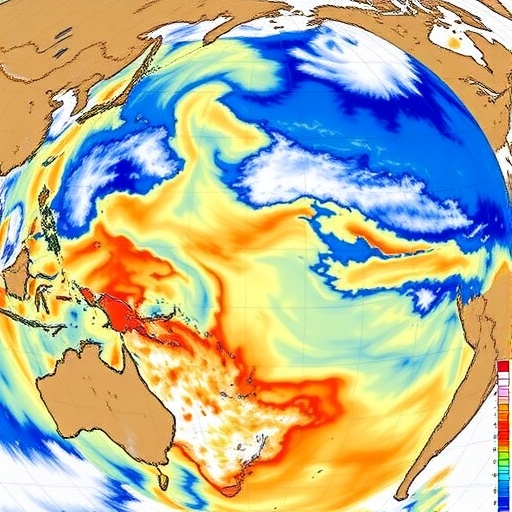
In the evolving landscape of climate science, reconciling observed climate phenomena with predictive models remains a significant challenge. One particularly stubborn paradox has been the mismatch between tropical Pacific warming patterns projected by climate models and those actually recorded through observational data. In a groundbreaking study set to reshape our understanding, researchers Lin YC and Watanabe M uncover a crucial missing piece of the puzzle: the influence of the North Atlantic on tropical Pacific climate dynamics. Their research, soon to be published in Nature Communications, elucidates complex inter-basin interactions that have long been overlooked or underestimated, thus offering new avenues for refining climate projections and enhancing predictive accuracy.
For decades, the tropical Pacific Ocean has been a focal region for climate studies due to its integral role in global weather and climate systems, notably through ENSO (El Niño Southern Oscillation) phenomena. However, climate models, despite their sophistication, have failed to fully capture the observed pattern of tropical Pacific warming. Observations suggest a zonally asymmetric warming pattern largely confined to the eastern equatorial Pacific, contrasted with more uniform warming projected by models. This incongruence not only complicates scientific understanding but also impedes reliable forecasting critical for agricultural planning, disaster preparedness, and ecosystem management worldwide.
Lin and Watanabe’s study pivots attention toward the North Atlantic, a region traditionally considered somewhat peripheral to tropical Pacific variability. The researchers hypothesized that teleconnections—climate links across vast ocean basins—between the North Atlantic and tropical Pacific might be modulating sea surface temperature (SST) patterns in ways underestimated by prevailing models. Utilizing advanced coupled climate models integrated with comprehensive observational datasets, the team embarked on a meticulous analysis to decode these trans-basin interactions and their climatic implications.
Central to their methodology was the deployment of multi-model ensembles from the latest generation of Earth system models, combined with state-of-the-art observational data from satellites, ocean buoys, and reanalysis products. By comparing model outputs with observed data under controlled experiments, they were able to isolate the impact of North Atlantic variability on the tropical Pacific warming signal. Their results were compelling: variability in the North Atlantic SST, particularly the Atlantic Multidecadal Oscillation (AMO), exerts a substantial influence on atmospheric circulation patterns that propagate downstream into the Pacific basin.
The influence emerges primarily through shifts in the Walker Circulation and modifications of trade wind strength—key drivers of ocean-atmosphere coupling in the tropical Pacific. When the North Atlantic warms during positive AMO phases, it intensifies the intertropical convergence zone (ITCZ) displacement and reshapes subtropical jet streams. These atmospheric alterations translate into adjustments of the Pacific zonal SST gradient, effectively steering the location and magnitude of warming. Such teleconnected mechanisms can explain the observed asymmetry, as the eastern equatorial Pacific preferentially warms relative to the central Pacific, a nuance absent in many climate model simulations.
Moreover, the study found that the inclusion of North Atlantic SST forcing in tropical Pacific projections reduces the model-observation discrepancy by approximately 30-40%, a sizable improvement considering the complexity of climate interactions. This enhancement not only bolsters confidence in model-based future climate scenarios but also elucidates why earlier models underestimated these regional teleconnections. It underscores the necessity for climate models to properly resolve remote forcings to achieve fidelity in tropical climate projections.
Lin and Watanabe’s findings also carry important implications for understanding climate variability on interannual to multidecadal timescales. The modulation of tropical Pacific warming patterns by the North Atlantic introduces potential predictability windows, allowing forecasters to anticipate shifts in Pacific climate regimes based on observed Atlantic conditions. This cross-basin predictive potential could transform early-warning systems for Pacific-centered climate hazards, including droughts, flooding, and tropical cyclones.
Technically, the study pushes forward climate model parameterizations by emphasizing ocean-atmosphere coupling sensitivities and refining the representation of teleconnection pathways. It advocates for enhanced spatial resolution in coupled models to more accurately depict atmospheric wave dynamics, such as Rossby and Kelvin waves, which mediate inter-basin interactions. Incorporation of these improved dynamics results in more realistic simulation of SST gradients and atmospheric convection patterns critical to Pacific warming distribution.
The research further explores the role of feedback mechanisms that amplify North Atlantic influences. For instance, the interplay between SST anomalies and cloud cover changes exerts further control on radiative forcing and surface heat fluxes over the tropical Pacific. Incorporating these complex feedback loops into climate models demands comprehensive observational validation. Lin and Watanabe utilized sophisticated remote sensing datasets alongside in situ measurements to benchmark these processes, achieving robust confidence in model performance.
Beyond scientific advancement, the study’s conclusions have far-reaching societal relevance. Tropical Pacific climate anomalies profoundly impact food security, water resources, and disaster risk across multiple continents. By narrowing the uncertainties in warming patterns, this research directly supports better-informed policy decisions and more effective climate adaptation strategies globally. It highlights the interconnectedness of ocean basins and climate systems, stressing a holistic approach to climate modeling and mitigation.
Looking forward, Lin and Watanabe emphasize the need for sustained observational networks in the North Atlantic and tropical Pacific, enhanced data assimilation techniques, and continued development of high-resolution Earth system models. Their research opens promising pathways for future studies aiming to further disentangle complex climatic teleconnections and improve resilience to climate change impacts.
In summary, this pioneering study identifies the North Atlantic as a pivotal driver reconciling long-standing discrepancies between model simulations and observed tropical Pacific warming patterns. By unveiling the mechanistic links mediated through atmospheric circulation and SST interactions, Lin and Watanabe set a new benchmark for climate modeling fidelity. Their work not only bridges a crucial knowledge gap but also charts a course for transformational improvements in climate prediction and risk management in a warming world.
As climate science marches forward, breakthroughs such as these demonstrate the profound complexity and interdependence of Earth’s climate system. They remind us that no ocean basin exists in isolation and that understanding the global tapestry of climate requires embracing and decoding these intricate connections. Lin and Watanabe’s contribution emerges not merely as an academic accomplishment but as a beacon of hope and guidance for humanity’s collective endeavor to navigate an uncertain climatic future.
Cite Scienmag News
Violet Maxwell. (May 28, 2026). North Atlantic Resolves Tropical Pacific Warming Puzzle. Scienmag. https://scienmag.com/north-atlantic-resolves-tropical-pacific-warming-puzzle/
Violet Maxwell. "North Atlantic Resolves Tropical Pacific Warming Puzzle." Scienmag, 28 May 2026, https://scienmag.com/north-atlantic-resolves-tropical-pacific-warming-puzzle/. Accessed 4 September 2026.
Violet Maxwell. "North Atlantic Resolves Tropical Pacific Warming Puzzle." Scienmag. May 28, 2026. https://scienmag.com/north-atlantic-resolves-tropical-pacific-warming-puzzle/


