

Wednesday, July 29, 2026
Science
No Result
View All Result
  • Login
  • HOME
  • SCIENCE NEWS
  • CONTACT US
  • HOME
  • SCIENCE NEWS
  • CONTACT US
No Result
View All Result
Scienmag
No Result
View All Result
Home Science News Earth Science

Shrub-driven vertical coupling shaped Holocene ecosystem variability and transitions

July 29, 2026
in Earth Science
Reading Time: 2 mins read
0
Shrub-driven vertical coupling shaped Holocene ecosystem variability and transitions

Shrub-driven vertical coupling shaped Holocene ecosystem variability and transitions

65
SHARES
587
VIEWS
Share on FacebookShare on Twitter
ADVERTISEMENT

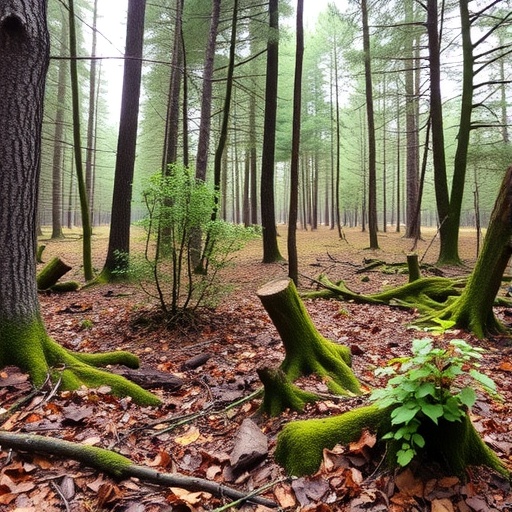
Shrubs are often viewed as passive background vegetation, but new research suggests they can act as active engineers of ecosystem change—especially across the dramatic climate swings of the Holocene. In a study published in Communications Earth & Environment, scientists report that shrub-mediated “vertical coupling” can regulate how ecosystems vary over time and how they transition between states.

The team, led by Wang and colleagues, focuses on the vertical links within ecological systems: interactions between near-surface conditions shaped by shrubs and deeper processes that determine longer-term stability. Shrubs modify the microclimate close to the ground—buffering temperature, altering moisture availability, and changing how energy and water move through soil.

Rather than treating vegetation and climate impacts as separate drivers, the researchers model a mechanism in which shrub structure creates a feedback loop between the surface and subsurface layers. This loop can amplify or dampen variability depending on prevailing environmental forcing. As a result, ecosystem behavior is not only a response to external climate change, but also a product of internal vertical connectivity.

Using Holocene-era evidence and system-based analysis, the study highlights how vertical coupling can influence transition dynamics—turning gradual shifts into tipping-like reorganizations under certain conditions. When coupling is strong, the system can resist disturbance and maintain coherence over longer periods. When coupling weakens, the same climate variability may translate into faster regime shifts.

Crucially, the authors argue that these dynamics help explain why some ecosystems exhibit persistent stability while others show episodic, abrupt changes during the Holocene. The pattern emerges from the interplay between shrub-driven microhabitats and deeper soil processes that control water retention and availability to plants.

The findings add a new layer to ecological prediction: vegetation structure may determine not just what ecosystems look like, but how they respond over decades to millennia. “Vertical coupling” provides a measurable framework for connecting plant form to system-level resilience.

For viral science news readers, the takeaway is clear: shrubs may be small, but their architecture can reorganize the physics of ecological change. As climate stress intensifies worldwide, understanding shrub-mediated coupling could improve forecasts of which landscapes will withstand variability—and which may flip into new states sooner than expected.

Subject of Research: Holocene ecosystem variability and transition dynamics regulated by shrub-mediated vertical coupling.

Article Title: Shrub-mediated vertical coupling regulates Holocene ecosystem variability and transition dynamics.

Article References: Wang, H., Liu, Y., Xiao, L. et al. Shrub-mediated vertical coupling regulates Holocene ecosystem variability and transition dynamics. Commun Earth Environ (2026). https://doi.org/10.1038/s43247-026-03877-2

Image Credits: AI Generated

DOI: https://doi.org/10.1038/s43247-026-03877-2

Keywords: Holocene; ecosystem variability; transition dynamics; shrub; vertical coupling; resilience; microclimate; soil processes.

Tags: climate swings impact on vegetationclimate-driven vegetation changesecosystem resilience and stabilityecosystem transitionsfeedback mechanisms in ecological systemsHolocene climate and vegetation dynamicsHolocene ecosystem variabilitymicroclimate modification by shrubsshrub-mediated vertical couplingsoil moisture and temperature regulationvegetation as active ecosystem engineersvertical connectivity in ecosystems
Share26Tweet16
Previous Post

KAIST AI Uncovers Its Hidden Weaknesses, Making Generative Models Safer

Next Post

EEG Modeling Predicts Conversion and Reveals Diverse Outcomes in Isolated REM Sleep Disorder

Related Posts

Flash Droughts Worsen Maize Yield Losses by Intensifying Atmospheric Dryness
Earth Science

Flash Droughts Worsen Maize Yield Losses by Intensifying Atmospheric Dryness

July 29, 2026
Subtropical Gyre Expansion Drives Southern Ocean Salinity Up, Defying Predictions
Earth Science

Subtropical Gyre Expansion Drives Southern Ocean Salinity Up, Defying Predictions

July 29, 2026
Continental Inorganic Halogens Shape Global Air Quality Evolution
Earth Science

Continental Inorganic Halogens Shape Global Air Quality Evolution

July 29, 2026
Aerobic Methanotrophs Enrichments Accelerate Methane Consumption in Hydrothermal Deep Waters
Earth Science

Aerobic Methanotrophs Enrichments Accelerate Methane Consumption in Hydrothermal Deep Waters

July 29, 2026
Mid-Holocene Thar Desert hydroclimate patterns reveal seasonal shifts in India
Earth Science

Mid-Holocene Thar Desert hydroclimate patterns reveal seasonal shifts in India

July 28, 2026
Mafic and Ultramafic Rocks Could Supply Reactive Phosphorus for Life Origins
Earth Science

Mafic and Ultramafic Rocks Could Supply Reactive Phosphorus for Life Origins

July 28, 2026
Next Post
EEG Modeling Predicts Conversion and Reveals Diverse Outcomes in Isolated REM Sleep Disorder

EEG Modeling Predicts Conversion and Reveals Diverse Outcomes in Isolated REM Sleep Disorder

  • Mothers who receive childcare support from maternal grandparents show more

    Mothers who receive childcare support from maternal grandparents show more parental warmth, finds NTU Singapore study

    27656 shares
    Share 11059 Tweet 6912
  • University of Seville Breaks 120-Year-Old Mystery, Revises a Key Einstein Concept

    1061 shares
    Share 424 Tweet 265
  • Bee body mass, pathogens and local climate influence heat tolerance

    682 shares
    Share 273 Tweet 171
  • Researchers record first-ever images and data of a shark experiencing a boat strike

    546 shares
    Share 218 Tweet 137
  • Groundbreaking Clinical Trial Reveals Lubiprostone Enhances Kidney Function

    531 shares
    Share 212 Tweet 133
Science

Embark on a thrilling journey of discovery with Scienmag.com—your ultimate source for cutting-edge breakthroughs. Immerse yourself in a world where curiosity knows no limits and tomorrow’s possibilities become today’s reality!

RECENT NEWS

  • Flash Droughts Worsen Maize Yield Losses by Intensifying Atmospheric Dryness
  • Single-Cell Profiling of NK/T-Cell Lymphoma Uncovers Stratified Immune States
  • EEG Modeling Predicts Conversion and Reveals Diverse Outcomes in Isolated REM Sleep Disorder
  • Shrub-driven vertical coupling shaped Holocene ecosystem variability and transitions

Categories

  • Agriculture
  • Anthropology
  • Archaeology
  • Athmospheric
  • Biology
  • Biotechnology
  • Blog
  • Bussines
  • Cancer
  • Chemistry
  • Climate
  • Earth Science
  • Editorial Policy
  • Marine
  • Mathematics
  • Medicine
  • Pediatry
  • Policy
  • Psychology & Psychiatry
  • Science Education
  • Social Science
  • Space
  • Technology and Engineering

Subscribe to Blog via Email

Enter your email address to subscribe to this blog and receive notifications of new posts by email.

Join 5,147 other subscribers

© 2025 Scienmag - Science Magazine

Welcome Back!

Login to your account below

Forgotten Password?

Retrieve your password

Please enter your username or email address to reset your password.

Log In
No Result
View All Result
  • HOME
  • SCIENCE NEWS
  • CONTACT US

© 2025 Scienmag - Science Magazine

Discover more from Science

Subscribe now to keep reading and get access to the full archive.

Continue reading
