


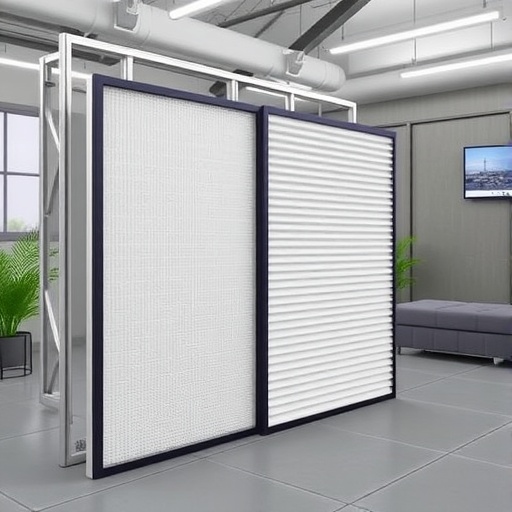
Breathing clean air depends on filters that do more than trap particles—they must hold them. In many conventional systems, captured dust can loosen under airflow and mechanical disturbances, which lowers filtration efficiency, shortens service life, and forces more frequent replacement. The bottleneck is not capture alone, but durable retention of what the filter catches.
A research team led by Professor Sanghyuk Wooh and Professor Chae Bin Kim has introduced a dynamic imine bond adhesive (DIBA) designed to keep airborne particles embedded. The concept is to marry solid-like stability with liquid-like adhesion, so the filter surface can “refresh” itself while working.
The coating is built by crosslinking polydimethylsiloxane (PDMS) via dynamic Schiff base chemistry. This chemistry enables bond exchange at the interface, allowing adhesive sites to reorganize over time rather than degrade into inert residue. The result is a coating that is both mechanically robust and chemically active.
When sprayed onto commercially available filter media, the DIBA layer behaves like an internal reservoir of stickiness. As particles are collected, they are drawn into the adhesive film rather than remaining only on the exterior fibers. Capillary-driven wetting then forms adhesive bridges around individual particulates, increasing the real contact area that governs holding strength.
Performance tests combined chemical, mechanical, and interfacial characterization—rheology, FTIR, atomic force microscopy, and microscopy—with filtration trials. The coating boosted particle adhesion dramatically, approaching a nearly seventy-fold improvement compared with typical behavior. Importantly, the adhesive renewal process helps counteract the gradual loss of attachment that plagues standard filters.
Filtration efficiency improved by roughly 10–30% across multiple commercial materials, without raising pressure drop. The upgrade is significant in practical terms: one reported shift is from MERV 6 toward MERV 11, indicating better capture at the same airflow penalty.
The coated filters also sustained operation under high-speed airflow (up to 20 m/s) and delayed pore clogging. By maintaining effective particulate capture for longer intervals, the DIBA approach extended filter lifespan by nearly a factor of two relative to conventional designs.
Because DIBA is applied through simple spray-coating, it is compatible with existing manufacturing and retrofit workflows. The researchers highlight applications ranging from HVAC and air purifiers to cleanrooms, industrial dust collectors, automotive cabin filters, and personal protective equipment.
More broadly, the work suggests a platform for next-generation filtration where energy use and replacement schedules improve simultaneously. The dynamic adhesive strategy could be adapted to other separations, including water purification and environmental remediation, wherever particles need to be captured and kept immobilized.
Keywords
Air filtration, dynamic adhesive chemistry, Schiff base, PDMS, particle retention, capillarity, MERV, particulate matter, surface engineering, polymers
Cite Scienmag News
Neil Sanderson. (July 29, 2026). Pusan National and Chung-Ang Develop Next-Gen Self-Renewing Air Filter Coating. Scienmag. https://scienmag.com/pusan-national-and-chung-ang-develop-next-gen-self-renewing-air-filter-coating/
Neil Sanderson. "Pusan National and Chung-Ang Develop Next-Gen Self-Renewing Air Filter Coating." Scienmag, 29 July 2026, https://scienmag.com/pusan-national-and-chung-ang-develop-next-gen-self-renewing-air-filter-coating/. Accessed 3 September 2026.
Neil Sanderson. "Pusan National and Chung-Ang Develop Next-Gen Self-Renewing Air Filter Coating." Scienmag. July 29, 2026. https://scienmag.com/pusan-national-and-chung-ang-develop-next-gen-self-renewing-air-filter-coating/


