


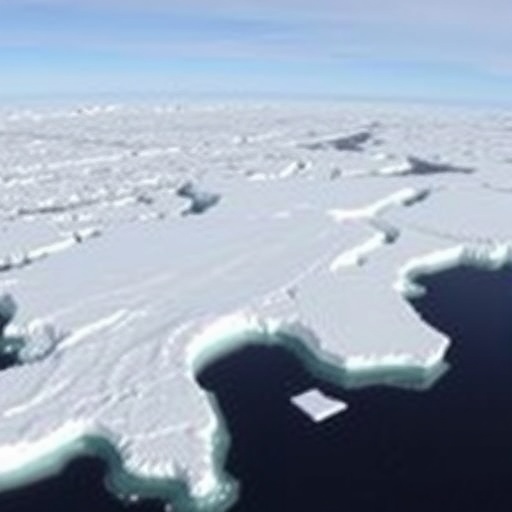
In a groundbreaking study that redefines our understanding of Antarctic Ice Sheet dynamics and their response to climate change, researchers have unveiled evidence of a nonlinear regime shift in the ice sheet’s sensitivity to atmospheric CO2 levels during the Mid-Pleistocene Transition roughly 1.2 million years ago. Utilizing state-of-the-art bihemispheric ice sheet models powered by realistic climate simulations, this research illuminates how Antarctic ice volume may have responded to ancient CO2 fluctuations—offering unprecedented insights into potential future ice sheet behavior under ongoing anthropogenic warming.
The Antarctic Ice Sheet, Earth’s largest reservoir of freshwater ice, plays a crucial role in global sea levels and climate regulation. Yet, accurately predicting its future trajectory remains one of the most formidable challenges in climate science, complicated by uncertainties in ice sheet–climate feedbacks and historical climate variability. Traditional ice sheet modeling confronted a major obstacle: the lack of spatially and temporally comprehensive global climate forcing datasets to drive transient simulations spanning millions of years. This study overcomes that bottleneck by integrating the Penn State University bihemispheric ice sheet–ice shelf model with the fully coupled Community Earth System Model, providing a continuous 3-million-year climate forcing dataset crucial for simulating ice sheet evolution.
The simulations generated for this investigation are revolutionary, retracing how the Antarctic Ice Sheet evolved through multiple glacial-interglacial cycles. The researchers detected a marked increase in the ice sheet’s sensitivity to atmospheric CO2 concentrations once levels dipped below approximately 240 parts per million by volume (ppmv), coinciding with the Mid-Pleistocene Transition—a major climatological shift when glacial cycles intensified and lengthened. This enhanced sensitivity implies that small decreases in CO2 below this threshold could have triggered disproportionately large expansions in Antarctic ice volume.
To elucidate the mechanisms behind this newfound nonlinearity, the team conducted additional controlled experiments probing the impact of Antarctic temperature reductions and falling global sea levels after the Mid-Pleistocene Transition. These factors, alongside dynamic bedrock responses beneath the ice sheet and altered ice mass balance patterns, combined synergistically to accelerate glacial expansions. The interaction of these processes fundamentally altered Antarctic Ice Sheet stability, making it more prone to rapid volumetric fluctuations in response to modest climatic perturbations.
What makes these findings especially disruptive to conventional paradigms is their implication for future projections under anthropogenic climate change. The detection of a past threshold behavior suggests that the Antarctic Ice Sheet could similarly exhibit nonlinear responses to modern and future CO2 increases—with potential tipping points that, once crossed, may lead to irreversible ice loss and catastrophic sea-level rise. These transitions are not gradual but rapid, reinforcing the urgency for improved climate mitigation efforts globally.
The team’s approach is notable for its unprecedented scope and integration of cutting-edge climate and ice sheet models. The Penn State ice sheet–ice shelf model is equipped to realistically simulate ice dynamics across both hemispheres, providing key insights into the interactions between terrestrial ice masses and surrounding oceanic environments. When driven by transient climate forcings derived from the Community Earth System Model, which includes atmosphere, ocean, and land surface components, the simulations capture complex feedback loops between ice sheets and global climate.
One key innovation of this study is the generation of a spatially continuous global climate forcing dataset spanning three million years, addressing long-standing limitations in ice sheet paleo-simulations. Previous efforts were constrained by snapshot or regional datasets, impeding efforts to understand time-evolving ice sheet responses to gradual climate shifts. This comprehensive climate forcing realistically mirrors atmospheric CO2 concentrations, global temperature trends, and sea-level fluctuations through geological epochs, enabling authentic ice sheet modeling.
The Mid-Pleistocene Transition itself represents a profound climatic overhaul, during which glacial cycles lengthened from roughly 40,000-year periodicity to approximately 100,000 years. This transition correlates with declining atmospheric CO2 concentrations and cooler global temperatures, factors that this study convincingly links to enhanced Antarctic Ice Sheet stability during cold intervals. The positive feedback between cooling and ice volume expansion may have ushered in a feedback loop stabilizing larger ice masses that persisted longer through glacial cycles.
Beyond paleoclimate insights, the research offers critical lessons for evaluating contemporary Antarctic vulnerability. Current atmospheric CO2 levels are climbing at unprecedented rates, expected to surpass 400 ppmv within decades—well above the ~240 ppmv threshold identified for heightened ice sheet sensitivity in the past. This contrast suggests that the Antarctic Ice Sheet’s response may be nonlinear once again, but with warming pushing the system towards rapid ice mass loss rather than growth. Early indications of accelerated ice shelf thinning and grounding line retreat in observational data align with these modeled projections.
Another indispensable facet of this study is the incorporation of bedrock dynamics—how the weight of ice depresses the Earth’s crust and how subsequent changes in ice mass load lead to bedrock uplift or subsidence. The interaction between ice mass and glacial isostatic adjustment significantly influences ice flow patterns and stability. Post-Mid-Pleistocene bedrock rebounds, coupled with altered mass balance scenarios, likely enhanced the resilience of Antarctic ice during glacial intensifications, an effect deftly captured in the modeling experiments.
The collective findings underscore the imperative to move beyond simplistic linear assumptions in predicting ice sheet behavior under climate change. The detection of threshold mechanisms and rapid regime shifts emphasizes the nonlinearity inherent in cryospheric responses, complicating forecasts but enhancing realism. This nuanced understanding can guide policymakers and modelers in framing risk assessments more accurately, incorporating potential abrupt changes rather than gradual trends alone.
As global warming accelerates, the Antarctic Ice Sheet may again approach critical thresholds with profound consequences for global sea-level rise. This study’s modeling suggests the pace and magnitude of potential ice loss could be far greater than predicted by linear extrapolations, heightening coastal flood risks worldwide. The prospect of crossing tipping points calls for immediate and robust climate action to limit CO2 emissions and stabilize global temperatures.
This research bridges a fundamental gap between paleoclimate paleoevidence and future ice sheet projections, harnessing long-term geological archives to inform present-day vulnerability assessments. By reconstructing how Antarctic ice volume responded to slowly evolving climate forcings millions of years ago, scientists now possess a clearer lens through which to view potential future trajectories under anthropogenic influence. It marks a milestone in understanding cryosphere–climate feedbacks and builds momentum to refine Earth system models.
In sum, the enhanced sensitivity of the Antarctic Ice Sheet to declines in atmospheric CO2 during the Mid-Pleistocene Transition reveals a complex and nonlinear cryosphere–climate relationship. This discovery emphasizes the urgent need to consider threshold dynamics when projecting ice sheet responses in a warming world. It challenges previous assumptions of incremental change, presenting a sobering outlook for future sea-level rise and climate policy. Future research must continue elaborating these nonlinear responses using integrated paleoclimate and earth system modeling frameworks.
The study’s innovative methodology and its implications extend beyond Antarctic science to broader discussions of climate tipping points globally. It exemplifies the power of interdisciplinary approaches combining paleo-data, climate simulations, and ice sheet dynamics. Their findings compel the scientific community and decision-makers alike to acknowledge the potential for rapid and irreversible environmental changes triggered by crossing critical CO2 thresholds.
This pioneering work thus defines a new frontier in climate science, illustrating how Earth’s ancient climatic rhythms hold vital clues about our planet’s future in a human-dominated epoch. By unraveling the Antarctic Ice Sheet’s past nonlinear responses to CO2, it invites us to reconsider the stability of the cryosphere under 21st-century warming scenarios. Ultimately, its lessons reiterate the profound interconnectedness of Earth’s systems and the urgent need to safeguard our planet’s future through sustained emission reductions and climate resilience efforts.
Cite Scienmag News
Violet Maxwell. (May 28, 2026). Antarctic Ice Sheet More Sensitive to CO2 Drop. Scienmag. https://scienmag.com/antarctic-ice-sheet-more-sensitive-to-co2-drop/
Violet Maxwell. "Antarctic Ice Sheet More Sensitive to CO2 Drop." Scienmag, 28 May 2026, https://scienmag.com/antarctic-ice-sheet-more-sensitive-to-co2-drop/. Accessed 3 September 2026.
Violet Maxwell. "Antarctic Ice Sheet More Sensitive to CO2 Drop." Scienmag. May 28, 2026. https://scienmag.com/antarctic-ice-sheet-more-sensitive-to-co2-drop/


