


Metamaterials have long captivated scientists and engineers with their promise of extraordinary properties derived not from their composition but from their carefully engineered structures. What appears ordinary to the naked eye conceals intricate micro-architectures designed to impart mechanical and physical behaviors impossible in the base materials alone. Since gaining momentum in the 1990s, research on metamaterials has evolved rapidly, delivering innovations that span numerous industries—from sports gear and safety equipment to microelectronics.
One particularly exciting frontier in this field is phononic metamaterials, designed to manipulate the propagation of mechanical waves such as vibrations and sound. Researchers at ETH Zurich, led by Professor Dennis Kochmann, have pushed the boundaries further by developing a novel silicon-based phononic metamaterial that exhibits unprecedented control over these waves. This silicon membrane with a unique micro-patterned architecture promises applications ranging from vibration energy harvesting to mechanical signal processing without electrical power.
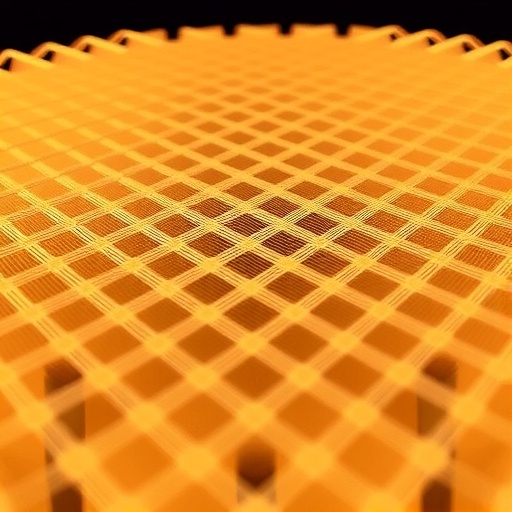
The core of this technology lies in creating a wafer-thin silicon membrane structured with millions of microscopic elements arranged in a highly specific pattern. Unlike conventional phononic crystals where unit cells remain unchanged, these patterns are graded—each unit cell varies slightly, particularly in the length of the arms in the star-shaped features at their centers. This gradient modulates wave propagation in extraordinary ways, enabling the manipulation of vibrations along complex, engineered routes.
Manufacturing these microstructures demands the utmost precision. The team utilized photolithography and advanced etching techniques in the ultraclean environment of ETH Zurich’s nanotechnology cleanroom, working from standard silicon wafers to create membranes nearly invisible to the naked eye but meticulously patterned at the microscale. Each unit cell measures just a few micrometers, combining to form a labyrinthine network designed computationally to guide elastic waves.
Simulating such a vast and complex system challenges conventional computational methods, as directly modeling every microscopic interaction would require untenable resources. Instead, Charles Dorn, now an assistant professor at the University of Washington and a key member of the research team, pioneered novel simulation frameworks that treat wave energy propagation similarly to rays in optics. This modular approach perceives the metamaterial as a puzzle, where individual pieces perform specific functions such as turning wave paths by right angles or splitting signals according to frequency. This design philosophy allows assembly of intricate, multi-path waveguides, such as figure-eight trajectories, for precise control over vibrations.
Testing the fabricated silicon membranes revealed remarkable results. Using pulsed lasers to induce vibrations and highly sensitive optical measurement techniques to track wave movement, the researchers confirmed that the waves adhered to intended paths, sustaining these trajectories far longer than anticipated. Notably, while the system was designed for a target frequency of roughly 750 kilohertz, it demonstrated robust functionality across a wide bandwidth ranging from approximately 250 to 800 kilohertz—a resilience that speaks to the robustness of the design.
Silicon’s intrinsic low damping characteristics enable long-lived wave propagation within the membranes, a significant advantage over polymer-based metamaterials, which tend to dissipate vibrations rapidly. This trait opens exciting possibilities for integrating these phononic devices into micro- and nanoelectronic platforms, mitigating unwanted vibrations that can impair signal integrity or device stability. Moreover, the ability to process mechanical signals without external energy input holds promise for autonomous sensing applications, particularly in harsh or remote environments where power availability is limited.
Beyond sensing, Kochmann envisions applications in vibrational energy harvesting. By channeling mechanical waves toward piezoelectric converters embedded within or alongside the silicon membrane, ambient vibrations could be transformed into usable electrical energy, powering small devices sustainably. This innovation could profoundly impact fields from infrastructure health monitoring to wearable technologies, creating self-powered systems harnessing ubiquitous environmental vibrations.
Looking ahead, the ETH team plans further miniaturization, delving into the nanometer scale where fabrication limitations and physical phenomena converge in new and challenging ways. Understanding the underlying physics that result in the system’s broadband operational capacity remains a subject of fundamental research. Unraveling these mysteries not only advances metamaterial science but also enriches knowledge of wave-matter interactions at the microscale.
The ability to explore these frontiers without immediate commercial pressures is a unique advantage at ETH Zurich, enabling the researchers to methodically probe fundamental questions that often lead to unexpected and revolutionary applications. This dedicated inquiry exemplifies the symbiotic relationship between basic science and applied technology, where curiosity-driven exploration fuels innovation that reshapes entire technological landscapes.
This groundbreaking research, published in leading journals such as Physical Review X and Nature Communications, marks a significant milestone in the evolution of metamaterials. It heralds a new era in elastic wave management, blending cutting-edge computational design, precision nanofabrication, and sophisticated experimental validation into a cohesive strategy capable of transforming our control over mechanical energy.
News Publication Date: March 5, 2026.
Web References:
References:
- Kannan V, Dorn C, Drechsler U, Kochmann DM: Microscale Architected Materials for Elastic Waveguiding: Fabrication and Dynamic Characterization across Length and Time Scales. Phys. Rev. X 16, 011047 (2026).
- Dorn C, Kannan V, Drechsler U, et al. Graded phononic metamaterials based on scalable microfabrication and design. Nat Commun 17, 3192 (2026).
Keywords
Metamaterials, phononic metamaterials, elastic waveguiding, silicon membrane, microfabrication, nanotechnology, vibration control, energy harvesting, mechanical signal processing, photolithography, graded microstructure, computational modeling.
Cite Scienmag News
Neil Sanderson. (May 28, 2026). Innovative Metamaterial Channels Vibrations Along Customized Pathways. Scienmag. https://scienmag.com/innovative-metamaterial-channels-vibrations-along-customized-pathways/
Neil Sanderson. "Innovative Metamaterial Channels Vibrations Along Customized Pathways." Scienmag, 28 May 2026, https://scienmag.com/innovative-metamaterial-channels-vibrations-along-customized-pathways/. Accessed 5 September 2026.
Neil Sanderson. "Innovative Metamaterial Channels Vibrations Along Customized Pathways." Scienmag. May 28, 2026. https://scienmag.com/innovative-metamaterial-channels-vibrations-along-customized-pathways/


