


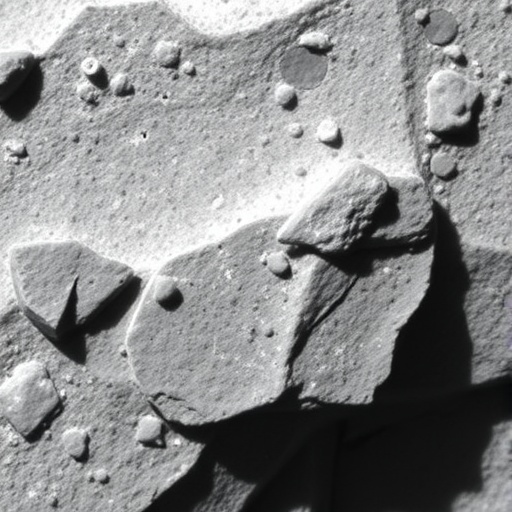
The Moon’s surface stands as a celestial archive, preserving an unfiltered history of space weathering due to the absence of an atmosphere and typical terrestrial geological agents such as flowing water, wind, and biological activity. Unlike Earth, where weathering processes rapidly erase surface records, the lunar regolith harbors long-term evidence of the interactions between the Moon’s surface and the hostile environment of space. This unaltered state makes it an invaluable site for studying space weathering phenomena on airless bodies, including Mercury and various asteroids.
Space weathering involves a complex suite of processes including bombardment by micrometeorites, solar wind irradiation, impact melting, sputtering, and rapid quenching of molten material. These processes incessantly reshape the morphology, chemical composition, and optical characteristics of the lunar surface materials at scales ranging from micrometers down to nanometers. Thorough comprehension of these nanoscale and microscale physicochemical transformations is critical for accurate interpretation of remote sensing data, as well as for understanding the distribution and form of extraterrestrial resources that may eventually support sustained lunar exploration and habitation.
In a groundbreaking advancement, an interdisciplinary team led by Professor YIN Zongjun of the Nanjing Institute of Geology and Palaeontology (NIGPAS), alongside Professors SHEN Bing and ZHOU Jihan from Peking University, undertook meticulous investigations of impact-glass particles derived from Chang’e-5 lunar soil samples. The Chang’e-5 mission is renowned for bringing back pristine regolith from the Moon’s surface, igniting new opportunities to probe the deep-time effects of space weathering phenomena.
Published in both the Journal of Geophysical Research: Planets and Proceedings of the National Academy of Sciences (PNAS), these complementary studies reveal the underpinnings of lunar surface evolution at the nanoscale. They specifically elucidate the dual mechanisms driving the formation of complex structures in lunar impact glasses: impact-induced silicate phase separation and the genesis of nanophase metallic iron (npFe^0), both pivotal for modifying the optical signatures visible in remote sensing spectra.
The investigation published in the Journal of Geophysical Research: Planets employed aberration-corrected transmission electron microscopy and scanning transmission electron microscopy combined with advanced spectroscopic techniques. This high-resolution analytical framework unveiled nanometer-scale droplets rich in iron embedded within silicon-rich glass matrices, along with silicon-rich droplets encased in iron-rich glass. Intriguingly, these droplets were found to be amorphous, lacking crystalline order, and appeared in clusters indicating partial coalescence and growth. The data compellingly suggest that the intense, transient heating during micrometeorite impacts melts lunar soil locally and induces silicate liquid immiscibility—a phase separation process where different silicate components spontaneously segregate due to their thermodynamic incompatibility—followed by rapid quenching that freezes these transient phases into the impact glass.
Extending beyond structural characterization, the PNAS paper delved into the origin and spatial distribution of npFe^0 within the same glass particles. Nanophase metallic iron is a hallmark product of lunar space weathering, significantly influencing the reflectance spectra of lunar regolith and thus its perceived coloration. By leveraging electron tomography, energy-dispersive X-ray spectroscopy, and electron energy-loss spectroscopy at the nanoscale, researchers reconstructed a three-dimensional map showing 1,506 discrete npFe^0 particles within a single volume of impact glass. These nanospheres averaged approximately 3.4 nm in diameter, with a median size of 2.9 nm. Remarkably, different stratigraphic layers within the glass exhibited distinct particle size distributions, densities, and ferrous iron volume fractions, suggesting a complex multiphase genesis influenced by spatial heterogeneity in weathering conditions.
The creation mechanisms underlying these nanoparticles were elucidated through a combination of structural and valence-state analysis of iron within the glass. The team introduced a novel parameter, denoted ξ, to quantify the role of external electron transfer in the reduction of iron ions—a critical step in npFe^0 formation. Their results revealed that the sulfur-rich layers containing irregularly shaped, larger particles primarily derived from the decomposition of iron sulfides. Other layers rich in fine nanoparticles were dominated by Fe^2+ disproportionation, a redox reaction where Fe^2+ simultaneously undergoes oxidation and reduction to yield Fe^3+ and Fe^0. A near-surface region displayed signatures of ongoing modification through solar wind irradiation, which further influenced glass structure alteration and promoted growth and ripening of npFe^0 particles.
Notably, through precise quantification, the researchers concluded that the metallic iron content in mature domains of impact-glass can reach up to 7.1 weight percent. This figure far exceeds previous estimates derived from bulk lunar soil analyses of Chang’e-5 samples, spotlighting profound microscale heterogeneity in nanophase iron distribution that bulk techniques cannot resolve. Such insight has profound implications for interpreting lunar regolith reflectance data and assessing the moon’s available iron resources for in situ utilization.
Collectively, these twin studies illustrate a dynamic tapestry of processes simultaneously recorded in Chang’e-5 impact glass—ranging from rapid impact melting and silicate phase separation to complex redox reactions, sulfide decomposition, and solar wind-induced modification. Importantly, the adoption of advanced three-dimensional electron tomography techniques surpasses traditional two-dimensional imaging limitations, enabling volumetric reconstructions that reveal both morphological and chemical subtleties essential for reconstructing the nano-architectures and their formation histories.
These findings provide a paradigm shift in our understanding of the Moon’s spectral evolution and the physical nature of its surface materials, also extending to other airless planetary bodies across the solar system. By deciphering the intertwined processes at the nanoscale, researchers are poised to refine models for lunar surface aging, resource distribution, and remote sensing data interpretation in a way previously unattainable. This nano-analytical approach heralds a new era, unlocking the Moon’s secrets layer by layer with unprecedented clarity.
Beyond academic interest, these revelations bear significant practical implications for future lunar exploration ventures. A better grasp of the distribution and morphology of nanophase iron informs both the interpretation of orbital sensing data and the engineering of sustainable resource extraction technologies, underpinning plans for long-duration human presence on the Moon. Moreover, the techniques demonstrated here set a benchmark for nanoscale investigations on extraterrestrial materials, promising broader applications in planetary science and astromaterials research.
As humanity advances toward renewed exploration and potential habitation of the Moon, understanding these minute yet crucial nanoscale processes serves as an essential foundation. Through the intricate dance of melting, phase separation, and redox chemistry preserved in lunar impact glass, we gain not only the story of the Moon’s enduring surface but also a roadmap for exploiting its resources and deciphering its past.
- Journal of Geophysical Research: Planets
- PNAS article
Image Credits: NIGPAS
Keywords
Lunar regolith, space weathering, nanophase iron, impact glass, Chang’e-5, electron tomography, silicate liquid immiscibility, redox reactions, solar wind irradiation, lunar resources, nanoscale analysis, transmission electron microscopy
Cite Scienmag News
Grant Pearson. (May 27, 2026). Nanoscale Space-Weathering Processes Uncovered in Chang’e-5 Regolith Studies. Scienmag. https://scienmag.com/nanoscale-space-weathering-processes-uncovered-in-change-5-regolith-studies/
Grant Pearson. "Nanoscale Space-Weathering Processes Uncovered in Chang’e-5 Regolith Studies." Scienmag, 27 May 2026, https://scienmag.com/nanoscale-space-weathering-processes-uncovered-in-change-5-regolith-studies/. Accessed 4 September 2026.
Grant Pearson. "Nanoscale Space-Weathering Processes Uncovered in Chang’e-5 Regolith Studies." Scienmag. May 27, 2026. https://scienmag.com/nanoscale-space-weathering-processes-uncovered-in-change-5-regolith-studies/


