


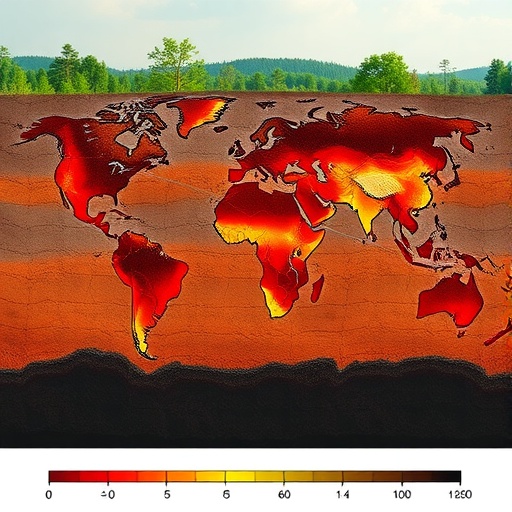
Emerging research on global Mollisol croplands unveils profound nonlinear responses in soil organic carbon dynamics amid temperature shifts, an insight set to recalibrate our understanding of climate change impacts on agricultural soils. This pivotal study, conducted by Meng, Bao, Ustin, and colleagues, sheds light on complex feedback loops governing soil carbon balance, revealing patterns of loss and gain that defy linear expectations and carry significant implications for global carbon cycling.
Mollisols, known for their rich organic matter and vital role in global food production, have long been recognized as carbon reservoirs. However, how these soils respond to changing thermal regimes across diverse geographic locales has remained elusive. The new findings bridge this knowledge gap through exhaustive analysis, illustrating that temperature fluctuations do not translate directly or predictably into soil carbon outcomes but instead trigger nonlinear transitions. These transitions alternate between carbon loss and gain phases, substantially influencing soil health and atmospheric carbon concentrations.
The core mechanism driving these nonlinear responses lies in the biogeochemical interplay between microbial activity, substrate availability, and moisture conditions within Mollisol matrices. As temperatures deviate from historical norms, soil microbial communities accelerate decomposition processes but also adjust metabolic pathways and community composition, which in turn modulate organic carbon turnover rates. Such shifts result in soil carbon stocks experiencing episodic expansions or contractions rather than steady declines or increases.
Intriguingly, the study elucidates thresholds or tipping points at which minor temperature changes precipitate disproportionate transformations in soil carbon dynamics. Below certain thermal limits, enhanced microbial efficiency and elevated plant residue inputs augment carbon sequestration, whereas beyond these thresholds, accelerated decomposition predominates, leading to rapid loss of organic carbon. This delicate balance underscores the double-edged nature of warming on soil carbon reservoirs in Mollisols, reflecting intricate feedback mechanisms that stabilize or destabilize soil carbon pools.
A sophisticated synthesis of satellite observations, long-term soil monitoring datasets, and advanced ecosystem modeling underpins the analysis. The researchers leveraged remote sensing to capture regional vegetation productivity, linked with soil carbon stock measurements, and integrated these within predictive models encompassing microbial respiration kinetics sensitive to temperature gradients. This multifaceted approach enabled unprecedented resolution in teasing apart spatial-temporal patterns of carbon fluxes under variable thermal scenarios.
Beyond fundamental ecology, the implications of this work extend into climate policy and agricultural management. Since Mollisol croplands account for a substantial fraction of global terrestrial productivity and carbon storage, understanding their nonlinear temperature responses equips scientists and policymakers with refined tools for forecasting carbon-climate feedbacks. Such insight is crucial for developing adaptive strategies that mitigate soil carbon losses and harness potential gains in response to warming.
The research further challenges assumptions embedded in existing Earth system models, which often rely on linear parameterizations of temperature effects on soil organic matter decomposition. By incorporating nonlinear dynamics evidenced in this study, future models can better capture emergent phenomena in carbon cycling, leading to more accurate climate projections. This advancement marks a significant leap towards closing critical gaps in coupling soil processes with atmospheric changes at continental scales.
Equally notable is the study’s emphasis on temporal variability, acknowledging that soil carbon transitions unfold over diverse timescales—seasonal, interannual, and decadal. Short-term warming episodes may promote carbon gains via enhanced photosynthesis and residue deposition, while prolonged exposure to elevated temperatures can reverse this trend through sustained microbial mineralization. Capturing these temporal nuances constitutes a methodological innovation key to disentangling the net effect of warming on soil organic carbon.
The complexity unraveled extends to spatial heterogeneity within Mollisols themselves. Variations in soil texture, mineralogy, and hydrological regimes mediate carbon turnover responses, producing mosaic patterns of carbon loss and gain within landscapes subjected to similar climatic forces. This spatially explicit understanding calls for refined land management approaches tailored to local edaphic conditions, optimizing soil carbon resilience under evolving climates.
Furthermore, the team’s integration of functional microbial ecology reveals shifts in decomposer communities underpinning carbon transitions. Temperature alterations selectively favor microbial taxa with distinct enzymatic capabilities affecting organic matter breakdown pathways. These community dynamics profoundly influence whether soil organic carbon accumulates or diminishes, highlighting the need to consider microbial ecology as a critical factor in carbon-cycle models.
The findings carry resonance for global efforts targeting soil carbon sequestration as a nature-based solution to climate change. While warmer temperatures often signal increased carbon release, this study points to windows of opportunity where appropriate agronomic interventions could enhance sequestration, offsetting emissions. Practices such as cover cropping, reduced tillage, and organic amendments may leverage temperature-mediated microbial responses to stabilize or build soil carbon stocks within Mollisol ecosystems.
Scientific discourse emerging from this research underscores the urgency of monitoring soil carbon trajectories with precision and depth. Real-time and long-term observation networks must capture nonlinear thresholds and temporal variability to detect early warning signs of carbon pool destabilization. This anticipatory capacity is critical for preempting adverse feedbacks to the climate system and sustaining agricultural productivity.
By advancing theoretical frameworks and empirical evidence concerning nonlinear temperature responses, the study enriches foundational knowledge of soil biogeochemistry. It reframes soil organic carbon not simply as a passive pool reacting uniformly to warming but as a dynamic entity governed by complex ecological and physicochemical interactions. This perspective fosters integrative research exploring how other global change drivers—such as moisture shifts, land-use transitions, and nutrient cycles—intersect with temperature effects.
The research team advocates for interdisciplinary collaborations combining soil science, microbial ecology, climate modeling, and land-use planning to operationalize these insights. Such efforts are vital to devise holistic strategies that safeguard soil carbon assets amid accelerating environmental change. As climate warming intensifies, nuanced understanding of nonlinear carbon dynamics becomes indispensable for sustainable stewardship of terrestrial ecosystems vital to human well-being.
Ultimately, this groundbreaking study paves the way for more refined, realistic models of carbon cycling and climate feedbacks, spotlighting the intricate dance between temperature and soil organic carbon in Mollisol croplands worldwide. It sparks a paradigm shift, compelling the scientific community to embrace complexity and temporal-spatial heterogeneity in predicting the fate of critical carbon reservoirs under future climate trajectories.
Cite Scienmag News
Violet Maxwell. (May 27, 2026). Nonlinear Temperatures Drive Soil Carbon Shifts Globally. Scienmag. https://scienmag.com/nonlinear-temperatures-drive-soil-carbon-shifts-globally/
Violet Maxwell. "Nonlinear Temperatures Drive Soil Carbon Shifts Globally." Scienmag, 27 May 2026, https://scienmag.com/nonlinear-temperatures-drive-soil-carbon-shifts-globally/. Accessed 4 September 2026.
Violet Maxwell. "Nonlinear Temperatures Drive Soil Carbon Shifts Globally." Scienmag. May 27, 2026. https://scienmag.com/nonlinear-temperatures-drive-soil-carbon-shifts-globally/


