


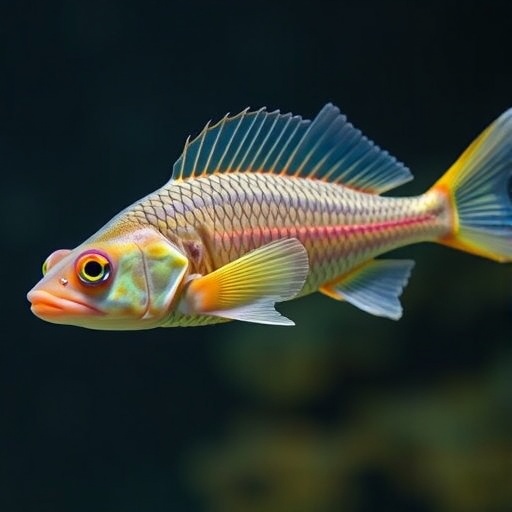
In the intricate dance of survival, animals rely heavily on their ability to maintain stable posture and sensory perception. One fundamental aspect of this is head stabilization, which ensures steady sensory input and accurate spatial awareness critical for navigating the environment. While tetrapods, including humans, have evolved a distinct “neck” structure allowing them to level their head through a reflex called the vestibulo-collic reflex, the question has long remained: how do fish, devoid of this morphological neck, manage to stabilize their heads? A groundbreaking study published in Communications Biology now unravels the mystery behind this evolutionary enigma, revealing that larval zebrafish exhibit a sophisticated head stabilization behavior, underpinned by neural circuits remarkably analogous to those found in mammals.
Humans and other quadrupeds employ their cervical muscles to produce compensatory movements, stabilizing the head relative to the environment during body tilts. This vestibulo-collic reflex is a hallmark of vertebrate motor control, integrating sensory inputs from the vestibular system with motor outputs to neck muscles. Fish, strikingly, lack a neck connecting the skull and trunk, raising crucial biological questions about their postural control mechanisms. The investigative team, led by Takumi Sugioka, Masashi Tanimoto, and Shin-ichi Higashijima at the Exploratory Research Center on Life and Living Systems (ExCELLS) / National Institute for Basic Biology (NIBB), Japan, undertook this challenge by leveraging the larval zebrafish model. This organism’s simplified body plan and well-mapped neural architecture make it an ideal candidate for dissecting the neuronal basis of postural reflexes.
Initial behavioral observations were conducted using precise body tilt assays wherein the larval zebrafish were subjected to controlled angular deviations. The researchers documented that the zebrafish exhibited graded trunk flexion responses corresponding directly to the tilt angle, with ventral bending during head-up postures and dorsal bending during head-down postures. This trunk flexion effectively adjusted the head orientation back toward a horizontal plane, a remarkable finding indicating head stabilization despite the absence of a neck. Advanced motion tracking and biomechanical analyses quantified these subtle posture adjustments, highlighting them as an active and adaptive mechanism rather than passive physical constraints.
Further investigations delved into the underlying neuronal circuitry orchestrating this adaptive postural control. Employing state-of-the-art calcium imaging and targeted cell ablation, the team delineated two distinct yet complementary neural pathways responsible for trunk flexion. For head-up tilting, ventral flexion was executed through a circuit comprising vestibular nucleus neurons projecting to reticulospinal neurons, which in turn activated spinal motor neurons targeting ventral specialized muscles. Conversely, dorsal flexion during head-down tilting was controlled by a direct vestibular nucleus to spinal motor neuron pathway, targeting dorsal specialized muscles. These dual circuitries coordinate to maintain head stability with precision.
This neural configuration, although lacking the anatomical neck structure seen in tetrapods, reveals a functional parallel to the mammalian vestibulo-collic reflex. Both systems rely on vestibular inputs to generate motor commands stabilizing the head’s spatial orientation, underscoring a conserved evolutionary strategy. The fish’s trunk flexion paradigm might represent a primordial form of the vestibulo-collic reflex, predating the morphological innovations leading to a distinct vertebrate neck. This insight extends our understanding of neural evolution, suggesting that fundamental sensorimotor strategies for head stabilization have deep ancestral roots.
The implications of these findings are profound. They not only solve a longstanding biological puzzle about head stabilization in neckless fish but also provide a model framework to investigate the evolutionary transitions from trunk-based to neck-based postural control. The zebrafish’s relatively simple yet functionally sophisticated neural circuits offer a unique window into the origins of vertebrate sensory-motor integration and behavioral adaptation. Future exploration of this system could reveal new principles of neural circuit plasticity and motor control relevant across species.
Moreover, the study’s methodology, combining precise behavioral assays with modern neurobiological techniques, sets a benchmark for research in comparative neuroethology. Calcium imaging allowed real-time monitoring of neuronal activity during active postural maneuvers, while targeted ablations confirmed the causal role of specific neurons in motor execution. Such integrative experimental design strengthens the conclusions and opens pathways to genetically manipulate these circuits, potentially translating findings into biomedical insights relevant to human motor disorders.
An intriguing aspect is the specialization of trunk muscles into dorsal and ventral groups, each selectively engaged by distinct neural circuits to enact head stabilization. This anatomical division of labor compensates for the structural absence of a neck, and understanding the molecular determinants guiding such muscle specialization could further elucidate vertebrate musculoskeletal evolution. Future research might explore how developmental gene expression patterns underlie this functional differentiation and how similar mechanisms operate in other aquatic vertebrates.
Additionally, the direct influence of vestibular inputs on spinal motor neurons in fish highlights an ancestral neural architecture favoring rapid and efficient postural adjustments. By bypassing intermediate relay centers like the reticulospinal system in certain pathways, fish might achieve faster reflexive responses essential for survival in dynamic aquatic environments. This neurophysiological economy contrasts with the more layered vertebrate motor systems, suggesting evolutionary trade-offs between reflex speed and control complexity.
The study also provokes reconsideration of how the absence of morphological structures does not equate with absence of function. Fish demonstrate that essential motor behaviors like head stabilization can arise from alternative anatomical and circuit configurations, reflecting biological flexibility. This realization broadens the conceptual framework of motor control, encouraging scientists to uncover non-canonical circuit architectures achieving analogous functions across taxa.
Finally, understanding these fundamental postural mechanisms in fish has the potential to impact bio-inspired robotics and rehabilitation. Designing robotic systems or prosthetics mimicking the fish’s trunk-based stabilization strategies could yield resilient and adaptable devices capable of maintaining orientation without complex joint structures. Insights from zebrafish neural circuits may also inform therapeutic approaches for humans suffering from vestibular dysfunctions or cervical spine injuries by highlighting compensatory pathways and motor patterns.
In summary, the discovery of head stabilization behaviors in larval zebrafish reveals a deeply conserved motor control strategy, implemented through specialized trunk muscles and dual neural circuits. This vertebrate-animal model defies the notion that a neck is requisite for head stability, demonstrating instead an evolutionarily ancient mechanism that likely paved the way for the development of the sophisticated vestibulo-collic reflex seen in tetrapods. As research progresses, these findings are poised to unlock new dimensions in neurobiology, evolutionary science, and applied biotechnology, capturing the imagination of scientists and the public alike.
Cite Scienmag News
Cassandra Pierce. (May 26, 2026). New Insights into Head Stabilization and Neural Circuits Revealed in Neckless Fish. Scienmag. https://scienmag.com/new-insights-into-head-stabilization-and-neural-circuits-revealed-in-neckless-fish/
Cassandra Pierce. "New Insights into Head Stabilization and Neural Circuits Revealed in Neckless Fish." Scienmag, 26 May 2026, https://scienmag.com/new-insights-into-head-stabilization-and-neural-circuits-revealed-in-neckless-fish/. Accessed 3 September 2026.
Cassandra Pierce. "New Insights into Head Stabilization and Neural Circuits Revealed in Neckless Fish." Scienmag. May 26, 2026. https://scienmag.com/new-insights-into-head-stabilization-and-neural-circuits-revealed-in-neckless-fish/


