


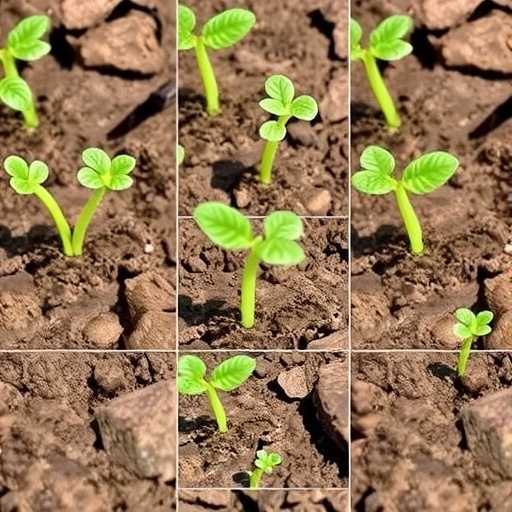
In the ever-changing tapestry of Earth’s ecosystems, water availability serves as a critical thread weaving the complex interactions that sustain life. Recent pioneering research published in Communications Earth & Environment unravels the intricate molecular choreography performed by soil microbes under water-limited conditions, providing unprecedented insight into how these microscopic communities orchestrate biogeochemical stability in some of the planet’s most challenging environments. By harnessing the power of multi-omics integration—a comprehensive approach combining genomics, transcriptomics, proteomics, and metabolomics—scientists have decoded the sophisticated strategies that allow microbial networks to endure and maintain ecosystem functions in arid soils.
Water scarcity is a defining feature of numerous terrestrial habitats globally, influencing the cycling of essential elements such as carbon, nitrogen, and phosphorus, which underpin ecosystem productivity and soil health. Soils under water stress pose a significant threat to agricultural sustainability and natural biodiversity, prompting urgent investigations into the mechanisms enabling microbial resilience and functional redundancy. The groundbreaking study led by Freire-Zapata, Ayala-Ortiz, Walker, and colleagues illuminates the microbial molecular repertoire that stabilizes soil biogeochemistry, highlighting an extraordinary level of biochemical coordination and adaptability previously unknown.
The methodology employed sets a new benchmark in environmental microbiology. By assimilating multiple omics layers, researchers transcended the limitations of traditional single-dimensional analyses, capturing a holistic snapshot of how microbial communities dynamically respond to drought stress. Genomic data unveiled the inherent genetic potential of the resident microorganisms to metabolize and transform nutrients, while transcriptomic profiles revealed real-time gene expression shifts triggered by water limitation. Complementing these, proteomic and metabolomic data cataloged the functional proteins produced and the metabolic pathways activated, respectively, linking molecular actors directly to ecosystem processes.
One of the most profound revelations of the research lies in the identification of coordinated microbial consortia that orchestrate complementary metabolic functions, thereby sustaining critical soil processes despite water deficits. These consortia appear to engage in complex interspecies interactions, including resource sharing and chemical signaling, effectively buffering the community against environmental perturbations. This emergent property of microbial ecosystems underscores the evolutionary advantage of collective resilience mechanisms, which may be pivotal in maintaining elemental cycles under increasing drought scenarios projected by climate change models.
The research further delineates the biochemical pathways pivotal for maintaining nitrogen cycling in dry soils. Specific microbial taxa show enhanced capacities for nitrogen fixation and ammonium oxidation under limited moisture, offsetting the traditionally expected decline in nutrient availability. Enzymatic activities facilitating these processes remain remarkably stable, a testament to microbial adaptive regulation and functional plasticity. Such findings challenge preexisting notions that water scarcity uniformly suppresses soil nutrient dynamics, hinting instead at nuanced, context-dependent microbial responses.
Carbon cycling, a cornerstone of global climate regulation, also exhibits intriguing stability mediated by microbial communities. The integration of omics data revealed a balance between carbon assimilation and respiration, maintained through synergistic metabolic pathways involving both aerobic and anaerobic processes. This equilibrium prevents the excessive loss of soil organic carbon—a critical reservoir that when depleted, accelerates atmospheric CO2 accumulation. The study’s insights suggest that microbial metabolic flexibility acts as a biogeochemical stabilizer, enabling soils to retain carbon stocks even under prolonged drought stress.
In addition to elemental cycling, the researchers explored how microbes modulate soil physicochemical properties to influence water retention and availability. Multi-omics evidence points to microbial synthesis of extracellular polysaccharides and biofilm formation, enhancing soil aggregate stability and moisture retention. These biological structures create microhabitats that conserve water, providing refuge for microbial populations and facilitating nutrient exchange. The dynamic production of such biofilms illustrates sophisticated microbial strategies that extend beyond metabolism, embracing habitat engineering to withstand desiccation.
A fascinating dimension unveiled is the role of microbial secondary metabolites in signaling and community regulation. The multi-omics approach identified an array of small molecules produced specifically under drought conditions, acting as chemical messengers coordinating stress responses at the community level. These metabolites influence gene expression and metabolic activity in neighboring cells, effectively synchronizing population-level adaptations. The study posits these signaling networks as crucial for the resilience of microbial consortia, enabling rapid reconfiguration of functional roles aligned with environmental demands.
Importantly, this research bridges molecular-scale observations with ecosystem-scale implications. By linking omics-derived data with soil geochemical measurements, the study establishes a cause-effect continuum demonstrating how microbial molecular mechanisms drive and stabilize nutrient flows. This integrative framework opens avenues for predictive modeling of soil health trajectories under future climate stress scenarios, offering vital tools for ecosystem management and restoration efforts aimed at mitigating drought impacts on global food security.
The implications for applied science are profound. Understanding microbial coordination in arid soils lays the foundation for bioengineering strategies designed to enhance soil resilience. For example, targeted inoculation with functionally complementary microbial consortia or stimulation of indigenous beneficial microbes could promote sustainable agriculture in drought-prone regions. Moreover, insights into microbial metabolic plasticity can inform the development of biofertilizers and soil amendments that bolster natural microbial functions, reducing dependency on chemical inputs and contributing to environmental conservation.
This study also advances theoretical ecology by illuminating principles of microbial community assembly and maintenance under stress. The observed emergent properties reflect complex adaptive systems capable of maintaining homeostasis through redundancy, cooperation, and phenotypic plasticity. Such concepts resonate across biological scales and could inform parallel research in human microbiomes, bioremediation, and synthetic ecology, highlighting universal strategies for life’s persistence amidst adversity.
The utilization of multi-omics integration, while methodologically demanding, proved indispensable for capturing the multifaceted microbial responses to water limitation. The study exemplifies how coupling high-throughput sequencing, mass spectrometry, and advanced computational analyses creates a multidimensional view of soil microbiomes previously unattainable. These technological advances mark a paradigm shift in environmental microbiology, emphasizing the value of integrative approaches to decipher complex biological interactions central to ecosystem functioning.
Looking forward, the research team envisions expanding this integrative framework to explore microbial dynamics in diverse soil types and climatic zones, aiming to map functional microbial landscapes at a global scale. Such efforts will be crucial for building robust predictive models that guide conservation policies and agricultural practices under accelerating climate challenges. The data generated provides a foundational resource for investigators probing the molecular ecology of drought resilience, promoting interdisciplinary collaborations across microbiology, soil science, and climate science.
In conclusion, the work by Freire-Zapata, Ayala-Ortiz, Walker, and colleagues represents a milestone in unraveling the hidden molecular symphony sustaining life in the planet’s most parched soils. Through the lens of multi-omics, it reveals how microbial communities transcend individual limitations to collectively uphold biogeochemical stability and ecosystem viability under water scarcity. This breakthrough enriches our understanding of soil microbiomes, fosters innovative solutions for environmental stewardship, and underscores the resilience of microbial life in the face of global change—a powerful reminder of nature’s inherent ingenuity and persistence.
Cite Scienmag News
Morgan Morrow. (May 22, 2026). Microbial Networks Sustain Soil Stability in Dry Conditions. Scienmag. https://scienmag.com/microbial-networks-sustain-soil-stability-in-dry-conditions/
Morgan Morrow. "Microbial Networks Sustain Soil Stability in Dry Conditions." Scienmag, 22 May 2026, https://scienmag.com/microbial-networks-sustain-soil-stability-in-dry-conditions/. Accessed 3 September 2026.
Morgan Morrow. "Microbial Networks Sustain Soil Stability in Dry Conditions." Scienmag. May 22, 2026. https://scienmag.com/microbial-networks-sustain-soil-stability-in-dry-conditions/


