


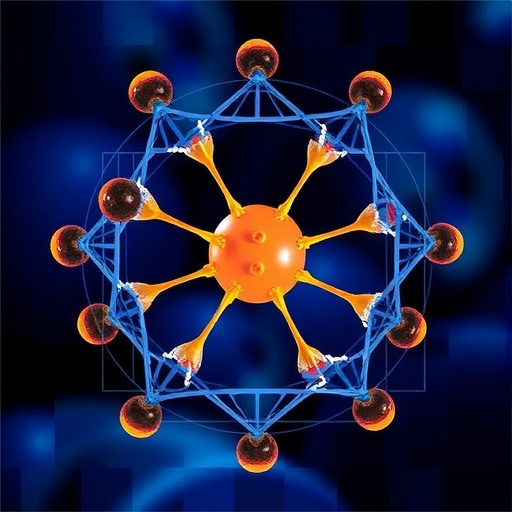
In a groundbreaking advancement poised to redefine the landscape of catalysis and energy conversion, researchers have unveiled a novel class of tubular single-atom copper catalysts that enable unprecedented long-range electronic interactions within nanoconfined environments. This discovery, heralded for its potential to dramatically enhance direct electron transfer oxidation processes, shines a spotlight on the intricate interplay between atomic-scale structure and electronic behavior in catalytic systems. The work delves into the delicate architecture of Cu-N₃ configurations situated within tubular nanostructures, unlocking new pathways to elevate catalytic efficiency by harnessing spatially extended electronic interactions that were previously thought unattainable.
Catalysts operate by facilitating chemical reactions, often by lowering the activation energy or offering an alternative reaction pathway. However, the quest for higher efficiency, selectivity, and durability has driven scientists to explore the atomic limits of catalyst design. Single-atom catalysts (SACs) have emerged as the zenith of this trend, where isolated metal atoms are anchored onto support structures, maximizing atom utilization and unique quantum mechanical properties. Yet, the intricacies of how these solitary atoms interact electronically over extended distances, particularly within confined nano-environments, remained poorly understood until this new study.
At the heart of this research lies the innovative design of a tubular configuration embedding copper atoms coordinated with three nitrogen atoms—Cu-N₃ motifs—distributed along nanoscopic tubes. These Cu-N₃ single atoms do not merely act as isolated active sites; instead, they engage in collective electronic interactions that extend far beyond nearest-neighbor distances. The tubular morphology fosters an environment akin to a nanoconfined arena, where quantum effects and electron delocalization intensify, enabling a direct electron transfer mechanism that bypasses traditional energy barriers associated with oxidation reactions.
Direct electron transfer oxidation is a pivotal reaction in numerous industrial and environmental applications, from biomass conversion to pollutant degradation and electrochemical energy devices. Traditional catalysts often operate via mediated electron transfer, which introduces inefficiencies and potential side reactions. The ability to spatially engineer catalyst architecture such that electrons traverse directly from the substrate to the catalytic site with minimal loss marks a significant technological leap. This tubular Cu-N₃ catalyst system, through its carefully engineered electronic landscape, capitalizes on the coherent coupling of single atoms, effectively creating an ‘electron highway’ that facilitates oxidation with remarkable efficiency.
Detailed electron microscopy and spectroscopy analyses reveal the atomic precision of copper atom placements within nitrogen-coordinated sites lining the inner surface of a hollow tubular matrix. This configuration not only stabilizes the single atoms but also mediates their interaction through the conduction band of the supporting structure. The research team employed advanced in situ spectroscopic techniques to observe electron transfer events in real time, confirming that the electronic coupling extends over surprisingly long distances compared to conventional SAC systems.
Fundamentally, this long-range interaction challenges the prevailing notion that single atoms act as discrete, independent catalytic centers. Instead, it suggests a paradigm where collective behavior can emerge from spatially periodic atomic arrangements, especially when confined within nanoscale geometries. The tubular structure essentially acts as a conduit, enabling charge carriers to propagate and engage with multiple catalytic sites synergistically, thereby promoting reaction kinetics and turnover rates that surpass expectations based on isolated atom models.
The synthesis of such a sophisticated catalyst demands precision engineering and an astute understanding of coordination chemistry. The researchers utilized a bottom-up approach, starting from molecular precursors that direct the formation of nitrogen-coordinated copper centers during the growth of carbonaceous tubular frameworks. This method ensures uniformity in atom dispersion and electronic properties, critical for achieving reproducible catalytic performance.
Computational modeling played an instrumental role in elucidating the electronic structure and interaction mechanisms underlying the observed phenomena. Density functional theory (DFT) simulations provided insights into the charge density redistribution and energy level alignment within the Cu-N₃ tubular system. These calculations corroborated experimental data, indicating that the nanoconfinement not only restricts spatial configurations but also modulates electronic states, enhancing the overlap of atomic orbitals necessary for efficient electron transfer.
From an application standpoint, the implications are vast. Enhanced direct electron transfer oxidation through such catalysts could revolutionize electrochemical devices, including fuel cells and sensors, by reducing overpotentials and improving stability. Moreover, environmentally relevant oxidation processes could be conducted under milder conditions with higher selectivity and fewer byproducts, aligning with sustainable chemistry goals.
The researchers also highlight the potential adaptability of this tubular single-atom catalyst design. By substituting different metal centers or tuning the nitrogen coordination environment, the platform could be optimized for a broad spectrum of reactions beyond oxidation. This modularity opens avenues for custom-designed catalytic systems tailored to specific industrial challenges, pushing the boundaries of what single-atom catalysis can achieve.
Furthermore, the study underscores the importance of nano-architecture in dictating not just the physical but also the electronic properties of catalytic materials. It illustrates that moving beyond simple supports and embracing complex, yet controlled, nanostructures can unlock functionalities inaccessible to traditional catalyst designs. This insight is poised to stimulate a new wave of research focused on coupling nanoscale design with single-atom precision.
The stability and durability tests conducted affirm that the tubular Cu-N₃ system maintains its structural integrity and catalytic performance over extended operational cycles. This resilience is critical for practical deployment where catalysts face harsh conditions and prolonged use. The robustness is attributed to strong metal-support interactions within the tubular scaffold, which also prevent aggregation of copper atoms—one of the common pitfalls in SAC research.
Notably, the study’s interdisciplinary approach, integrating synthetic chemistry, advanced characterization, theoretical modeling, and reaction engineering, exemplifies the direction modern catalysis research must take to solve complex problems. Such comprehensive investigations are essential to bridge the gap between fundamental science and scalable technology.
Looking forward, the researchers envision this concept inspiring further explorations into how confined geometries can be exploited to tailor electronic interactions at the atomic scale. They propose that extending this principle to other catalytic systems and reaction types may unlock new mechanisms previously unconsidered, potentially leading to the development of next-generation catalysts that operate with unprecedented efficiency and specificity.
In conclusion, the demonstration of long-range electronic interactions within tubular single-atom Cu-N₃ catalysts marks a paradigm shift in the understanding and application of single-atom catalysis. By ingeniously combining nanoconfinement with atomically dispersed active sites, this research paves the way for designing catalysts that harness cooperative effects, ushering in a new era of catalytic science and technology with far-reaching impact across energy, environment, and chemical manufacturing sectors.
Cite Scienmag News
Bethany Barker. (May 21, 2026). Long-Range Electron Transfer in Single-Atom Cu-N3 Catalysts. Scienmag. https://scienmag.com/long-range-electron-transfer-in-single-atom-cu-n3-catalysts/
Bethany Barker. "Long-Range Electron Transfer in Single-Atom Cu-N3 Catalysts." Scienmag, 21 May 2026, https://scienmag.com/long-range-electron-transfer-in-single-atom-cu-n3-catalysts/. Accessed 5 September 2026.
Bethany Barker. "Long-Range Electron Transfer in Single-Atom Cu-N3 Catalysts." Scienmag. May 21, 2026. https://scienmag.com/long-range-electron-transfer-in-single-atom-cu-n3-catalysts/


