


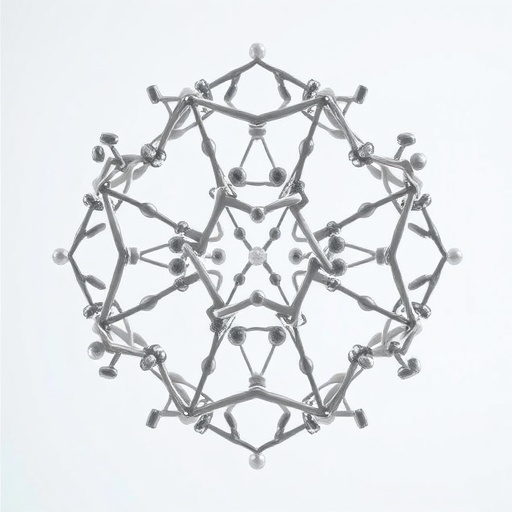
In a striking leap forward at the intersection of nanotechnology and molecular biology, researchers have successfully engineered two-component, quasisymmetric protein cages through computational design, mimicking the architectural marvels of viral capsids. Traditional viral capsids, known for their icosahedral symmetry, assemble via the repetitive arrangement of pentagons and hexagons. However, these biological structures achieve size versatility by adopting quasisymmetry, where identical protein subunits assume different conformations in non-equivalent positions to tessellate these shapes. Recapitulating such complexity outside of nature has long been a formidable challenge.
The innovative approach, detailed by Wang et al., embraces the concept of geometric frustration as a foundational strategy. Geometric frustration pertains to the inherent incompatibility between local packing preferences and global symmetry constraints, a principle cleverly harnessed by the researchers to drive the assembly of curvaceous cages beyond the strict limits of classical icosahedral symmetry. By designing complementary protein components—specifically trimeric and dimeric units—that preferentially form positively curved hexagonal networks, the team overcame the intrinsic barrier faced by hexagonal lattices, which cannot tile spherical surfaces alone without introducing curvature-inducing defects.
These defects manifest as pentagonal disclinations within the hexagonal lattice and are crucial for closing the structure into a contiguous spherical-like coat, reminiscent of viral capsid formation but with customizability engineered into the system. Unlike the natural viruses that rely on quasisymmetric folding imposed by evolutionary constraints, these designed cages offer tunable dimensions governed by the curvature encoded into the dimeric components. This control enables the creation of structures with diameters spanning from approximately 40 nanometers up to over 200 nanometers, corresponding to molecular weights stretching from 2 million to beyond 50 million Daltons, a size range on par with some of the largest natural virus capsids.
High-resolution electron microscopy provided compelling evidence of the cages’ architecture, clearly highlighting the presence of these pentagonal defects integrated among hexagonal patches to enable spherical closure. Such observations not only validate the design rationale but also open the door to the rational blueprinting of molecular assemblies with tailored aesthetics and functional parameters. The structural flexibility achieved here signals a powerful new paradigm whereby synthetic protein architectures can rival the intricate precision and size scalability of evolved biological systems.
Beyond mere structural curiosity, the researchers expanded the utility of these cages by functionalizing them with additional protein domains, enhancing their capacity for molecular cargo handling. Specifically, the cages were adapted to load ribonucleoprotein cargoes, thereby demonstrating their potential as vehicles for delivering biologically active macromolecules intracellularly. This functionalization hints at broad applicability in the fields of therapeutic delivery and synthetic biology.
Taking it a step further, these protein assemblies were expressed within mammalian cells and fluorescently labeled, enabling live-cell visualization of their behavior. Utilizing these scaffolded cages as rheological probes afforded a unique window into the cytoplasmic milieu, allowing for a systematic exploration of how particle size impacts diffusion dynamics and protein localization inside living cells. Such intracellular studies underscore the intrinsic value of these synthetic cages as investigative tools, providing new quantitative insights into cellular biophysics.
The modular nature of the design permits not only customization of size but also surface chemistry and reactivity, suggesting future iterations could be tailored for specific biomedical or biotechnological missions. For example, altering the cage exterior with targeted ligands or stealth coatings could optimize interactions with cells or immune systems for therapeutic delivery. There is also intriguing potential for these assemblies to serve as nanoreactors or scaffolds for enzymatic cascades by virtue of their large interior volumes and programmable interfaces.
Crucially, this work bridges a significant technological gap by demonstrating that quasisymmetry—a concept once confined to natural protein assemblies—can now be harnessed in synthetic systems by integrating principles of geometric frustration with state-of-the-art computational protein design. The computational pipeline used enables the fine-tuning of component geometries and interaction interfaces to achieve the desired curvature and assembly outcomes, marking a milestone in de novo biomolecular engineering.
This achievement also advances understanding of symmetry-breaking mechanisms in protein assemblies, shedding light on how local structural variations can be orchestrated to yield functional diversity. By leveraging symmetry mismatches and defects rather than viewing them as imperfections, the study shifts the perspective on nanoscale design, embracing controlled frustration as a tool rather than a hurdle.
From a practical standpoint, these quasisymmetric protein cages represent a new class of biomaterials that combine the robustness of natural viral capsids with the design freedom afforded by computational methods. Their customizable size and function, coupled with biocompatibility, unlocks numerous possibilities in drug delivery, vaccination platforms, imaging agents, and synthetic organelles.
In summary, the work by Wang and colleagues pioneers the first de novo construction of quasisymmetric two-component protein cages, employing a clever strategy rooted in geometric frustration to surpass traditional size and symmetry limitations. This research not only expands fundamental understanding of protein assembly principles but also sets the stage for wide-ranging applications in nanomedicine and molecular cell biology, illustrating the transformative power of merging computational design with biomolecular engineering.
Cite Scienmag News
Denise Maddox. (May 21, 2026). De Novo Design of Quasisymmetric Protein Cages. Scienmag. https://scienmag.com/de-novo-design-of-quasisymmetric-protein-cages/
Denise Maddox. "De Novo Design of Quasisymmetric Protein Cages." Scienmag, 21 May 2026, https://scienmag.com/de-novo-design-of-quasisymmetric-protein-cages/. Accessed 3 September 2026.
Denise Maddox. "De Novo Design of Quasisymmetric Protein Cages." Scienmag. May 21, 2026. https://scienmag.com/de-novo-design-of-quasisymmetric-protein-cages/


