


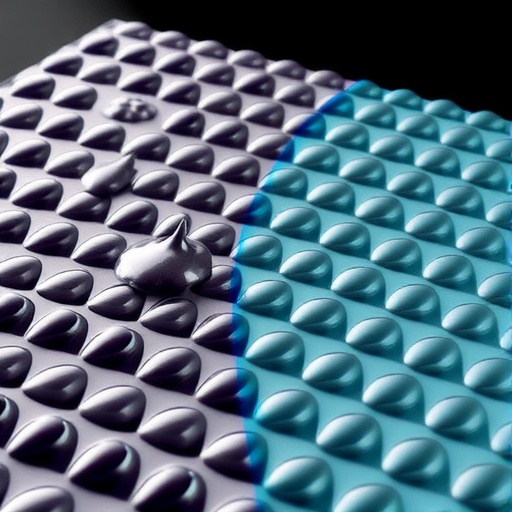
A groundbreaking discovery by researchers at the National Institute for Materials Science (NIMS) promises to revolutionize our fundamental understanding of liquid wetting on solid surfaces. For over two centuries, it was believed that a single wetting state — whether a droplet adheres firmly or rolls off — is uniquely dictated by the chemical nature of the solid and liquid involved. This new research defies that long-standing paradigm by demonstrating, for the first time, that droplets can simultaneously exhibit two distinct wetting states—sticky and repellent—on the exact same smooth, non-textured surface.
Wetting, the phenomenon describing how a liquid interacts with and spreads on a solid surface, profoundly impacts natural processes and numerous industrial applications, from inkjet printing to coatings and microfluidics. The classical framework established by Thomas Young in 1805 postulated a deterministic relationship between surface chemistry and droplet behavior. His equation mathematically linked contact angles to surface tensions, asserting that the wetting state was a fixed characteristic of the material pairing. Now, NIMS researchers challenge this orthodoxy with compelling empirical evidence of bistability—droplets existing concurrently in repellent and sticky states on a single, unpatterned surface.
This bimodal wetting arises from a novel molecular design approach focused on the interfacial chemistry involving hydrogen bonds. The research team ingeniously engineered the solid surface to present precisely controlled “molecular hands,” formed by specific hydrogen bond sites, that mediate interactions between the substrate, the oil environment, and water droplets. By delicately balancing these molecular interactions, the same substrate-oil pairing exhibits two dramatically different wetting states depending solely on the sequence of droplet deposition and oil immersion. When the surface is first immersed in oil and then water droplets are applied, the droplets exhibit a repellent state, gliding off effortlessly. Conversely, casting water droplets onto the substrate before immersing it in oil yields droplets that adhere tenaciously in a sticky state.
Notably, this bistable wetting is not fixed. The team demonstrated that an external mechanical stimulus—the application of a shear stress parallel to the surface with a simple Teflon needle—can transform droplets from the sticky to the repellent state without altering the surface chemistry. This switching capability introduces a dynamic component to wettability control, potentially enabling on-demand tuning of liquid behavior for advanced functional surfaces.
These findings dethrone the century-old assumption that the wetting state is a static property dictated by material chemistry alone. Instead, the research elucidates a universal surface design principle leveraging interfacial molecular recognition and ordering to cultivate states of wetting that can branch and switch. The implications extend across science and industry, opening avenues to create durable, smart surfaces with tailored liquid affinity that respond dynamically to environmental or mechanical cues.
Crucially, this approach circumvents reliance on per- and poly-fluoroalkyl substances (PFAS), known for their environmental persistence and toxicity, which have traditionally been used to engineer superhydrophobic, repellent surfaces. By utilizing non-fluorinated chemistry and smooth, non-textured substrates, the method promises environmentally friendly wettability control while maintaining mechanical robustness. Unlike microtextured surfaces prone to abrasion and fouling, the smooth substrates maintain functionality after prolonged use and stress exposure, marking a significant advance in surface engineering durability.
The fundamental insight centers on the molecular interplay at the solid-liquid-oil interface. Hydrogen bonding sites act as controllable anchors, or “hands,” that modulate surface affinity by forming or breaking binding interactions dynamically. This molecular-level tuning imparts bistability and switchability to the macroscopic droplet behavior, bridging nanoscale chemistry and macroscale material properties in an unprecedented manner. Such a mechanism offers a blueprint for creating “smart” surfaces capable of precisely modulating liquid adhesion in a reversible and stimulus-responsive fashion.
Potential applications are expansive and transformative. The ability to rapidly switch between wetting states without irreversible chemical modification could enable innovative microfluidic devices with programmable droplet transport and mixing. Industrial coatings may become self-cleaning or anti-fouling on demand. Medical diagnostics and lab-on-chip technologies could leverage these surfaces to manipulate minute volumes of fluids with unprecedented precision and control. Furthermore, reducing dependence on environmentally harmful fluorochemicals aligns with global sustainability goals.
This research also challenges and expands the theoretical foundations of interfacial science. The experimental observation of concurrent wetting bifurcation on identical substrates under identical chemical conditions suggests that factors beyond equilibrium surface energies—such as molecular configuration history and mechanical stimuli—play vital roles in wetting state determination. This insight invites a reevaluation of wetting models and motivates development of dynamic, multi-state frameworks that incorporate molecular kinetics and external perturbations.
The team’s meticulous experimental design allowed direct observation of the coexistent states, capturing droplet behavior via high-resolution imaging combined with controlled sequential immersion protocols. Their approach underscores the importance of experimental nuance and molecular-scale surface engineering in unlocking new interfacial phenomena. The publication of these findings online in Advanced Materials Interfaces on April 2, 2026, marks a watershed moment in materials science.
In summary, the NIMS discovery opens an entirely new chapter in wettability science: smooth surfaces with engineered molecular “hands” that enable droplets to exist in bistable sticky and repellent states, switchable by external mechanical forces. This paradigm shift overturns classical doctrine, heralds green engineering alternatives to fluorinated repellents, and lays the groundwork for smart liquid manipulation technologies with far-reaching impact across science and industry.
Cite Scienmag News
Neil Sanderson. (May 20, 2026). Breaking a 200-Year-Old Belief: Novel Surface Design Achieves Two Distinct Wetting States on One Substrate. Scienmag. https://scienmag.com/breaking-a-200-year-old-belief-novel-surface-design-achieves-two-distinct-wetting-states-on-one-substrate/
Neil Sanderson. "Breaking a 200-Year-Old Belief: Novel Surface Design Achieves Two Distinct Wetting States on One Substrate." Scienmag, 20 May 2026, https://scienmag.com/breaking-a-200-year-old-belief-novel-surface-design-achieves-two-distinct-wetting-states-on-one-substrate/. Accessed 3 September 2026.
Neil Sanderson. "Breaking a 200-Year-Old Belief: Novel Surface Design Achieves Two Distinct Wetting States on One Substrate." Scienmag. May 20, 2026. https://scienmag.com/breaking-a-200-year-old-belief-novel-surface-design-achieves-two-distinct-wetting-states-on-one-substrate/


