


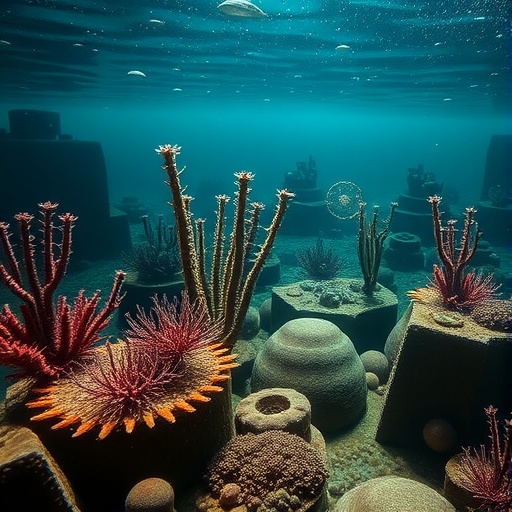
From the towering peaks of mountain ranges to the unfathomable depths of the ocean, Earth’s biosphere showcases an immense diversity of life. Central to this vitality are eukaryotes—organisms whose cells harbor a nucleus encased in membranes and a suite of intricate organelles like mitochondria. These lifeforms encompass nearly all multicellular organisms visible in our environment today, including animals, plants, and fungi. Yet, despite their overwhelming presence, the evolutionary origins and early ecological niches of eukaryotes remain subjects of intense scientific inquiry. Recently, a collaborative team of researchers from the University of California, Santa Barbara (UCSB) and McGill University has shed new light on our earliest eukaryotic ancestors, revealing surprising aspects about their lifestyles, habitats, and biochemical requirements that overturn longstanding scientific assumptions.
The study, published in the highly regarded journal Nature, provides compelling evidence that the earliest known eukaryotes were dependent on oxygen for their energy metabolism—a finding that not only refines our understanding of ancestral eukaryote physiology but also redefines their ecological setting. Co-lead author Leigh Anne Riedman, a paleontologist at UCSB, emphasized that these ancient organisms were predominantly benthic, inhabiting oxygenated environments on or within the ancient seafloor rather than freely floating in the water column as had been traditionally assumed. This conclusion was reached by meticulously analyzing microfossils from sediment cores in Australia’s McArthur and Birrindudu basins, the oldest known repositories of well-preserved eukaryote fossils.
Historically, life’s classification system has used Kingdom as a primary descriptor, grouping animals, plants, and fungi under Eukarya, a domain characterized by cellular complexity. Possessing mitochondria, membrane-bound organelles, and nuclear DNA packaged within a membrane-enclosed nucleus defines these lifeforms. The intricate categorization belies the true complexity of biology, which continuously challenges rigid taxonomies. Initial hypotheses in the early 2000s suggested that these primordial eukaryotes, many of which were microscopic and single-celled, inhabited the photic zone of ancient seas, drifting as plankton. They were also believed to universally possess mitochondria and rely on oxygen for respiration. However, some scientists, including senior author Susannah Porter of UCSB’s Earth Science Department, began questioning whether these features were truly universal at such an ancient stage. Their earlier work suggested the intriguing possibility that some early eukaryotes predated the acquisition of mitochondria or oxygen-dependent respiration.
The UCSB-McGill team combined paleontological data with detailed sedimentological and geochemical analyses to investigate whether these putative early eukaryotes indeed used oxygen for energy conversion. Their strategy centered on reconstructing the depositional environments represented in ancient rock layers, linking the presence of specific fossil taxa to variables like oxygen concentration and sediment type. The McArthur and Birrindudu basins—currently characterized by dry outback and savanna landscapes punctuated by lush wetlands—were shallow inland seas ranging from lagoons to offshore mudflats between 1.75 and 1.4 billion years ago. This timeframe corresponds to a critical period when oxygen levels in Earth’s oceans were rising but still highly heterogeneous, with atmospheric oxygen concentrations less than one percent of today’s levels. “Atmospheric levels would have been insufficient to support human respiration,” Porter remarked, underscoring the challenging conditions early eukaryotes faced.
Microfossils extracted from drilled core material were taxonomically sorted by Riedman, who identified key eukaryote lineages in the assemblages. Simultaneously, Max Lechte and Galen Halverson of McGill University characterized sedimentological frameworks and environmental conditions respective to each fossil layer to delineate habitat types such as lagoons, tidal flats, coastal margins, and deeper offshore basins. Geochemical proxies played a central role, with mineralogical indicators revealing subtle redox gradients in these ancient marine environments. The presence of iron sulfide minerals like pyrite indicated oxygen-deficient conditions since oxygen would have otherwise oxidized sulfur species to sulfates. Trace metal concentrations of elements such as vanadium, molybdenum, and uranium—sensitive to redox state—offered additional evidence to reconstruct paleo-oxygen conditions with remarkable resolution.
Integrating taxonomy, sedimentology, and geochemistry, the team demonstrated a consistent pattern: these primitive eukaryotes thrived exclusively in environments with detectable oxygen levels in sediment porewaters. Remarkably, this oxygen dependency extended beyond shallow coastal zones into offshore sedimentary deposits that maintained oxygenated conditions. This restriction to oxygenated substrates suggests a benthic lifestyle, with early eukaryotes physically tethered to or inhabiting the sea floor. If they had been abundant in surface waters, their remains would likely appear in oxygen-poor sediments as well, yet this was not observed. Such spatial confinement signals that mitochondria-dependent aerobic metabolism was probably already established, as oxygen availability would have been crucial for efficient energy generation, supporting cellular complexity and diversification.
One of the more striking outcomes acknowledged by the authors is the surprising ecological confinement of early eukaryotes. “Why would organisms reliant on oxygen prefer the seafloor over the oxygen-rich surface waters?” Porter mused. The researchers hypothesize that environmental constraints or ecological competition might have delayed the transition into the water column, despite its abundant oxygen. This benthic origin is compelling when considering the fossil record’s enigmatic stagnation of eukaryote diversity for nearly a billion years. The same “cast of characters” dominants 1.7-billion and 800-million-year-old fossils, hinting that the restricted seafloor niche limited adaptive radiation and evolutionary innovation until environmental revolutions such as the Cryogenian “Snowball Earth” glaciations dramatically reshaped the planet.
The Cryogenian glaciations around 720 million years ago introduced pervasive ice coverage, triggering mass extinction events and creating vacant ecological niches. These post-glacial opportunities may have catalyzed the explosive diversification of eukaryotes during the subsequent Ediacaran period, eventually leading to the emergence of complex multicellular organisms. The researchers’ findings underscore that the earliest eukaryotes’ deep evolutionary roots and survival in limited environments foretold later biological complexities that paved the way for all multicellular life forms, including humans.
Furthermore, the geographic association between early eukaryotes and oxygenated sediments lends support to the hypothesis that mitochondria were acquired very early in eukaryotic evolution. These energy-generating organelles originated from a symbiotic relationship between an ancestral eukaryotic cell and aerobic bacteria. Living on or near the seafloor would have placed these ancestral eukaryotes in intimate proximity with microbial communities, facilitating such endosymbiotic events. Intriguingly, fossil morphologies from the McArthur and Birrindudu basins display complex structural features consistent with this advanced cellular machinery, implying sophistication long before eukaryotes ventured beyond benthic habitats.
Despite the relatively low absolute diversity of early eukaryotes, their considerable morphological variety suggests a deep evolutionary history preceding these fossils. This complexity challenges simplistic linear models of eukaryotic evolution and stimulates ongoing inquiries into when and how eukaryotes first acquired defining features like mitochondria and nuclear membranes. Porter, Riedman, and colleagues are now studying microfossils from even older geological layers in both Australian and North American basins, seeking to pierce deeper into the eukaryotic origin story. These investigations hold promise for untangling the molecular and ecological processes that ushered in the eukaryotic domain, laying the foundations for the incredible biodiversity observed today.
This research is supported by major grants from the Simons Foundation and Gordon and Betty Moore Foundation, alongside NASA’s Exobiology program, reflecting its interdisciplinary importance at the intersection of evolutionary biology, paleontology, and exobiology. As Riedman eloquently summarized, studies like this transcend taxonomy and static classification—offering a dynamic window into the lives of microorganisms from Earth’s distant past. By reconstructing their habitats, metabolic strategies, and interactions, scientists can piece together the monumental evolutionary saga culminating in today’s vibrant ecosystems and, ultimately, our own biological heritage.
Cite Scienmag News
Gavin Prescott. (May 20, 2026). Early Complex Life Thrived on Oxygen-Rich Seafloors for Hundreds of Millions of Years. Scienmag. https://scienmag.com/early-complex-life-thrived-on-oxygen-rich-seafloors-for-hundreds-of-millions-of-years/
Gavin Prescott. "Early Complex Life Thrived on Oxygen-Rich Seafloors for Hundreds of Millions of Years." Scienmag, 20 May 2026, https://scienmag.com/early-complex-life-thrived-on-oxygen-rich-seafloors-for-hundreds-of-millions-of-years/. Accessed 4 September 2026.
Gavin Prescott. "Early Complex Life Thrived on Oxygen-Rich Seafloors for Hundreds of Millions of Years." Scienmag. May 20, 2026. https://scienmag.com/early-complex-life-thrived-on-oxygen-rich-seafloors-for-hundreds-of-millions-of-years/


