


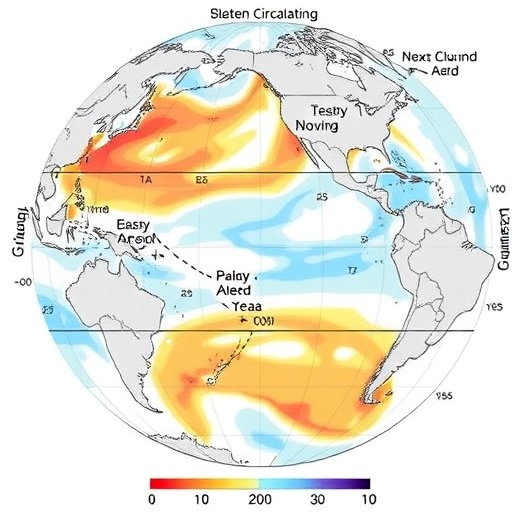
In a groundbreaking study published in Nature Communications, researchers Guo, Hu, Meehl, and their colleagues have unveiled compelling evidence that shifts in ocean circulation significantly drive the migration of the Intertropical Convergence Zone (ITCZ). This discovery holds profound implications for our understanding of tropical climate dynamics and offers fresh insights into how global weather patterns may evolve amidst ongoing climatic changes.
The ITCZ, often described as the planet’s “rain belt,” is a critical atmospheric feature near the equator where trade winds converge, generating intense thunderstorms and driving the global hydrological cycle. Its position fluctuates seasonally, influencing rainfall and temperature patterns over vast regions, thereby impacting millions of people, especially those reliant on consistent monsoons for agriculture and water resources.
For decades, the primary focus has been on atmospheric processes to explain the ITCZ’s movements. However, Guo and colleagues’ research disrupts this paradigm by rigorously demonstrating the dominant role that changes in ocean circulation play in shifting the ITCZ’s longitudinal and latitudinal position. Utilizing advanced climate models coupled with observational data, their work reveals a complex interaction between oceanic and atmospheric systems that jointly dictate this tropical convergence band’s location.
The study emphasizes that large-scale ocean circulation patterns — particularly those associated with the Atlantic Meridional Overturning Circulation (AMOC) and Pacific Ocean gyres — create asymmetries in sea surface temperature (SST) distributions. These asymmetries, in turn, generate differential heating, which modifies atmospheric pressure gradients and ultimately steer the ITCZ’s trajectory. This process acts as a powerful feedback loop, where ocean currents regulate atmospheric convection zones and climatic zones adjust their positioning accordingly.
Using state-of-the-art Earth system models capable of simulating deep ocean and atmospheric processes simultaneously, the researchers were able to isolate the effects of altered ocean circulation on the ITCZ from other climatic variables. They introduced perturbations in oceanic parameters within the models and observed consequent shifts in ITCZ placement. Their results consistently showed that a slowdown or reorganization of ocean currents corresponds with a marked displacement of the convergence zone.
Importantly, the study highlights that the hemispheric asymmetry in ocean temperatures—often arising from anthropogenic climate influences or natural variability—plays a decisive role. When the northern hemisphere ocean circulation weakens, leading to cooling, the ITCZ tends to migrate southward, while the opposite occurs when southern hemisphere circulation diminishes. This asymmetric response underscores the sensitivity of tropical climate systems to ocean circulation dynamics.
Another crucial insight from this research pertains to how future climate scenarios might shape tropical weather extremes. The ITCZ’s shift changes precipitation patterns, potentially leading to prolonged droughts or intensified flooding in vulnerable tropical zones. This has significant implications for agriculture-dependent economies and regions already stressed by climate variability.
By explicating the ocean circulation’s influence on the ITCZ movement, the study enhances predictive capabilities regarding seasonal rainfall variability across the tropics. Enhanced prediction models can better forecast monsoon onset and duration, which are vital for water resource management, disaster preparedness, and food security in numerous equatorial nations.
Furthermore, this research opens avenues for exploring feedback mechanisms between ocean circulation changes and atmospheric carbon fluxes. Since the ITCZ influences tropical rainforest distribution and ocean carbon uptake, its migration could affect global carbon cycles and climate regulation.
The methodology employed by Guo and colleagues integrates observational datasets, including satellite-measured SSTs and in-situ ocean current velocities, with meticulously calibrated climate simulations. This fusion of empirical and theoretical approaches equips the research with robustness rarely seen in analogous climate studies.
Recognition of ocean circulation’s role also calls for more comprehensive monitoring of ocean dynamics in climate observation programs. Current observation networks and modeling frameworks need to prioritize ocean-atmosphere coupling phenomena to refine predictions of tropical climate variability.
In addition to emphasizing oceanic importance, the team draws attention to the need for interdisciplinary climate research that bridges meteorology, oceanography, and climatology. Such collaborations will be instrumental in identifying processes that can either exacerbate or mitigate the impacts of anthropogenic climate change, especially concerning tropical rainfall and extreme weather events.
This study not only alters our foundational understanding of atmospheric convergence zones but also sets the stage for reassessing climate intervention strategies. For instance, geoengineering efforts aimed at modifying ocean circulation or cloud feedbacks must consider their potential to unintentionally shift the ITCZ, threatening ecological and human systems dependent on its current positioning.
Moreover, the findings raise awareness about the delicate balance sustaining tropical climate stability. Even modest disruptions in ocean current patterns, whether from natural decadal oscillations or human-induced warming, might trigger substantial climatic repercussions by displacing the ITCZ.
Looking ahead, the researchers advocate for expanding model resolution and incorporating biogeochemical components to further unravel feedback complexities within the coupled ocean-atmosphere system. Such enhancements will enable more precise scenario planning and risk assessment related to tropical rainfall extremes.
In conclusion, Guo, Hu, Meehl, and their team’s pioneering work spotlights the vital, yet previously underappreciated, role of ocean circulation in controlling the ITCZ’s migratory behavior. Their insights enrich not only academic discourse but also practical climate resilience planning, underscoring the interconnectedness of Earth’s oceanic and atmospheric processes in shaping our climate future.
Guo, Y., Hu, A., Meehl, G.A. et al. Migration of the intertropical convergence zone driven by ocean circulation changes.
Nat Commun (2026). https://doi.org/10.1038/s41467-026-73200-2
Cite Scienmag News
Violet Maxwell. (May 18, 2026). Intertropical Convergence Zone Shifts Due to Ocean Circulation. Scienmag. https://scienmag.com/intertropical-convergence-zone-shifts-due-to-ocean-circulation/
Violet Maxwell. "Intertropical Convergence Zone Shifts Due to Ocean Circulation." Scienmag, 18 May 2026, https://scienmag.com/intertropical-convergence-zone-shifts-due-to-ocean-circulation/. Accessed 4 September 2026.
Violet Maxwell. "Intertropical Convergence Zone Shifts Due to Ocean Circulation." Scienmag. May 18, 2026. https://scienmag.com/intertropical-convergence-zone-shifts-due-to-ocean-circulation/


