


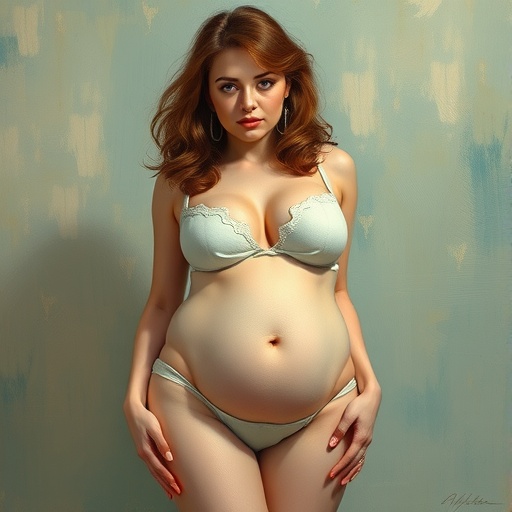
Throughout history, human perceptions of beauty have not been static; they have fluctuated according to cultural, social, and economic forces that shape societies. A fascinating new study published in the International Journal of Obesity delves into this dynamic by quantifying the body mass index (BMI) of female figures depicted in Impressionist paintings and contrasting these findings with contemporary beauty standards, which currently favor thinness. The research undertakes a methodical, technical approach to re-evaluate how artistic representations from the late 19th and early 20th centuries offer a counter-narrative to modern aesthetics.
The Impressionist movement, which flourished between approximately 1870 and 1900, is renowned for its innovative techniques and novel representations of everyday life. However, beyond their stylistic significance, Impressionist paintings also serve as visual historical records reflecting societal norms, including perceptions of female beauty. This study employs advanced image analysis techniques to estimate BMI from artwork, an approach unprecedented in its rigor and specificity, thus bridging art history with quantitative health metrics.
Researchers meticulously analyzed a selection of famous Impressionist portraits by artists such as Renoir, Degas, and Morisot. Using digital anthropometry, they assessed the proportional dimensions of the painted female figures, applying anatomical landmarks and calibrated image scaling to estimate weight-to-height ratios. This innovative methodology enabled a more objective analysis that transcends subjective artistic interpretation, provided that the inherent stylization by painters was accounted for through rigorous cross-validation with historical data.
The data reveal that the average BMI of women portrayed in Impressionist works falls within the range that modern medicine would classify as overweight or even mildly obese. This finding starkly contradicts the slender ideal pervasive in today’s media and fashion industries, which promote a BMI often below 18.5 as desirable. The historical preference, as illuminated by these paintings, indicates an era where fuller body types signified health, fertility, and social prosperity—a critical insight into how socio-economic context influences beauty ideals.
Modern ideals, shaped heavily by media exposure and digital culture, emphasize thinness to an unprecedented degree. This shift has far-reaching consequences on body image perception, psychological health, and eating behaviors worldwide. The study’s juxtaposition of past and present BMI representations serves not only as an academic exercise but also as a cultural commentary. It challenges the viewer to reconsider contemporary beauty norms through the lens of historical variability.
From a technical perspective, the research deploys computational algorithms calibrated against empirical anthropometric datasets to improve accuracy in BMI estimation from two-dimensional art. This interdisciplinary collaboration between art historians, data scientists, and medical experts represents a methodological advance that could open new research avenues in visual sociology and digital humanities.
Moreover, the findings imply that the artistic canon, often interpreted through a purely aesthetic or cultural framework, can also function as a quantitative repository of public health data from the past. This interdisciplinary approach underscores the potential for art to contribute to scientific discourse, particularly in understanding the evolution of health standards and body image over time.
Importantly, the study addresses potential confounders, such as the possibility of idealization or exaggeration by artists, by comparing multiple works across different painters and geographic regions. This methodological caution ensures that the results do not merely reflect stylistic conventions but instead capture genuine historical trends in body representation.
The implications of this research extend beyond academic curiosity. As societies grapple with rising rates of eating disorders and body dysmorphia, understanding the historical fluidity of beauty ideals could inform public health campaigns and social policies aimed at promoting healthier body images and psychological well-being.
Psychologists and sociologists may find this research a compelling case study in the cultural construction of body ideals, emphasizing that beauty is not a fixed biological truth but rather an evolving social construct. Consequently, interventions to address body dissatisfaction could benefit from incorporating historical context to deconstruct harmful stereotypes perpetuated by modern media.
The technological aspect of this study also holds promise for future investigations. Machine learning techniques could be refined to automate BMI estimation across vast digital archives of visual art, enabling more extensive temporal and cultural analyses. Such advancements would significantly enhance our understanding of not only beauty standards but also the intersection of art, health, and societal values.
Furthermore, this study stimulates an important dialogue on the ethical dimensions of body image promotion through art and media. By highlighting the acceptance and even celebration of fuller figures in past eras, it questions the current cultural obsession with extreme thinness and its associated health risks.
In conclusion, the research published by Messina, Saturnino, and Pozzilli represents a groundbreaking convergence of art history, biomedical science, and digital image processing. By quantifying the BMI of female figures in Impressionist paintings, it provides empirical evidence that beauty standards have not only changed but have done so in ways that challenge modern prejudices. This work underscores the necessity of historical perspective in understanding and potentially reshaping contemporary ideals around the human body.
As society continues to wrestle with issues of body image and self-esteem, studies like this underscore the importance of revisiting and reevaluating past representations to foster a more inclusive and healthier view of beauty. The Impressionists, in their celebration of everyday life and its diverse forms, remind us that the human body, in all its variations, has always been a canvas for cultural expression, reflection, and, ultimately, reinterpretation.
Cite Scienmag News
Ophelia Keating. (May 18, 2026). Female Body Mass in Impressionism vs. Modern Ideals. Scienmag. https://scienmag.com/female-body-mass-in-impressionism-vs-modern-ideals/
Ophelia Keating. "Female Body Mass in Impressionism vs. Modern Ideals." Scienmag, 18 May 2026, https://scienmag.com/female-body-mass-in-impressionism-vs-modern-ideals/. Accessed 3 September 2026.
Ophelia Keating. "Female Body Mass in Impressionism vs. Modern Ideals." Scienmag. May 18, 2026. https://scienmag.com/female-body-mass-in-impressionism-vs-modern-ideals/


