


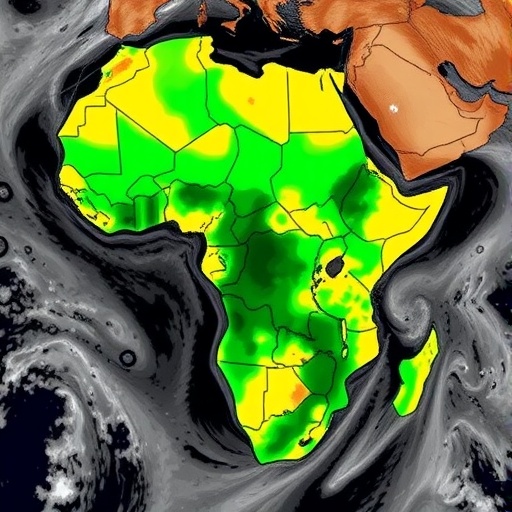
In a groundbreaking study set to reshape our understanding of climate extremes across the African continent, researchers Akinsanola, Taguela, and Bobde have unveiled robust evidence highlighting the intensification of regional precipitation extremes projected for Africa. Published in Nature Communications in 2026, this research not only advances climate science but also signals urgent implications for environmental planning, disaster preparedness, and socio-economic resilience in a region that is especially vulnerable to climatic fluctuations.
Africa, with its vast and diverse climatic zones—from arid deserts to lush tropical forests—has historically exhibited complex precipitation patterns influenced by numerous climatic drivers. However, despite the continent’s climatic heterogeneity, the intensification of precipitation extremes poses a unifying threat, exacerbated by anthropogenic climate change. Akinsanola and colleagues delve deep into this intricacy, deploying state-of-the-art climate models and rigorous statistical frameworks to project the evolution of extreme rainfall events across different African regions throughout the 21st century.
The core of this investigation lies in the robust identification of trends and magnitudes of extreme precipitation events, which are expected to increase both in frequency and intensity in many sub-regions of Africa. Utilizing ensembles of high-resolution regional climate models, the researchers circumvent common pitfalls related to model biases and spatial resolution limitations that typically undermine projections in climate science. Their approach ensures a higher confidence level in quantifying extremes, an aspect critical for translating scientific forecasts into actionable policy.
One of the pivotal technical insights presented in this paper is the differentiation between climatological drivers influencing regional precipitation. The study meticulously parses out the contributions of global warming-induced changes in thermodynamic conditions—such as atmospheric moisture content—from those driven by alterations in circulation patterns and local feedback mechanisms. This nuanced separation allows for a better grasp of the fundamental physical processes underpinning the intensification trends, a scientific leap beyond general attribution studies.
Significantly, the authors highlight that the amplifications in precipitation extremes are not uniform across Africa. West Africa, for instance, is projected to witness pronounced increases in the intensity and frequency of heavy rainfall events, a phenomenon tied closely to shifts in the West African monsoon system and enhanced moisture convergence. Conversely, parts of Southern Africa reveal a different climatological response, where dynamic changes and local feedbacks interplay to produce distinct patterns of precipitation extremes, underscoring the regional specificity critical for localized climate adaptation strategies.
The application of bias correction techniques and evaluation against observational datasets further strengthens the reliability of the projections. The researchers validate model outputs by comparing historical simulations of extreme precipitation with observed records derived from satellite and ground-based measurement systems. This meticulous cross-validation process ensures that the projected future scenarios rest on a foundation of accurate historical performance, lending credibility to the forecasted amplification trends of extreme rainfall events.
From a methodological perspective, the integration of multiple global climate model outputs downscaled via regional climate modeling frameworks emerges as a highlight of the study. This multi-model, multi-scenario ensemble approach accounts for inherent uncertainties in climate projections, enabling an assessment of the robustness of trends. The quantification of uncertainty is indispensable for stakeholders and policymakers as they deliberate over contingency planning and infrastructural investments in flood-prone regions.
Importantly, the study explores the implications of intensified precipitation extremes beyond climatology, venturing into hydrological impacts. The researchers demonstrate that increases in extreme rainfall will likely trigger exacerbated flood risks, soil erosion, and degradation of water quality. The overarching environmental consequences cascade further into socio-economic realms, threatening agriculture-dependent communities, urban centers with inadequate drainage infrastructures, and biodiversity reliant on stable hydrological regimes.
A notable scientific advancement in this work is the effort to link projected precipitation extremes with large-scale atmospheric teleconnections and oceanic forcing mechanisms. By examining the influence of phenomena such as the Atlantic Multidecadal Oscillation and the Indian Ocean Dipole on precipitation variability, the authors provide a holistic understanding of potential modulators of African rainfall extremes under changing climate conditions. This integrated approach is vital for improving seasonal to decadal prediction frameworks.
Moreover, the authors emphasize the urgency of these findings in the context of the continent’s increasing population, urbanization, and food security challenges. Intensified rainfall extremes complicate water management, exacerbate flood hazards, and disrupt seasonal agricultural cycles. Hence, this study serves as a clarion call for investment in climate-resilient infrastructure, early warning systems, and adaptive governance frameworks designed to mitigate the multifaceted vulnerabilities that arise from shifting precipitation regimes.
The study’s projections, extending into the late 21st century, underscore the pathway-dependence of precipitation extremes on future greenhouse gas emission scenarios. Under high-emission trajectories, intensification of extremes is more pronounced, whereas mitigation efforts limiting warming may reduce the severity and frequency to some extent. This critical linkage illustrates the tangible benefits of climate action and bolsters calls for global cooperation to curb emissions.
Looking forward, Akinsanola, Taguela, and Bobde recommend that further research endeavors incorporate socio-economic data and downscaled hydrological models to enhance the granularity of impact assessments. They also advocate for enhanced observational networks across the continent to improve the real-time monitoring of precipitation extremes and to better calibrate climate models, a necessity made evident by the inherent challenges posed by data-scarce environments.
In summary, this seminal 2026 Nature Communications publication is a tour de force in African climate science, effectively synthesizing complex model projections, observational data, and physical climate dynamics. Its detailed exposition of the robust intensification of regional precipitation extremes across Africa not only augments scientific comprehension but also acts as a pivotal resource for governments, NGOs, and international agencies aiming to safeguard vulnerable populations and ecosystems against an increasingly volatile climate future.
By delivering robust, high-confidence evidence of the impending escalation in extreme rainfall, the study sets a new benchmark for climate impact research on the continent. It exemplifies how cutting-edge scientific inquiry, when meticulously designed and executed, can provide invaluable foresight into the multifaceted challenges posed by climate change, thereby informing the development of more resilient societies equipped to face the uncertainty of our warming world.
Cite Scienmag News
Violet Maxwell. (May 16, 2026). Africa’s Regional Rainfall Extremes Set to Surge. Scienmag. https://scienmag.com/africas-regional-rainfall-extremes-set-to-surge/
Violet Maxwell. "Africa’s Regional Rainfall Extremes Set to Surge." Scienmag, 16 May 2026, https://scienmag.com/africas-regional-rainfall-extremes-set-to-surge/. Accessed 3 September 2026.
Violet Maxwell. "Africa’s Regional Rainfall Extremes Set to Surge." Scienmag. May 16, 2026. https://scienmag.com/africas-regional-rainfall-extremes-set-to-surge/


