


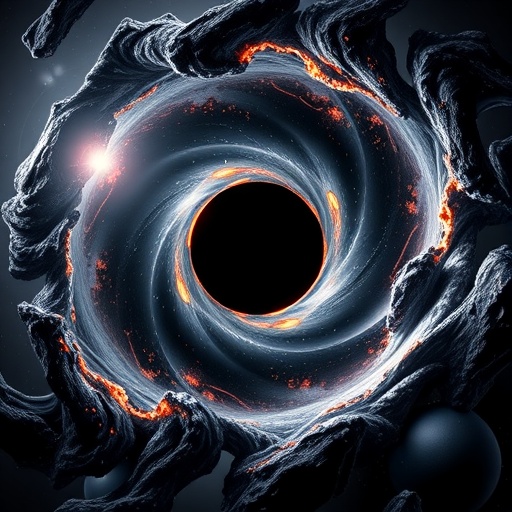
The immense gravitational pull of black holes is known to warp spacetime so drastically that even light cannot escape from their grasp. This extraordinary feature of black holes not only produces the iconic event horizon silhouette but also bends and deflects light rays in complex ways. Researchers have long studied how light behaves near black holes to unlock the secrets of these enigmatic objects. A groundbreaking new study has taken this endeavor to a compelling new frontier by investigating subtle correlations in the light emanating from near a black hole, revealing fresh ways to probe extreme gravitational lensing effects that occur in these cosmic titans.
Black holes’ gravity is so intense that it can deflect passing photons by arbitrary large angles, effectively turning spacetime around them into a natural, extreme gravitational lens. Any fluctuations in light emission close to the black hole do not appear as singular events; instead, they manifest as multiple echoing images that arrive with slight time delays as the light takes varied curved paths around the black hole’s warped environment. These light echoes create a complex phenomenology in the observed brightness fluctuations when viewed as a time-dependent sequence, akin to a cinematic movie of the black hole’s neighborhood.
Traditional observational approaches often focus on time-averaged images or integrated light curves from black hole accretion flows. However, these methods mask the intricate patterns hidden in the timing and spatial distribution of light variations caused by gravitational lensing. The team behind this novel research proposed leveraging a two-point image correlation function applied to time-resolved movies of black hole emissions to untangle these effects. This correlation function quantifies the relationships between brightness fluctuations at different points in space and time, potentially revealing underlying patterns uniquely dictated by general relativity.
To test this bold idea, the researchers employed state-of-the-art computer simulations that combine general relativistic magnetohydrodynamics (GRMHD) with sophisticated ray tracing techniques. These simulations generate time-dependent synthetic images—essentially virtual black hole movies—that capture realistic dynamics of matter and radiation in the intense gravity field near the event horizon. Using this simulated data allows them to explore theoretical predictions about gravitational lensing signatures in exquisite detail without observational constraints.
One of the critical challenges addressed was understanding how these exotic lensing signatures would appear at the finite angular resolution achievable by next-generation Earth-based very-long-baseline interferometric (VLBI) arrays. Such observational platforms, with planned upgrades, promise unprecedented capacity to image black holes with sharpness never before possible. When the researchers blurred their simulated movies to the resolution expected from these tools, traditional time-averaged metrics and autocorrelations of light curves failed to reveal the nuanced lensing features.
Remarkably, the two-point correlation function of brightness fluctuations uncovered these extreme gravitational lensing fingerprints clearly. This approach exploits the full spatiotemporal richness of the movie data, sensitive to subtle time delays and spatial shifts in light echoes produced by multiple light paths around the black hole. The correlation patterns extracted provide a promising new diagnostic, disentangling intricate source properties from the universal imprint of gravitational physics.
These findings represent a paradigm shift in observational black hole astrophysics. Instead of relying solely on static images or averaged signals, time-dependent correlation analyses unlock hidden information encoded in the complex dance of photons near the black hole’s event horizon. This has the potential to provide direct observational probes of general relativity in its most extreme, nonlinear regime where gravity curves light to dramatic extremes.
Looking forward, the study motivates extensive further work on refining instrument capabilities and data analysis frameworks to harness these correlation signals from real black hole observations. There is a need to quantify how instrumental noise, observational cadence, and partial sky coverage impact the detectability of such lensing imprints. Additionally, developing robust inference methods capable of isolating these correlation signatures amidst astrophysical variability poses an exciting challenge for the community.
The broader astrophysical implications extend beyond fundamental physics. By unveiling the microstructure of light propagation near black holes, these techniques may yield unprecedented insights into the plasma physics of accretion flows, jet formation, and the nature of turbulent emission processes operating in these exotic environments. The ability to diagnose strong gravity effects with such precision promises to transform black hole imaging into a nuanced science of spacetime dynamics.
This novel application of two-point correlation functions aligns strongly with the vision of next-generation interferometric observatories such as the Event Horizon Telescope (EHT) upgrades and the proposed next-generation EHT (ngEHT). These platforms aim to push spatial and temporal resolution boundaries, capturing black hole environments in unprecedented detail across the electromagnetic spectrum. The new method provides a clear observational signature to guide instrument design and observational strategies.
In a broader context, this research spotlights the growing synergy between intensive numerical simulations and cutting-edge telescopes in modern astrophysics. With the advent of powerful computational capabilities, researchers can now create “virtual universes” to develop and test novel observational methods that can then be applied to real data to extract fundamental physics. This interplay between theory, simulation, and observation is pushing the frontier of knowledge regarding the most extreme objects in our cosmos.
By correlating brightness fluctuations in simulated black hole movies, the study demonstrates that extreme lensing phenomena, once considered mostly theoretical curiosities, are within reach observationally. This heralds a new era where minute time-resolved features imprinted by gravitational bending of light will serve as powerful probes of strong-field gravity, enhancing our understanding of black holes and their immediate surroundings.
The approach also offers the tantalizing prospect of detecting multiple, lagged images of individual emission events, akin to gravitational wave detectors capturing subtle time delays from different spatial locations. Unraveling such time-delayed echoes could provide unique tests of general relativistic predictions, including the structure of photon rings and the nature of spacetime curvature near the horizon.
Ultimately, these research advancements underscore the potential for black hole movies to evolve into multidimensional information reservoirs. Rather than static snapshots or averaged brightness measures, analyzing fluctuations across space and time in black hole emission creates a richer, more detailed view of these extreme objects. As observational capabilities continue to improve, methodologies based on correlated images promise to open new windows onto the fundamental physics of gravity and matter under the most extreme conditions.
In summary, this pioneering theoretical work demonstrates the feasibility of detecting extreme gravitational lensing effects through two-point correlation functions applied to simulated black hole movies. Given the rapid technological progress in black hole imaging, the prospects for realizing these ideas observationally are very high. These insights redefine how we can analyze and interpret the light streaming from the rims of black holes, turning them into dynamic laboratories for testing Einstein’s theory of gravity in its most extreme and fascinating manifestations.
Cite Scienmag News
Grant Pearson. (May 15, 2026). Extreme Lensing Unveiled in Simulated Black Hole Films. Scienmag. https://scienmag.com/extreme-lensing-unveiled-in-simulated-black-hole-films/
Grant Pearson. "Extreme Lensing Unveiled in Simulated Black Hole Films." Scienmag, 15 May 2026, https://scienmag.com/extreme-lensing-unveiled-in-simulated-black-hole-films/. Accessed 6 September 2026.
Grant Pearson. "Extreme Lensing Unveiled in Simulated Black Hole Films." Scienmag. May 15, 2026. https://scienmag.com/extreme-lensing-unveiled-in-simulated-black-hole-films/


