


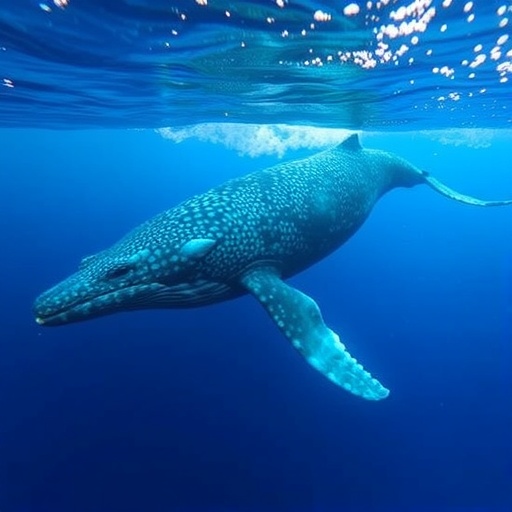
In a groundbreaking advancement for marine ecology, a team of researchers from the Scripps Institution of Oceanography at UC San Diego and California Polytechnic State University (Cal Poly) has unveiled an innovative method to estimate whale populations along the California coastline. This new approach harnesses the power of microbial ecological data, employing complex statistical models to assess whale prevalence with unprecedented accuracy. The study leverages microbial and planktonic indicators as proxies, sidestepping some of the limitations inherent in traditional whale monitoring techniques.
Traditional methods for assessing whale populations—including visual sightings, photographic identification, acoustic monitoring, satellite imagery, and genomic analyses—offer valuable data but present significant challenges. Common issues such as the expansive migratory routes of whales, sporadic surfacing behaviors, and environmental variability make consistent population estimates difficult. These complexities often result in gaps or inaccuracies that hinder both conservation efforts and ecological understanding.
Addressing these hurdles, the Cal Poly-Scripps team focused on an ecological niche not previously exploited for whale detection: microbial communities found in seawater, which respond dynamically to the presence of large filter-feeding whales. By examining these microbial “ecological habitats,” researchers decoded patterns that correlate closely with whale densities along the California coast from San Diego to Morro Bay over a span of six years, from 2014 to 2020.
Baleen whales such as blue whales, fin whales, and humpbacks exhibit a unique feeding strategy that involves straining vast quantities of water through baleen plates to capture small prey like krill, zooplankton, and small fish. This biological filtration inherently influences the surrounding microscopic life, creating detectable shifts in microbial communities that serve as biological signals. By analyzing environmental DNA (eDNA) extracted from seawater samples, the researchers identified genetic markers signifying the presence and abundance of these microscopic organisms, indirectly revealing whale activity.
The integration of eDNA techniques with sophisticated statistical modeling was central to this research. The team developed a pioneering computational framework capable of interpreting microbial data to predict whale presence. This model is finely tuned to accommodate the complex relationships between whales and their surrounding microbial and planktonic ecosystems, surpassing more traditional environmental proxy methods that are often multiple steps removed from actual whale biology.
A critical asset for this study was the extensive dataset provided by the California Cooperative Oceanic Fisheries Investigations (CalCOFI), the world’s longest-running marine ecosystem monitoring program, currently in its 77th year. CalCOFI’s longitudinal data allowed for robust model training and validation, ensuring that predictions were grounded in extensive empirical evidence and ecological consistency.
Trevor Ruiz, assistant professor of statistics at Cal Poly and co-lead author of the study, highlighted the novel aspects of their approach, emphasizing its versatility. Unlike conventional off-the-shelf models, their tailored statistical methods are designed with adaptability in mind, paving the way for broader applications in marine ecological forecasting using microbial datasets. The team also made their software tools publicly available to encourage adoption and replication across different marine environments and species.
Collaborative efforts between statisticians and marine ecologists were essential to the study’s success. This interdisciplinary fusion allowed the biological insights from Scripps researchers to inform computational strategies developed by Cal Poly statisticians, resulting in a robust analytical pipeline that bridges microbiology, ecology, and advanced data science.
Graduate contributor Nick Patrick reflected on the interdisciplinary nature of the project, underscoring how the blend of ecological, genomic, and statistical expertise enriched the analytical framework. Such collaborative synergy exemplifies the future of ecological research, marrying diverse scientific domains to tackle complex environmental challenges.
The practical implications of this research are profound. Erin Satterthwaite, a Scripps-affiliated marine ecologist involved in the study, explained that using microbial community structure derived from eDNA provides a closer biological connection to whale presence than previously used indirect methods. This fine-grained ecological insight enhances predictive models, resulting in whale density forecasts that are on average 53% more accurate than traditional approaches.
Beyond improving population estimates, the findings bolster broader ocean health monitoring efforts. Whales serve as critical indicators of marine ecosystem vitality, and their well-being directly reflects environmental pressures such as ship strikes, fishing gear entanglement, and acoustic disturbances. Understanding their interactions with microbial and plankton communities offers much-needed context for assessing the impacts of human activities on oceanic food webs and biodiversity.
The reduction in cost and the increasing accessibility of eDNA sequencing techniques promise to democratize this method, potentially transforming how marine megafauna populations are studied globally. Already, the researchers suggest that their approach could be adapted to other large marine species, including sharks and pelagic fish, to develop detailed range maps that are essential for informed conservation strategies.
This innovative coupling of microbial ecology and advanced statistical modeling offers a new window into ocean life, one that bypasses some of the limitations of direct observation. As eDNA-based ecological assessments become further refined, they are poised to supplement and enhance traditional monitoring tools, providing a scalable, accurate method to gauge the health and movements of some of the ocean’s most enigmatic organisms.
The study’s publication in PLOS One marks a significant milestone in marine science, setting a precedent for the integration of contemporary molecular techniques with cutting-edge data science frameworks. This interdisciplinary paradigm not only improves our capacity to monitor whales but also opens promising avenues for the application of microbial indicators in diverse ecological and environmental contexts.
As the scientific community continues to confront the challenges of marine conservation amidst rapidly changing global climates and escalating anthropogenic impacts, this research exemplifies the innovative thinking necessary to surmount traditional obstacles. Through nano-scale biological markers, an unseen microbial world now illuminates the presence of colossal ocean giants, rewriting our approach to marine ecological monitoring.
Cite Scienmag News
Violet Maxwell. (May 14, 2026). Microscopic Marine Life Aids Scientists in Estimating Whale Populations off California Coast. Scienmag. https://scienmag.com/microscopic-marine-life-aids-scientists-in-estimating-whale-populations-off-california-coast/
Violet Maxwell. "Microscopic Marine Life Aids Scientists in Estimating Whale Populations off California Coast." Scienmag, 14 May 2026, https://scienmag.com/microscopic-marine-life-aids-scientists-in-estimating-whale-populations-off-california-coast/. Accessed 3 September 2026.
Violet Maxwell. "Microscopic Marine Life Aids Scientists in Estimating Whale Populations off California Coast." Scienmag. May 14, 2026. https://scienmag.com/microscopic-marine-life-aids-scientists-in-estimating-whale-populations-off-california-coast/


