


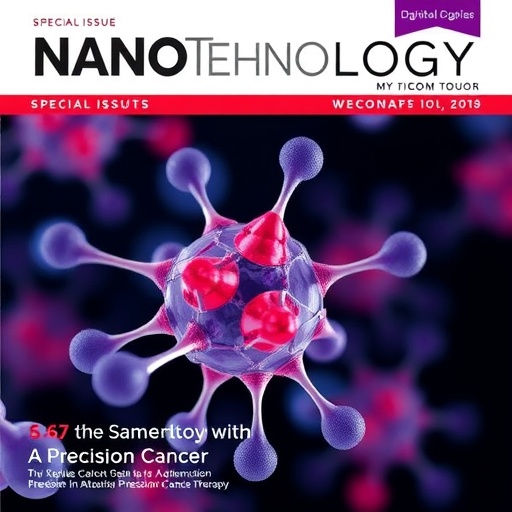
Nanotechnology is revolutionizing the landscape of cancer therapy, heralding a new era of precision oncology that extends far beyond traditional drug delivery systems. A recent special issue of Cancer Biology & Medicine presents a comprehensive collection of editorials and critical reviews that illustrate how advanced nanomaterials are no longer passive carriers but actively involved participants in cancer treatment. This thematic compilation also situates nanotechnology within the broader scientific context, highlighting its role in modulating the tumor microenvironment, enhancing immunotherapy responses, and evolving alongside cutting-edge chemical biology innovations. The issue underscores an integrated vision of future therapies that are both highly targeted and synergistically effective.
Cancer, as one of the most biologically complex and heterogeneous malignancies, continues to challenge researchers and clinicians worldwide. Its ability to evade immune surveillance and thrive within a dynamic tumor microenvironment complicates therapeutic interventions. Nanotechnology’s promise lies in its ability to navigate these complexities through targeted drug delivery, controlled release mechanisms, and the facilitation of multimodal therapies. However, advancements in cancer nanomedicine are increasingly influenced by breakthroughs in immunomodulation, novel chemical methodologies like click chemistry, and emerging insights into tumor biomineralization as well as the role of the microbiome in cancer pathogenesis.
By broadening the focus beyond the design of nanoscale drug vehicles, the special issue emphasizes that future progress hinges on a multidisciplinary approach that integrates nanotechnology with robust biological and clinical research. This synergy is essential for overcoming current limitations and accelerating the development of personalized cancer treatments that adapt to the evolving tumor landscape. Researchers must therefore deepen their understanding of how nanoscale platforms intersect with the molecular and cellular underpinnings of cancer and exploit this knowledge to formulate more effective therapeutic strategies.
Published in April 2026, this special issue was guest-edited by Professor Linqi Shi, a leading figure at Nankai University’s State Key Laboratory of Medicinal Chemical Biology. The collection extends the scope of “Anti-Cancer Research with Nanotechnology” beyond conventionally defined nano-drug delivery systems by including innovative topics such as postbiotics—bioactive compounds derived from probiotics that exhibit intrinsic anticancer effects and potential for nanoformulation—as well as cutting-edge research exploring tumor biomineralization as a transformative therapeutic modality. These novel perspectives reflect the field’s evolution toward addressing a broader spectrum of oncological challenges.
The issue features a detailed editorial on polymer-based antibody conjugation technologies that strategically enhance cancer immunotherapy by improving the specificity and efficacy of immune checkpoint inhibitors and monoclonal antibodies. Further, it delves into the design principles behind tumor microenvironment-responsive polymeric nanoparticles engineered to exploit the unique biochemical signatures of tumors, enabling site-specific drug release that maximizes therapeutic index while minimizing systemic toxicity.
Another highlight is the comprehensive review of click chemistry applications in tumor theranostics, which covers how these highly selective, efficient chemical reactions enable the creation of multifunctional nanoplatforms capable of simultaneous diagnosis and treatment. Click chemistry facilitates rapid, modular assembly of payloads and targeting ligands on nanocarriers, thereby streamlining the development of personalized and adaptive cancer therapies.
The exploration of tumor biomineralization marks a paradigm shift in oncology. Traditionally considered a diagnostic marker indicative of pathological mineral deposits within tumors, researchers are now investigating how to harness these biomineralization processes therapeutically. By leveraging mineralization pathways, novel nanomaterials can induce tumor cell apoptosis and disrupt tumor progression, opening new avenues for intervention that were previously unexplored.
One of the most provocative contributions examines the interplay between poor-prognosis cancers often complicated by bacterial infections and the potential for nanodrug strategies to overcome these challenges. The article discusses current hypotheses and emerging evidence suggesting that nanotechnology-mediated targeting of tumor-associated bacteria could not only improve drug delivery but also modulate the tumor microenvironment to enhance immune responses and patient outcomes. This integrative approach underscores the multifaceted potential of nanomedicine to address complex oncological scenarios.
Collectively, these studies illuminate how precision cancer nanomedicine is being progressively shaped by converging advances across multiple scientific and clinical domains. The integration of biologically inspired design with smart nanomaterials is yielding platforms that not only deliver drugs but also sense, respond, and adapt within the tumor milieu, thereby offering unprecedented control over treatment modalities.
The special issue emphasizes that the future of cancer nanotechnology research does not rest on choosing between advanced materials science and biological innovation. Rather, it is situated in the convergence of these disciplines, where nanoscale technological capabilities are harmonized with deeper mechanistic insight and translational research. This balance is vital for developing therapies that are not just technologically novel but also clinically meaningful and patient-centered.
Moreover, the issue conveys a clear vision for personalized cancer therapy that transcends the limitations of current monotherapies. It advocates for an integrated research model combining molecular precision afforded by nanotechnology with immunotherapy, chemical biology, and clinical validation to forge new paths in cancer treatment. This multidisciplinary synergy promises therapies that are both more effective and more adaptable to individual patient profiles.
By synthesizing cutting-edge nanotechnological innovation with ongoing biological discoveries, the special edition of Cancer Biology & Medicine offers a forward-looking snapshot of a field poised to radically transform cancer care. It envisions a future where nanomedicine not only enhances existing treatments but also unlocks entirely new therapeutic possibilities.
For oncologists, researchers, and stakeholders shaping the future of cancer treatment, this compilation underscores the immense potential of nanomaterials as both tools and partners in the fight against cancer. It serves as a clarion call to embrace integrated approaches, ensuring that nanotechnology fulfills its promise as a core enabler of precision oncology in the coming decade.
Cite Scienmag News
Nathaniel Bowman. (May 14, 2026). Nanotechnology Special Issue Highlights Smart Platforms Driving Advances in Precision Cancer Therapy. Scienmag. https://scienmag.com/nanotechnology-special-issue-highlights-smart-platforms-driving-advances-in-precision-cancer-therapy/
Nathaniel Bowman. "Nanotechnology Special Issue Highlights Smart Platforms Driving Advances in Precision Cancer Therapy." Scienmag, 14 May 2026, https://scienmag.com/nanotechnology-special-issue-highlights-smart-platforms-driving-advances-in-precision-cancer-therapy/. Accessed 4 September 2026.
Nathaniel Bowman. "Nanotechnology Special Issue Highlights Smart Platforms Driving Advances in Precision Cancer Therapy." Scienmag. May 14, 2026. https://scienmag.com/nanotechnology-special-issue-highlights-smart-platforms-driving-advances-in-precision-cancer-therapy/


