


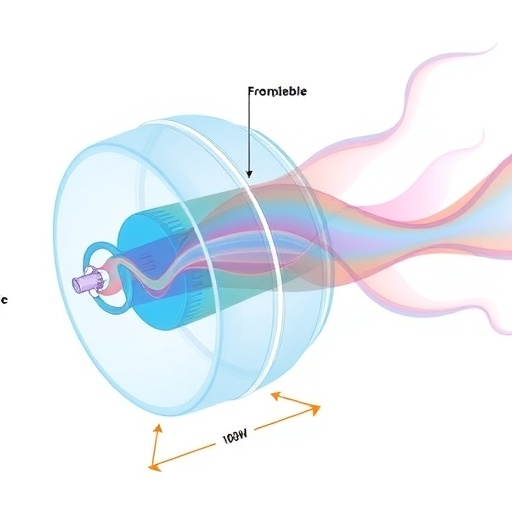
In a groundbreaking advance that redefines the capabilities of soft robotics, researchers have developed a jellyfish-inspired magnetic soft robot (J-MSR) that achieves unprecedented speeds and multifunctional operation, potentially transforming biomedical applications. Mimicking the intricate biomechanical principles of natural jellyfish propulsion, this innovative soft robot operates without onboard power or tethering, swimming upward at a blistering speed of 14.85 body lengths per second (BL/s)—a significant leap beyond previous designs capped at about 10 BL/s.
Natural jellyfish employ a fascinating locomotion strategy: their swimming relies on spatial and temporal asymmetries. The contraction phase is swift and extensive, generating forward thrust, while the recovery phase is slower and more compact, minimizing resistance. Inspired by this, the development team engineered an asymmetric trapezoidal magnetic field waveform to actuate the robot’s motion. By optimizing six critical waveform parameters—including the positive and negative magnetic flux densities and the discrete durations of preload, contraction, glide, and recovery phases—they perfected a propulsion cycle emulating natural jellyfish swimming, but with superior efficiency.
Central to the design process was a fully coupled magnetic-fluid-solid multiphysics simulation conducted in COMSOL. This sophisticated model drastically reduced the need for protracted trial-and-error experiments by capturing the complex interplay between the robot’s structural deformation, magnetic actuation, and fluid dynamics in a single computational framework. Simulations revealed that rapid, large-amplitude contractions combined with a finely tuned glide phase—during which the robot maintains a streamlined bell shape—yield maximum forward fluid loading and minimal drag, explaining the observed high swimming speeds.
One of the most astonishing attributes of the J-MSR is its performance despite negative buoyancy. With a density exceeding that of water by more than 0.4 g/cm³, the robot’s ability to surge upwards so rapidly defies conventional expectations. This negates the need for auxiliary buoyancy aids that would otherwise add bulk and drag, thus preserving the robot’s spatial efficiency and maneuverability. Such a feature is crucial for deployment in confined, liquid environments similar to those found in biomedical contexts.
Beyond its raw speed, the J-MSR boasts remarkable multimodal maneuverability. By programming the internal magnetization patterns during fabrication and harnessing a three-axis Helmholtz coil system capable of generating complex, arbitrary magnetic field vectors, the robot deftly executes an array of navigational feats. Swimming at angles ranging from 0° to an impressive 122°, it can also roll, climb slopes, traverse narrow apertures, and execute intricate S-shaped trajectories. These capabilities highlight the robot’s adaptability to complex and unstructured environments.
In an instructive ex vivo experiment within a pig stomach model, the superiority of this multimodal approach became clear. Attempts to cross gastric folds solely through rolling motion failed, but by alternating between phases of floating upwards and swimming horizontally, the robot succeeded in navigating the challenging terrain. Such fluid transitions between locomotion modes—floating, swimming upward or horizontally, descending, and anchoring—are vital for traversing the unpredictable topography characteristic of human internal organs.
A defining innovation of the J-MSR platform is the integration of a 10-mm central cavity within its structure, enabling it to carry a diverse range of payloads without degrading propulsion efficiency. In one vivid demonstration, the robot housed a light-emitting diode (LED) and a receiving coil, allowing it to emit light reminiscent of bioluminescent jellyfish. This was achieved through dual-frequency magnetic actuation: low-frequency fields generated swimming motions, while high-frequency fields wirelessly powered the LED. This approach replicates natural jellyfish signaling mechanisms, opening pathways for non-invasive optical communication or monitoring without the burden of batteries or wiring.
In another compelling proof-of-concept, the researchers incorporated a variable-density device containing a low-boiling-point liquid alongside a copper foil inside the cavity. Exposure to a high-frequency magnetic field vaporized the liquid, inflating a soft shell and drastically reducing the robot’s density to below that of water. This phase transition enabled the J-MSR to clamp onto submerged objects, trigger buoyant ascent while securely holding its payload, and thus execute a sophisticated “swim-and-carry” sequence rarely seen in soft microrobots. This mechanism offers novel possibilities for underwater manipulation tasks.
The biomedical promise of the J-MSR was vividly showcased in further experiments. Attaching a polylactic acid microneedle to the central cavity, the robot was able to accurately navigate towards a hemostatic clip marker inside an ex vivo pig stomach model, guided by ultrasound imaging. It successfully penetrated targeted tissue, with bench tests demonstrating a targeting precision of 4.4 ± 1.85 mm relative to the microneedle’s footprint. This milestone brings the prospect of magnetically guided, minimally invasive drug delivery or biopsy in the gastrointestinal tract closer to reality.
Moreover, the J-MSR’s ability to carry a binocular capsule endoscope outfitted with dual vision sensors drastically enhances diagnostic potential. In stomach models marked with letters A through F, the robot demonstrated up to 21.8° tilting—far beyond what traditional magnetically actuated capsule endoscopes can achieve, as these typically rely on static fields and offer limited reorientation. This active self-orientation capability eliminates blind spots, enabling comprehensive visual inspections and potentially revolutionizing visceral diagnostics.
While the current incarnation of the J-MSR is a tour de force, the researchers acknowledge areas ripe for improvement. They point to the need for fully three-dimensional simulation models to capture even more nuanced dynamics, the application of machine-learning algorithms to further optimize waveform parameters, and development of closed-loop autonomous control systems to enhance responsiveness and precision in complex environments. These advancements will accelerate the transition from sophisticated prototypes to clinically viable tools.
In summary, the jellyfish-inspired magnetic soft robot represents a major leap forward in soft robotics, combining ultrafast speed, multimodal mobility, and functional versatility in a single platform. By harnessing bioinspired design principles, advanced simulation techniques, and magnetic actuation, the J-MSR can perform complex navigation, payload delivery, wireless signaling, and targeted tissue interaction—all without onboard power sources or physical tethers. This innovative technology opens exhilarating prospects for minimally invasive diagnosis and treatment, offering a new paradigm for interventions in the confined and convoluted spaces of the human body.
The study, led by Professors Quanliang Cao and Lining Yao at Wuhan National High Magnetic Field Center, Huazhong University of Science and Technology, and supported by the National Natural Science Foundation of China and Central University research funds, offers a compelling vision of the future where soft robots swim through living organisms with agility, speed, and purpose. As research continues to push the boundaries of magnetic soft robotics, the J-MSR stands poised to catalyze breakthroughs in biomedical applications ranging from real-time gastric monitoring to precision drug delivery and beyond.
Cite Scienmag News
Denise Maddox. (May 14, 2026). Ultrafast and Versatile Magnetic Soft Robots Inspired by Jellyfish for Advanced Biomedical Applications. Scienmag. https://scienmag.com/ultrafast-and-versatile-magnetic-soft-robots-inspired-by-jellyfish-for-advanced-biomedical-applications/
Denise Maddox. "Ultrafast and Versatile Magnetic Soft Robots Inspired by Jellyfish for Advanced Biomedical Applications." Scienmag, 14 May 2026, https://scienmag.com/ultrafast-and-versatile-magnetic-soft-robots-inspired-by-jellyfish-for-advanced-biomedical-applications/. Accessed 4 September 2026.
Denise Maddox. "Ultrafast and Versatile Magnetic Soft Robots Inspired by Jellyfish for Advanced Biomedical Applications." Scienmag. May 14, 2026. https://scienmag.com/ultrafast-and-versatile-magnetic-soft-robots-inspired-by-jellyfish-for-advanced-biomedical-applications/


