


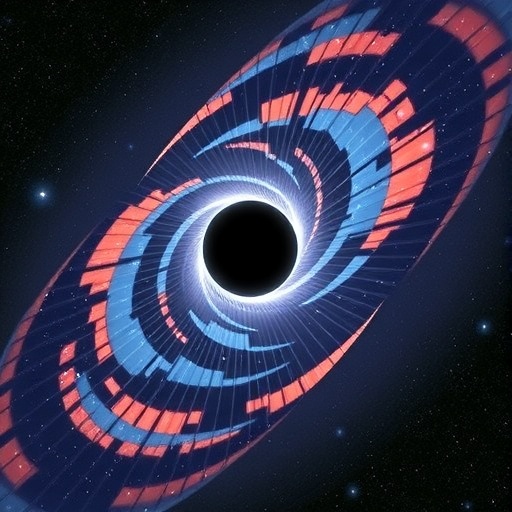
In a groundbreaking advancement for astrophysics, researchers at the University of Cambridge have introduced a sophisticated technique to analyze the ‘ringdown’ phase of black holes following their cataclysmic collisions and mergers. This phase, akin to the resonant tones of a plucked guitar string or a ringing bell, offers an unprecedented window into the fundamental nature of black holes by tracing the intricate gravitational waves they emit as they settle into stability. Their findings, recently published in the prestigious journal Physical Review Letters, shed new light on the complex vibrational signatures—known as quasinormal modes—that characterize these cosmic behemoths post-merger.
Black holes, those enigmatic objects with gravitational pull so intense that not even light escapes, emit gravitational waves when they collide. This collision leads to formation of a new, larger black hole, which then ‘rings’ in a manner comparable to a musical instrument, albeit through ripples in spacetime itself. Unlike sound waves, these gravitational waves traverse the cosmos, carrying encoded information about the mass, spin, and other intrinsic properties of the merging black holes. The ringdown phase is the final stage in this cosmic symphony, and its detailed study holds the key to decoding the very essence of black holes.
At the heart of this ringing phenomenon lie the quasinormal modes: specific vibration frequencies that depend on the black hole’s characteristics. These modes not only underpin the unique ‘fingerprint’ of a black hole but are also pivotal in validating Einstein’s general theory of relativity under extreme gravitational conditions. Precisely identifying these frequencies enables physicists to test whether our deepest theories of gravity hold true when subjected to the universe’s most violent events.
The Cambridge researchers’ novel method significantly elevates the precision with which quasinormal modes are catalogued. Through meticulous examination of high-fidelity computer simulations that replicate binary black hole mergers, the team extracted both the dominant fundamental frequencies and their subtler counterparts—known as overtones. These overtones, fainter and ephemeral, dissipate more quickly yet carry invaluable insights into the black hole’s immediate post-merger state. Prior to this work, debates persisted about the identification and timing of these modes, but the new approach ushered in clarity by applying rigorous, data-driven analysis.
Richard Dyer, the study’s lead author, emphasized the challenge of detecting these quieter vibrational whispers amid the noise inherent in gravitational wave data. “While the loudest mode is routinely observed in gravitational wave data, many quieter modes are much more difficult to detect, and there has been ongoing debate about which modes are present and when they appear,” he explained. The team’s methodology employs Bayesian inference, a sophisticated statistical framework that systematically assesses varying pieces of evidence to determine the most probable mode content, enabling the disentanglement of complex gravitational signals with unprecedented precision.
Beyond fundamental frequencies and overtones, the investigators uncovered intriguing ‘nonlinear modes,’ born from the intricate interaction of different vibration frequencies. These nonlinear combinations resonate much like the distorted chords produced by an electric guitar, where multiple tones merge and interfere, generating an enriched harmonic palette. Detecting such modes demands not only exceptionally clean data but also comprehensive computational algorithms to differentiate genuine signals from background noise, marking a substantial leap in the analysis of gravitational waveforms.
The practical implications of this research extend far beyond theoretical curiosity. The team, including co-author Dr. Christopher Moore, applied their technique to an extensive, publicly accessible catalogue of simulated gravitational waves. This robust database encompasses a wide range of black hole collisions with varying mass ratios and spin configurations, enabling the team to map out when and which vibrational modes become detectable. This mapping acts as an invaluable guide for future gravitational wave observations, informing researchers where to look and what to expect as they study real cosmic collisions.
Gravitational wave observatories such as LIGO (Laser Interferometer Gravitational-Wave Observatory) and Virgo stand to benefit enormously from these refined insights. By targeting specific frequency modes illuminated by this research, the detectors’ ability to perform fine-grained tests of general relativity will be remarkably enhanced. For instance, by scrutinizing the consistency of the observed quasinormal modes with predictions from Einstein’s equations, physicists can confirm or challenge the robustness of our current gravitational framework.
Moreover, the arrival of next-generation gravitational wave detectors promises even greater sensitivity, and the catalog provided by this work will be pivotal in guiding future discoveries. As instruments evolve to capture weaker and more complex signals, analyzing the full spectrum of quasinormal modes—including elusive overtones and nonlinear interactions—will deepen our understanding not only of black holes but of the very fabric of spacetime itself.
The ‘ringdown’ phase thus emerges not merely as a theoretical curiosity but as a powerful diagnostic tool. It encodes a wealth of information about the end stages of black hole mergers, and extracting this data is crucial for pushing the boundaries of modern physics. Yet, the challenges in isolating these signals amidst cosmic noise are immense, and the Cambridge team’s principled, statistically rigorous methodology represents a quantum leap in this endeavor.
In sum, this research marks an exciting milestone in gravitational wave astronomy, embodying the union of theoretical physics, sophisticated simulations, and advanced statistical tools. By refining the catalog of quasinormal modes and revealing previously hidden nonlinear vibrations, it opens new avenues for probing the dynamics of black hole mergers with extraordinary clarity. These advances not only enhance our ability to test fundamental physics but also deepen our appreciation for the complex, resonant melodies played out on the grand cosmic stage.
As our observational capabilities continue to scale new heights, the resonant ‘ring’ of black holes will serve as a clarion call for discoveries yet to come, harmonizing theory and experiment in a profound exploration of gravity’s most extreme manifestations.
News Publication Date: 13-May-2026
Web References: 10.1103/ptmd-rz1t
Keywords
black holes, gravitational waves, quasinormal modes, ringdown phase, general relativity, Bayesian analysis, nonlinear modes, overtones, LIGO, Virgo, astrophysics, spacetime
Cite Scienmag News
Grant Pearson. (May 13, 2026). New Method May Reveal the Hidden Secrets of ‘Ringing’ Black Holes. Scienmag. https://scienmag.com/new-method-may-reveal-the-hidden-secrets-of-ringing-black-holes/
Grant Pearson. "New Method May Reveal the Hidden Secrets of ‘Ringing’ Black Holes." Scienmag, 13 May 2026, https://scienmag.com/new-method-may-reveal-the-hidden-secrets-of-ringing-black-holes/. Accessed 3 September 2026.
Grant Pearson. "New Method May Reveal the Hidden Secrets of ‘Ringing’ Black Holes." Scienmag. May 13, 2026. https://scienmag.com/new-method-may-reveal-the-hidden-secrets-of-ringing-black-holes/


