


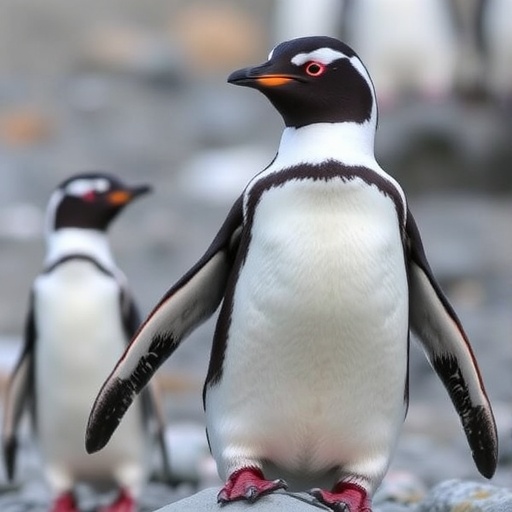
In a scientific discovery that reshapes our understanding of penguin biodiversity, researchers have identified an entirely new species of gentoo penguin inhabiting the remote Kerguelen Islands. This breakthrough comes after more than a century since a new penguin species was last named and highlights the intricate evolutionary pathways these birds have taken across the Southern Hemisphere. The study, published in the prestigious journal Communications Biology, leverages comprehensive genomic analyses alongside detailed observations of behavior, morphology, and ecology to reveal how gentoo penguins, once thought to be a single widespread species, actually represent a complex of at least four genetically distinct species.
The gentoo penguin’s familiar black-and-white plumage, streamlined for both camouflage against predators and efficiency in capture of prey within the ocean, belies a hidden diversity that until now remained cryptic. This newly described species, dubbed the southeastern gentoo penguin (Pygoscelis kerguelensis), occupies the isolated Kerguelen Archipelago—known in French as the Desolation Islands—situated roughly 2,000 miles from any permanent human habitation. The isolation and unique environmental pressures at these sub-Antarctic islands have driven this divergence, resulting in subtle differences in size, vocalizations, and genetic makeup compared to other gentoo populations.
What is revolutionary in this discovery is not just the new species itself, but the elevation of three previously classified subspecies to full species status based on robust genomic data. By sequencing whole genomes of 64 gentoo penguins collected from 10 breeding colonies spanning nearly the entire geographic range of the group, researchers have resolved a long-standing debate in penguin taxonomy that persisted for over a century. This integrative approach combines genetic data with comparative analyses of breeding timing, diet, vocal behavior, and physical characteristics, marking a watershed moment in avian evolutionary research.
The gentoo penguin’s ecological flexibility—evident in its varied diet and localized breeding habits—is thought to have facilitated this speciation. Unlike more specialized penguin species dependent on krill, gentoo penguins exploit a broad range of marine resources including fish, squid, and cuttlefish. This dietary generalism reduces long-range foraging, causing each breeding colony to evolve distinct behavioral and physiological traits finely tuned to their particular environment. Such isolation, both ecological and geographical, compounded by the Antarctic Polar Front’s oceanographic barrier, has catalyzed divergence over the past 300,000 to 500,000 years.
Emerging from the genomic data are four distinct gentoo lineages, each constrained to differentiated regions north or south of the Polar Front. The northern lineage (Pygoscelis papua) is confined to South America’s Falkland/Malvinas and Martillo Islands. The eastern lineage (Pygoscelis taeniata) resides on islands including Crozet, Marion, and Macquarie. Adjacent to the Polar Front lies the newly confirmed southeastern gentoo, isolated to Kerguelen and potentially Heard Island. Farther south exists the southern gentoo (Pygoscelis ellsworthi), the most populous of the group, occupying Antarctic Peninsula locales and islands such as South Georgia. Each lineage not only varies genetically but shows adaptations aligned with environmental demands.
Genomic insights into these adaptations are profound. The southern gentoo shows genetic signatures tied to extreme cold tolerance, including genes associated with thermogenesis, lipid metabolism, and light sensitivity, which likely aid with surviving the seasonal fluctuations in polar light and frigid conditions. Conversely, the eastern gentoo displays allelic variation in genes favoring efficient carbohydrate metabolism and enhanced diving capacities that facilitate underwater foraging in nutrient-poor waters. Meanwhile, the northern gentoo’s genome reflects adaptations favoring sustained muscle activity and cardiac function, potentially linked to its more temperate foraging habitats.
Climate change imperils several of these species, particularly the island-associated sub-Antarctic gentoos, with model projections indicating that many currently inhabited islands will become inhospitable by 2050 due to temperature and habitat shifts. Unlike their southern relatives, which may expand into newly accessible Antarctic terrain, sub-Antarctic populations face the prospect of severe range contraction or extinction due to geographic isolation and limited dispersal opportunities. This vulnerability underscores the importance of multinational conservation strategies across the islands governed by various nations including Chile, South Africa, France, and New Zealand.
Researchers emphasize that the discovery calls for a reassessment of conservation priorities. The distinct needs and vulnerabilities of each gentoo lineage demand site-specific strategies, particularly as global climate phenomena disrupt oceanic ecosystems and predator-prey dynamics. While emperor and Adélie penguins suffer from sea ice loss and krill declines, gentoo populations in Antarctica may exhibit resilience or even benefit from ecological shifts. In contrast, the rarer island populations with small numbers and restricted habitats face a precarious future.
This research represents a milestone in avian genomics, employing thousands of single nucleotide polymorphisms (SNPs) across whole genomes to unravel patterns of speciation and local adaptation with remarkable precision. Beyond taxonomy, these data provide a critical baseline for understanding penguin evolutionary biology in the face of disease outbreaks such as avian influenza and anthropogenic pressures. Insights into genetic markers of disease resistance or vulnerability could prove invaluable for mitigation efforts as wildlife health crises intensify globally.
The international collaboration underscores the growing imperative for integrative biological studies combining fieldwork, genomics, and climate modeling to elucidate evolutionary processes and inform conservation policies. This study unites expertise from continents and disciplines, exemplifying how cutting-edge genomic tools can resolve classical taxonomic controversies while highlighting urgent environmental challenges. The revelation of cryptic biodiversity in one of the planet’s most iconic avian groups raises the tantalizing prospect that many more undiscovered species persist in Earth’s remote, understudied habitats.
The discovery of this new gentoo penguin species heralds a new chapter in our understanding of Antarctic and sub-Antarctic biodiversity. It challenges conventional views, highlighting how isolation, diet, and environmental barriers combine to shape evolutionary trajectories even in well-known animals. As climate change accelerates, such integrative studies will be essential to ensuring effective stewardship of fragile ecosystems and the survival of their remarkable inhabitants.
Cite Scienmag News
Margaret Porter. (May 8, 2026). Gentoo Penguin Revealed as Four Distinct Species, Including One Newly Discovered—Three Face Threatened Status. Scienmag. https://scienmag.com/gentoo-penguin-revealed-as-four-distinct-species-including-one-newly-discovered-three-face-threatened-status/
Margaret Porter. "Gentoo Penguin Revealed as Four Distinct Species, Including One Newly Discovered—Three Face Threatened Status." Scienmag, 8 May 2026, https://scienmag.com/gentoo-penguin-revealed-as-four-distinct-species-including-one-newly-discovered-three-face-threatened-status/. Accessed 3 September 2026.
Margaret Porter. "Gentoo Penguin Revealed as Four Distinct Species, Including One Newly Discovered—Three Face Threatened Status." Scienmag. May 8, 2026. https://scienmag.com/gentoo-penguin-revealed-as-four-distinct-species-including-one-newly-discovered-three-face-threatened-status/


