


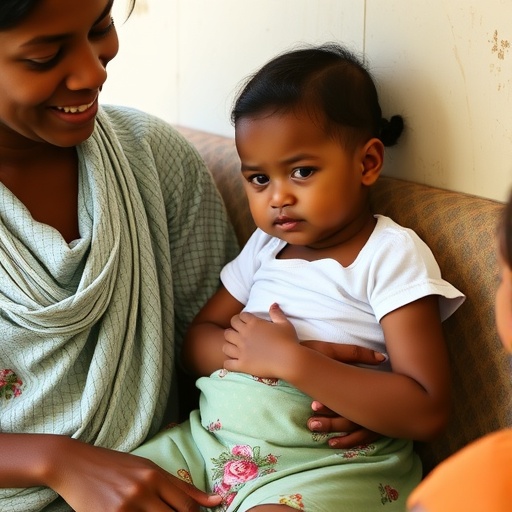
In a groundbreaking study published in JAMA Pediatrics, researchers have uncovered compelling evidence that economic support programs targeting prenatal and infant populations can drastically reduce the incidence of child maltreatment investigations. This research sheds light on the critical role that economic stability plays not only in immediate child health outcomes but also in preventing long-term involvement with child welfare services. The findings emerged from an analysis of the Rx Kids prenatal and infant cash prescription program, which provides families with monetary assistance aimed specifically at improving health and social outcomes during the crucial early stages of a child’s development.
The study navigates a complex intersection of social welfare, pediatrics, and economic policy, emphasizing that the alleviation of financial stress can lead to measurable improvements in child safety and wellbeing. Unlike previous studies that primarily focused on the direct health benefits of such programs, this research advances the field by demonstrating a statistically significant correlation between economic support and the reduction of reported maltreatment cases. This paradigm shift recognizes economic intervention as a vital preventive medicine strategy with profound implications for public health and social policy makers.
To conduct this investigation, the researchers employed a rigorous cohort design, tracking infants whose families participated in the Rx Kids program against those who did not receive such interventions. Through meticulous linkage of healthcare records with child welfare data, they accounted for confounding variables including socioeconomic status, maternal health, and community resource availability. The robust methodology enabled the clarification of causal pathways whereby economic stability reduces environmental stressors that often precipitate neglect and abuse, both leading precipitating factors in child maltreatment cases.
The mechanisms through which economic support programs confer protection against maltreatment are multifaceted. Financial relief provided by prescriptions designated for essential health-related expenses reduces the burden on low-income families, thereby improving their capacity to meet the basic needs of infants. This, in turn, diminishes the chronic stress exposures that undermine parental mental health and caregiving capacity. Consequently, the findings suggest that fostering economic recovery and community stability through targeted financial interventions constitutes an underutilized but potent tool in the prevention of child welfare involvement.
Importantly, the study also contextualizes these findings within broader socio-economic frameworks, highlighting how macroeconomic conditions exacerbate vulnerabilities among young families. For instance, fluctuations in drug costs and food aid availability directly impact the feasibility of sustaining infant health and nutrition, both critical determinants of development and safety. By integrating economic theory with clinical pediatrics and social welfare perspectives, this research offers a comprehensive understanding of how systemic economic factors cascade down to affect individual family experiences and child outcomes.
Moreover, the policy implications drawn from this study are vast. It advocates for expanding prenatal and infant financial prescription initiatives as standard components of preventative care, pressing for medical systems and government agencies to collaborate in addressing social determinants of health. This approach aligns with a growing recognition that child welfare concerns cannot be resolved solely through reactive interventions but require upstream solutions addressing economic precarity, food insecurity, and healthcare access disparities.
Another vital contribution is the demonstration that economic assistance directly associated with medical prescriptions not only enhances medication adherence but also builds trust between healthcare providers and families. This trust facilitates more effective communication and engagement with preventive services, which are essential for early detection and intervention in potential maltreatment situations. The study’s interdisciplinary approach thus underscores the convergence between clinical medicine and social policy as foundational for advancing pediatric public health.
The research team, led by Sumit Agarwal, MD, MPH, PhD, employed sophisticated statistical models to parse the nuanced relationships between financial assistance and maltreatment investigations. The data reveal that families receiving Rx Kids support experienced a pronounced decline in reported cases of both neglect and physical abuse compared to control groups. This effect persisted even when controlling for regional economic factors and demographic variables, underscoring the robustness of the program’s protective benefits.
Furthermore, this investigation contributes to the field of medical economics by contextualizing cash prescription programs within broader discussions on healthcare costs and resource allocation. It highlights the potential for preventive economic interventions to reduce downstream expenditures associated with child protective services, legal proceedings, and long-term social care. Such findings provide compelling rationale for policymakers to view prenatal and infant economic stabilization not simply as social welfare expenditures but as strategic investments in societal health.
The study is particularly timely given the current socio-economic landscape marked by increasing disparities exacerbated by global economic shocks and environmental crises affecting food security and community stability. The direct connection between enhanced financial support and improved child welfare outcomes suggests that economic recovery efforts must prioritize vulnerable populations, especially families with infants, to mitigate far-reaching consequences of economic deprivation.
In conclusion, this pioneering research echoes the vital importance of embedding economic stability within the framework of preventive medicine. By validating the significant impact of the Rx Kids prenatal and infant cash prescription program on maltreatment investigations, this study calls for a paradigm shift in how health and social services converge to protect society’s most vulnerable—its youngest children. The evidence advocates for scaling similar programs worldwide, fostering healthier family environments and breaking intergenerational cycles of adversity through targeted, financially empowered preventive care.
For researchers, clinicians, and policymakers committed to child welfare and public health, these findings open new avenues to craft policies that harness economic tools as integral components of holistic healthcare strategies. The synergy between economic security and child safety serves as a potent reminder that health extends beyond biology, resting profoundly on the economic and social frameworks enabling families to thrive.
News Publication Date: [Not provided in the source]
Cite Scienmag News
Harold Sullivan. (May 7, 2026). Exploring the Impact of Perinatal Cash Transfers on Infant Maltreatment Investigations. Scienmag. https://scienmag.com/exploring-the-impact-of-perinatal-cash-transfers-on-infant-maltreatment-investigations/
Harold Sullivan. "Exploring the Impact of Perinatal Cash Transfers on Infant Maltreatment Investigations." Scienmag, 7 May 2026, https://scienmag.com/exploring-the-impact-of-perinatal-cash-transfers-on-infant-maltreatment-investigations/. Accessed 5 September 2026.
Harold Sullivan. "Exploring the Impact of Perinatal Cash Transfers on Infant Maltreatment Investigations." Scienmag. May 7, 2026. https://scienmag.com/exploring-the-impact-of-perinatal-cash-transfers-on-infant-maltreatment-investigations/


