


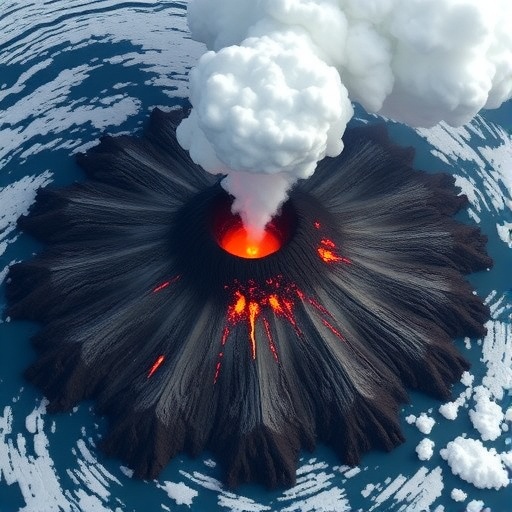
In an unprecedented convergence of natural catastrophe and atmospheric chemistry, scientists have unveiled groundbreaking insights into the methane dynamics triggered by the colossal Hunga Tonga-Hunga Ha’apai volcanic eruption. This recent study leverages advanced satellite technologies to quantify enhanced methane oxidation occurring within the stratospheric plume emitted by the eruption. By meticulously analyzing satellite data, researchers have charted the fate of methane—a potent greenhouse gas—following one of the most explosive volcanic events in recent history, dramatically altering our understanding of stratospheric chemical processes and their climatic ramifications.
The Hunga Tonga-Hunga Ha’apai eruption, which erupted with awe-inspiring force, thrust massive volumes of volcanic material and gases high into the stratosphere, creating a unique laboratory for studying atmospheric chemical reactions. Methane, a gas nearly 30 times more effective than carbon dioxide at trapping heat over a century, was observed to undergo enhanced oxidation in this turbulent plume. Satellite instruments measured the concentration and transformation of methane with unprecedented precision, revealing new pathways and reaction rates previously unknown to atmospheric scientists.
Central to this pioneering research is the deployment of cutting-edge satellite spectrometry that enables real-time, high-resolution detection of trace gases in the stratosphere. The satellite data illuminated the rapid conversion of methane to carbon dioxide through oxidation processes, likely catalyzed by hydroxyl radicals and other reactive species induced by the eruption’s injection of volcanic aerosols and water vapor. These chemical transformations hold profound implications for global methane budgets, indicating a self-limiting mechanism in methane’s atmospheric lifetime under extreme perturbations such as volcanic eruptions.
Beyond mere observation, the study’s authors developed sophisticated atmospheric models integrating satellite measurements with chemical kinetics to simulate the evolution of the methane plume. The models reveal that the enhanced oxidation significantly accelerates the removal of methane from the stratosphere compared to typical background conditions. This finding challenges longstanding assumptions that volcanic eruptions primarily contribute to greenhouse warming by injecting carbon dioxide and sulfates, instead highlighting a complex interplay wherein volcanic activity can transiently enhance methane sinks, thereby exerting a counterbalancing climatic influence.
The temporal dynamics traced in this investigation show a rapid initial spike in methane oxidation rates immediately following the eruption, coinciding with elevated concentrations of reactive radicals and increased photolytic activity thanks to the presence of volcanic aerosols. Over subsequent weeks, the oxidation rates gradually declined as the plume dispersed and chemical conditions normalized. The detailed temporal resolution provided by satellites allowed for nuanced insights into reaction mechanisms, emphasizing that episodic natural events like the Hunga Tonga eruption may episodically modulate greenhouse gas lifetimes on short but climatically significant timescales.
This study’s implications extend far beyond the physical and chemical characterization of a singular eruption. It underscores the critical role of satellite remote sensing as a transformative tool for tracking atmospheric composition changes on a global scale. By harnessing these capabilities, researchers can detect subtle yet impactful changes in greenhouse gas concentrations and chemical cycles induced by transient events, enhancing climate models’ accuracy and predictive power.
Another remarkable facet of the research lies in the identification of mechanistic links between volcanic plumes and the stratospheric oxidative capacity. Volcanic emissions, rich in sulfur and water vapor alongside methane, inject a cocktail of reactive species that foster environments conducive to heightened methane breakdown. This observation expands the conceptual framework of stratospheric chemistry, compelling atmospheric scientists to re-evaluate how natural forcings influence long-term atmospheric composition and radiative forcing.
The enhanced oxidation of methane following the eruption also invites a fresh perspective on the feedback mechanisms regulating the Earth’s climate system. Methane’s elevated break-down rate suggests a potential, albeit temporary, mitigating factor against the greenhouse effect during periods of intense volcanic activity. The net impact depends intricately on the balance between the warming effects of co-emitted gases and aerosols and the accelerated methane removal, pointing to a nuanced climate feedback loop that merits deeper exploration.
Underpinning this entire research effort is a novel methodological integration uniting satellite quantification with chemical transport modeling. This approach marks a significant advance from traditional ground-based measurements, which lack the spatial coverage and vertical resolution necessary to dissect stratospheric phenomena comprehensively. The synergy between observational and modeling techniques exemplified here sets a new standard for future studies probing dynamic atmospheric processes in response to natural perturbations.
Furthermore, the implications for environmental policy and global greenhouse gas monitoring are profound. Accurate accounting of methane sources and sinks is a cornerstone of climate mitigation strategies. Understanding the transient natural processes that alter methane lifetime enhances policymakers’ ability to differentiate anthropogenic impacts from natural variability, refining emission inventories and informing targeted interventions.
The study also highlights the importance of international collaboration in monitoring and analyzing global atmospheric events. The satellite data derives from multi-national space agencies, and the scientific team represents a consortium spanning several institutions worldwide. This global scientific partnership exemplifies how interdisciplinary and cross-border cooperation is essential to tackling complex environmental challenges that transcend national boundaries.
In terms of future research directions, the study opens avenues to investigate methane oxidation in different volcanic contexts and other episodic atmospheric disturbances. Comparative analyses could elucidate whether the enhanced oxidation observed during the Hunga Tonga plume is unique or part of a broader class of volcanic-atmospheric interactions. Additionally, expanding satellite monitoring capacities will enable continuous observation of these processes, fostering real-time environmental intelligence crucial for climate science.
The findings also provoke curiosity about the specific chemical pathways and intermediate species mediating this enhanced methane oxidation. Identifying and quantifying these reactive intermediates could unlock deeper mechanistic understanding and potentially reveal novel atmospheric chemistry dynamics. This level of knowledge is critical for refining chemical models that underpin our climate projections.
Importantly, the environmental significance of the research extends beyond methane and stratospheric chemistry. Volcanic eruptions such as Hunga Tonga-Hunga Ha’apai are natural laboratories for studying perturbations in the Earth system, including impacts on ozone chemistry, aerosol dynamics, and upper atmospheric circulation. The integrated assessment of such multifaceted effects enriches our holistic understanding of Earth’s atmospheric resilience and vulnerability in the face of natural shocks.
This study represents a milestone in the synthesis of satellite remote sensing, atmospheric chemistry, and climate science. By capturing and quantifying enhanced methane oxidation within a stratospheric volcanic plume, the research not only advances fundamental scientific knowledge but also enhances our capacity to monitor and perhaps mitigate future greenhouse gas challenges. The volcanic eruption’s atmospheric legacy, once regarded merely as a climatic hazard, is now revealed to be a complex dramaturgy of chemical transformations with far-reaching consequences.
As we deepen our exploration of these atmospheric processes, the innovative methodologies and insights from this study will undoubtedly inspire a new generation of research devoted to unraveling the intricacies of Earth’s changing climate system. The compelling narrative emerging from the Hunga Tonga eruption’s stratospheric plume is both a cautionary tale and a beacon of scientific ingenuity, illustrating how nature’s dramatic displays can illuminate the subtle mechanisms shaping our planet’s atmosphere and climate future.
Cite Scienmag News
Violet Maxwell. (May 8, 2026). Satellite Measures Methane Oxidation After Hunga Tonga Eruption. Scienmag. https://scienmag.com/satellite-measures-methane-oxidation-after-hunga-tonga-eruption/
Violet Maxwell. "Satellite Measures Methane Oxidation After Hunga Tonga Eruption." Scienmag, 8 May 2026, https://scienmag.com/satellite-measures-methane-oxidation-after-hunga-tonga-eruption/. Accessed 3 September 2026.
Violet Maxwell. "Satellite Measures Methane Oxidation After Hunga Tonga Eruption." Scienmag. May 8, 2026. https://scienmag.com/satellite-measures-methane-oxidation-after-hunga-tonga-eruption/


