


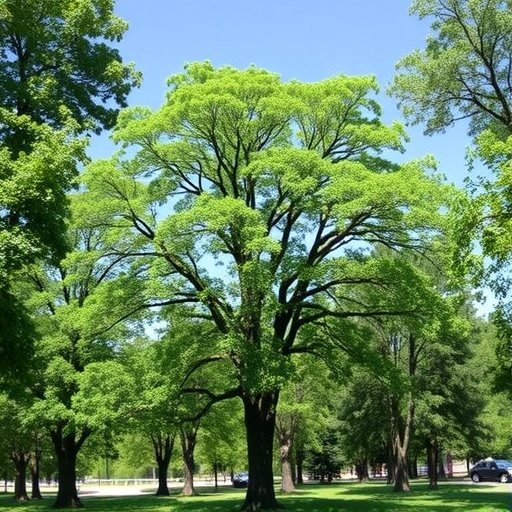
A groundbreaking study from Michigan State University has upended the widely held belief that urban tree planting uniformly benefits public health. While it is well-documented that exposure to natural environments, particularly tree-covered areas, can reduce stress and promote longevity, new research reveals that these advantages are not experienced equally across all socio-demographic groups in the United States. This disparity highlights the complex interplay between environmental factors and social determinants of health, challenging urban policymakers to rethink green infrastructure strategies in an era of persistent inequality.
Led by Dr. Amber Pearson, a professor at MSU’s Charles Stewart Mott Department of Public Health, the study analyzed data linking residential tree canopy coverage with physiological markers of stress known as allostatic load—the cumulative wear and tear on the body induced by chronic stress exposure. High allostatic load is strongly associated with adverse health outcomes including cardiovascular disease, diabetes, and premature mortality. By integrating satellite imagery of tree coverage with detailed public health datasets from the Centers for Disease Control and Prevention, the research team conducted a comprehensive population-based cross-sectional analysis across every U.S. census block, involving more than 40,000 adult participants.
Their findings, published in the Lancet Regional Health – Americas, confirm that higher tree canopy is generally correlated with lower allostatic load, indicating a beneficial stress-mitigating effect of urban greenery. However, this relationship was significantly modified by socioeconomic status and race/ethnicity. Specifically, individuals with higher income, greater educational attainment, and stable employment derived measurable physiological benefits from tree-rich environments. Strikingly, these advantages were not observed among less socioeconomically advantaged groups or non-Hispanic Black participants, despite a sizeable proportion of this group residing in high-canopy neighborhoods.
The absence of reduced allostatic load among non-Hispanic Black individuals living in leafy areas was particularly notable given that nearly one-quarter of these participants resided in neighborhoods with substantial tree coverage. This disconnect suggests that environmental stressors unique or more prevalent in disadvantaged communities may overshadow the salutary effects typically attributed to natural surroundings. Chronic exposure to structural discrimination, limited access to quality employment, and persistently poor neighborhood conditions likely function as dominant psychosocial stressors that gene-environment interactions alone cannot ameliorate.
Pearson emphasizes the multifaceted nature of health disparities, cautioning against simplistic assumptions that greening interventions are a panacea for urban health inequities. “Urban forestry is essential,” she notes, “but if we do not concurrently address the root causes of social and economic disadvantages—such as systemic racism, unemployment, and neighborhood disinvestment—the health returns from increased tree cover will remain unevenly distributed.” This revelation calls for an integrated public health approach that combines ecological enhancements with policy reforms targeting economic empowerment and social justice.
From a technical standpoint, the methodology employed in this study leveraged spatial epidemiology techniques, combining geospatial analysis of remote sensing data with biomarker assessments to uncover place-based health gradients. It illuminated how biophysical urban characteristics intersect with demographic variables to influence physiological stress responses at a population scale. Such evidence underscores the complexity inherent in urban ecosystems and human health dynamics, requiring multidisciplinary frameworks to unravel.
Moreover, the research challenges conventional urban planning paradigms that equate increasing green space with universal health benefits. It suggests that public health gains associated with urban trees are not merely a function of environmental aesthetics or proximity but are contingent on broader sociopolitical contexts and individual resources. This finding has implications for the design of equitable green infrastructure policies that prioritize not only tree planting but also community engagement, economic opportunities, and the alleviation of structural stressors.
The study also raises important questions about the psychosocial mechanisms underlying the interaction between nature exposure and stress physiology. While nature’s restorative effects on the nervous system—modulating autonomic function and reducing cortisol levels—are well-documented, these effects may be blunted or negated in populations experiencing pervasive social adversity. Understanding how discrimination-related stress and environmental factors converge to shape health outcomes offers a fertile avenue for future research, particularly with implications for tailored interventions.
In practice, these insights highlight the necessity of adopting intersectional lenses in public health and urban design. Strategies that integrate environmental enhancements with social policies addressing housing stability, economic inclusion, and anti-discrimination efforts have the potential to amplify the health-promoting attributes of urban forests for vulnerable populations. Without such comprehensive measures, the promise of nature-based solutions risks perpetuating existing inequities rather than mitigating them.
As urban centers across the globe grapple with climate change, mental health crises, and rising chronic disease burdens, the role of urban greenery remains crucial. However, this study urges caution against one-size-fits-all prescriptions. It advocates for nuanced, data-driven, and equity-focused approaches that recognize the heterogeneity of experiences within urban populations and the layered determinants of health.
In conclusion, while urban tree canopy undeniably contributes to reducing physiological stress and enhancing health, its benefits are not distributed equally across all communities. Addressing social determinants such as income, education, employment, and systemic discrimination is paramount to unlocking the full potential of nature-based health interventions. Dr. Amber Pearson and her team’s research provides a clarion call for integrated, justice-oriented urban environmental health policies that can truly serve all residents, fostering resilient and equitable cities for the future.
News Publication Date: 11-Mar-2026
Web References:
- https://www.thelancet.com/journals/lanam/article/PIIS2667-193X(26)00067-0/fulltext
- http://dx.doi.org/10.1016/j.lana.2026.101437
Cite Scienmag News
Courtney Benton. (May 7, 2026). Not Everyone Benefits Equally from Trees, MSU Study Reveals. Scienmag. https://scienmag.com/not-everyone-benefits-equally-from-trees-msu-study-reveals/
Courtney Benton. "Not Everyone Benefits Equally from Trees, MSU Study Reveals." Scienmag, 7 May 2026, https://scienmag.com/not-everyone-benefits-equally-from-trees-msu-study-reveals/. Accessed 3 September 2026.
Courtney Benton. "Not Everyone Benefits Equally from Trees, MSU Study Reveals." Scienmag. May 7, 2026. https://scienmag.com/not-everyone-benefits-equally-from-trees-msu-study-reveals/


