


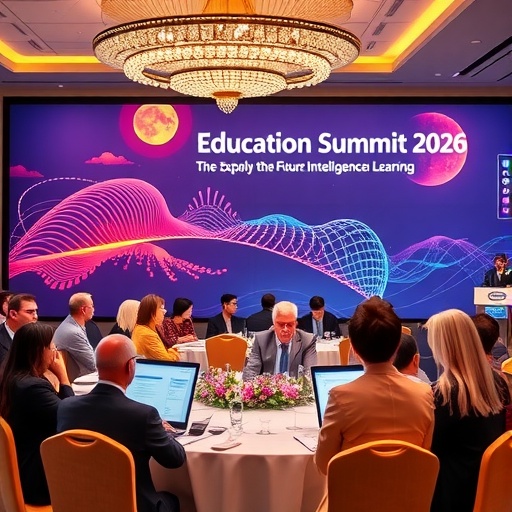
The 2026 Education Summit, held on April 19 at the iconic Loke Yew Hall of The University of Hong Kong (HKU), marked a pivotal moment in the ongoing discourse surrounding the integration of artificial intelligence (AI) and cross-cultural understanding in educational paradigms. Co-hosted by HKU’s Faculty of Education and the London Ball Foundation, the Summit assembled over 400 participants—including leading academics, policymakers, educators, and students—from across the globe to deliberate on the transformative potential and challenges AI presents within the realm of education.
Opening the Summit, Professor Xiang Zhang, President and Vice-Chancellor of HKU, contextualized the urgency of grappling with AI’s growing influence in educational contexts. His address underscored the dual imperative: harnessing AI’s power while ensuring it acts as a cohesive force capable of bridging cultural and generational divides rather than exacerbating them. Professor Zhang highlighted that AI’s incorporation into education demands not only technical skill development but also cultivation of humanistic values such as integrity, empathy, and justice to navigate an increasingly complex digital landscape.
Echoing these themes, Professor Sandy Lau, Chairlady and Co-Chair of the London Ball Foundation’s Education Summit, emphasized the synthesis of advanced technology with the enduring wisdom embedded in traditional educational philosophies, especially those rooted in Chinese pedagogy. She articulated a vision for education that marries rigorous intellectual development with a deep-rooted respect for cultural diversity and holistic personal growth, underscoring the importance of empathy as a foundation for true cross-cultural intelligence.
The Summit’s significance was further elevated by the presence of Dr. Jeff Sze, Under Secretary for Education of Hong Kong’s Education Bureau, who reaffirmed government initiatives aimed at positioning Hong Kong as a premier international education hub. Dr. Sze elaborated on strategic efforts such as scholarships enhancement, enrollment expansion, and the proposed Northern Metropolis University Town, all designed to attract global talent and foster synergistic innovation conducive to both local and international educational ecosystems.
Central to the Summit were the keynote presentations that dissected the intersection of artificial intelligence with education and cross-cultural collaboration. Professor Zhang’s keynote, “Challenges for Higher Education in the Artificial Intelligence Era,” meticulously explored the multifaceted demands placed on universities today. He asserted that institutions bear the responsibility not only for equipping students with technical competence but also for nurturing curiosity, creativity, and ethical insight—attributes essential for transcending AI’s capabilities. He introduced HKU’s latest AI initiatives, highlighting projects that integrate AI-driven learning analytics with personalized pedagogical strategies to foster adaptive and inclusive learning environments.
Complementing this was the keynote delivered by Dr. Michael Spence, President and Provost of University College London (UCL), who addressed “The Urgent Need for Universities to Foster Cross-Cultural Understanding.” Dr. Spence articulated the growing necessity for intercultural competencies amidst global fragmentation, emphasizing that the ability to engage constructively with diverse perspectives is paramount. He discussed UCL’s pioneering programs aimed at cultivating an inclusive academic culture, where dialogue and respect are central to both campus life and community engagements, stressing that cross-cultural intelligence extends beyond international contexts to enrich local societal cohesion.
The Summit’s panel discussions delved deeper into AI’s dual role as both enabler and challenge for educational cross-cultural intelligence. The first panel scrutinized “AI & Cross-Cultural Intelligence,” exploring how AI systems must be developed with nuanced cultural awareness to avoid the pitfalls of homogenization and bias. Experts discussed the imperative for AI curricula to integrate local linguistic and cultural contexts, and the ethical frameworks necessary for guiding AI’s development in education. These discussions revealed the complexities involved in creating AI tools that are culturally sensitive, inclusive, and capable of facilitating meaningful intercultural dialogue.
In the second panel, “AI & Interactive Education: Educators’ Views,” prominent educational leaders examined the impacts of AI-powered tools on pedagogical practices. The conversation highlighted the evolving roles of educators in a digitally enhanced classroom, where AI can personalize learning but must be balanced with human judgment and values. The discussion emphasized the necessity for new assessment methodologies that recognize critical thinking and motivation as central to learner development in an AI-rich environment. Through vibrant exchanges, panelists underscored that technology must be leveraged to empower educators and students rather than replace human-centric educational dynamics.
Together, these dialogues reinforced the Summit’s overarching commitment to educational excellence and the nurturing of cross-cultural intelligence in the digital age. The event positioned Hong Kong as a dynamic nexus for education, culture, and innovation, where global perspectives converge to shape the future of learning. The HKU Faculty of Education and London Ball Foundation’s collaboration demonstrated a shared vision: to confront the transformative challenges posed by AI while upholding education’s foundational role as a catalyst for human connection, understanding, and societal advancement.
Situated within a broader context, the Faculty of Education at HKU carries a legacy extending back to 1917, formally established in its current form in 1984. It continues to lead innovative research and policy influence, preparing graduates to thrive in complex, interconnected world settings. The London Ball Foundation complements this mission by fostering youth-centered initiatives and reinforcing Hong Kong’s aspirations as an educational global hub dedicated to sustainable development.
The 2026 Education Summit thus encapsulates a critical juncture where technology intersects with culture, education, and policy. It underscores an imperative for interdisciplinary dialogue and cooperation to ensure AI advances serve as conduits for inclusion, ethical integrity, and cross-cultural empathy rather than as divisive or reductive forces. As AI continues to permeate educational ecosystems worldwide, the Summit’s insights offer a blueprint for harnessing technology’s potential in ways that prioritize human values and cultural plurality, setting a precedent for the future trajectory of global education.
News Publication Date: April 19, 2026
Web References:
https://mediasvc.eurekalert.org/Api/v1/Multimedia/61c3c28b-93b5-4181-a8f2-978b1cdf27db/Rendition/low-res/Content/Public
References: Information based on the Education Summit 2026 hosted by The University of Hong Kong and the London Ball Foundation.
Cite Scienmag News
Courtney Benton. (May 7, 2026). Global Leaders Convene at Education Summit 2026 in Hong Kong to Explore the Future of Intelligence and Learning. Scienmag. https://scienmag.com/global-leaders-convene-at-education-summit-2026-in-hong-kong-to-explore-the-future-of-intelligence-and-learning/
Courtney Benton. "Global Leaders Convene at Education Summit 2026 in Hong Kong to Explore the Future of Intelligence and Learning." Scienmag, 7 May 2026, https://scienmag.com/global-leaders-convene-at-education-summit-2026-in-hong-kong-to-explore-the-future-of-intelligence-and-learning/. Accessed 3 September 2026.
Courtney Benton. "Global Leaders Convene at Education Summit 2026 in Hong Kong to Explore the Future of Intelligence and Learning." Scienmag. May 7, 2026. https://scienmag.com/global-leaders-convene-at-education-summit-2026-in-hong-kong-to-explore-the-future-of-intelligence-and-learning/


