


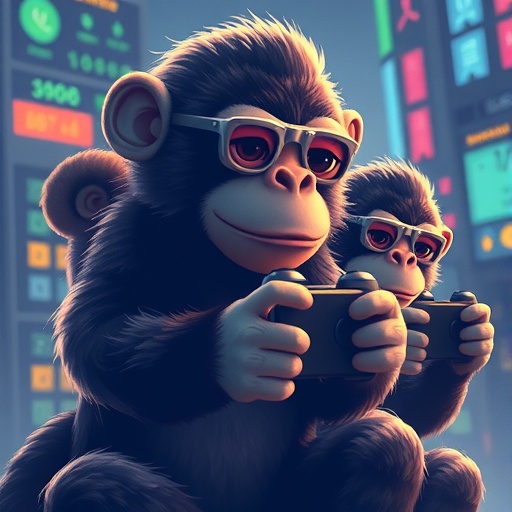
In a groundbreaking study conducted at Kyoto University, researchers have delved deep into the enigmatic realm of curiosity within nonhuman primates, revealing remarkable parallels with human cognitive behavior. While curiosity in humans is well-known as a powerful intrinsic motivator that operates independently of external rewards, its equivalent in animals remains less understood. This recent experimental research sheds light on how Japanese macaques exhibit a preference for stimuli of moderate uncertainty, aligning with the so-called Goldilocks principle, which posits that beings gravitate toward complexity that is “just right” — neither too simple nor too chaotic.
Curiosity, fundamentally, is a pursuit of knowledge for its own sake, a drive to reduce uncertainty and understand the environment better. For humans, this manifests in myriad ways, from scientific inquiry to playful exploration. Yet, the neurological and psychological underpinnings of curiosity are complex and difficult to isolate, especially in animal subjects who cannot verbally communicate their motivations or emotional states. By leveraging innovative touchscreen-based technologies and interactive gaming paradigms, the Kyoto University team implemented a novel approach to studying macaque curiosity, advancing both the methodology and theoretical framework of animal cognition research.
The core of the study centered on a bespoke video game designed to mimic the dynamics of hide-and-seek, a form of play known to stimulate cognitive engagement. When the macaques touched different buttons on the screen, a puppet appeared at varying locations determined by coded spatial noise levels. This meant each button was associated with a degree of predictability or uncertainty in where the puppet would show up next, ranging from very predictable (low noise) to highly unpredictable (high noise) conditions. By observing which buttons the monkeys chose consistently, the researchers could infer their preferences for uncertainty levels.
Intriguingly, the macaques demonstrated a distinct preference for the medium noise condition, where the puppet’s location was neither too predictable nor overly random. This behavior mirrors the Goldilocks principle of curiosity observed in humans, suggesting that macaques strategically seek out experiences that optimize informational gain and maintain engagement without being frustratingly vague or boringly certain. These findings present compelling evidence that cognitive propensities toward moderate uncertainty are evolutionarily conserved across species, enriching our understanding of the evolutionary roots of curiosity.
A particularly novel aspect of this research is the absence of external rewards such as food, which traditionally motivate laboratory animals to perform cognitive tasks. Instead, the monkeys were intrinsically motivated to engage with the game, with some individuals voluntarily participating in nearly 100 trials without any external incentive. This spontaneous engagement underscores curiosity as an intrinsic reward system and opens compelling avenues for designing enrichment tools to improve animal welfare in captive environments.
The implications for animal enrichment are substantial. Video games and digital interactive environments have been gaining traction in human cognitive therapy and rehabilitation programs. Kyoto University researchers propose that such tools, if adapted effectively, could be extended to nonhuman animals in zoos and laboratories to provide more stimulating mental activity and emotional well-being. This study is a proof-of-concept demonstrating that sophisticated games can successfully engage monkeys’ natural curiosity, possibly enhancing their quality of life by offering challenges suited to their cognitive capabilities.
Sakumi Iki, the lead researcher, emphasizes a long-standing interest in recreating play behavior under controlled laboratory conditions. Wild monkeys exhibit complex play behaviors integral to social and cognitive development, but replicating these behaviors in captivity remains difficult. Through technological innovation, this study captures spontaneous and naturally motivated play, bridging the gap between wild behavioral complexity and controlled scientific investigation.
Future research directions aim to ascertain the emotional states associated with this curiosity-driven play. Determining whether macaques experience positive affective responses while engaging in these games would significantly advance our understanding of animal emotions and cognition. Moreover, the exploration of different game designs tailored to varying cognitive and emotional needs may pave the way for a new era of animal cognitive enrichment, blending behavioral science with cutting-edge technology.
From a neuroscientific perspective, the preference for moderate uncertainty aligns with theories of dopamine modulation in reward circuits, where moderate unpredictability in outcomes tends to produce optimal dopamine release, reinforcing exploratory behavior. This intrinsic motivation mechanism has been studied extensively in humans but is less charted in nonhuman primates. The Kyoto University study provides direct behavioral data supporting this theory, reinforcing the view that curiosity is deeply rooted in neurobiological systems shared across species.
The study also tackles methodological challenges inherent in animal cognition experiments. By integrating touchscreen technology and game theory, the researchers elevated the granularity and ecological validity of the tasks. This approach allows for precise quantification of choice patterns and attentional dynamics, setting a new standard for future investigations into animal curiosity and decision-making processes.
Finally, these findings extend beyond academic curiosity to broader ecological and ethical considerations. Understanding the intrinsic drives of animals informs conservation strategies and captive care models, ensuring that enrichment activities reflect the animals’ cognitive and emotional worlds. It also challenges how we perceive intelligence and agency in other species, inviting a more empathetic and scientifically grounded approach to interspecies communication.
In summary, this Kyoto University study compellingly demonstrates that Japanese macaques, much like humans, exhibit a marked preference for engaging with stimuli that present a moderate level of uncertainty. This intrinsic curiosity fosters sustained interaction without external incentives, thereby illuminating fundamental cognitive mechanisms conserved across primates. Through innovative technological applications, the research opens promising frontiers for animal enrichment, cognitive science, and evolutionary biology alike.
Cite Scienmag News
Drew Townsend. (May 7, 2026). Curious Minds of Gaming Monkeys Unveiled. Scienmag. https://scienmag.com/curious-minds-of-gaming-monkeys-unveiled/
Drew Townsend. "Curious Minds of Gaming Monkeys Unveiled." Scienmag, 7 May 2026, https://scienmag.com/curious-minds-of-gaming-monkeys-unveiled/. Accessed 3 September 2026.
Drew Townsend. "Curious Minds of Gaming Monkeys Unveiled." Scienmag. May 7, 2026. https://scienmag.com/curious-minds-of-gaming-monkeys-unveiled/


