


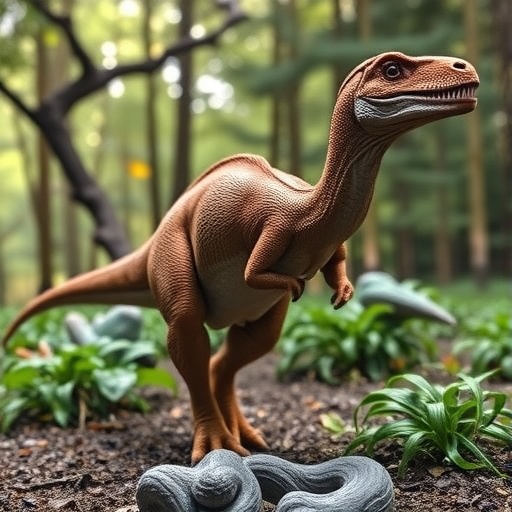
A groundbreaking discovery has emerged from the depths of Brazil’s Northeast, unveiling a colossal new dinosaur species named Dasosaurus tocantinensis. Unearthed accidentally during the construction of a road-rail terminal in Davinópolis, Maranhão, this titanosauriform dinosaur roamed the Earth approximately 120 million years ago and stretched an estimated 20 meters in length. This new species not only expands our understanding of dinosaur diversity in South America but also raises intriguing questions about prehistoric biogeographic connections between continents.
The fossilized remains of Dasosaurus tocantinensis present an extraordinary window into the Early Cretaceous period. This specimen includes an impressive 1.5-meter-long femur complemented by tail vertebrae, ribs, foot bones, and both arm and leg bones. Such an encompassing set of skeletal elements renders the fossil one of the most complete dinosaur specimens ever discovered in Maranhão, a region previously known chiefly for smaller sauropods like Amazonsaurus maranhensis, which measured roughly half the length of this new giant.
What makes Dasosaurus particularly fascinating is its closest known relative hailing from what is modern-day Spain, emphasizing a previously hidden evolutionary link straddling the ancient continents. Researchers propose that the ancestors of the Maranhão species traversed into South America from Europe via land connections through North Africa, when all these land masses were part of the Gondwanan supercontinent. This scenario presents invaluable evidence of faunal exchanges occurring across what would later become widely separated continents.
The discovery process itself underlines a paradox within paleontological research. While large-scale infrastructure projects risk destroying fossil evidence, they also serve as inadvertent excavators, revealing paleontological treasures otherwise buried deep beneath dense tropical vegetation. The well-organized fossil recovery, beginning with a multidisciplinary team that included paleontologists and geologists, allowed for careful excavation and detailed analysis, emphasizing the importance of collaboration between industry and scientific communities to safeguard these precious records.
An in-depth microstructural analysis of Dasosaurus bones further elevates the scientific significance of this find. Conducted by specialists at the Federal University of Rio Grande do Norte, the study revealed a unique histological growth pattern exhibiting traits from both ancient sauropods and their titanosaurs descendants. These observations suggest that key physiological adaptations related to rapid growth and bone remodeling evolved much earlier in dinosaurian evolution than previously documented, providing critical insight into the mechanisms that enabled some species to attain gigantic body sizes.
The newfound species’ name pays homage to its origins in Maranhão, Brazil. “Daso,” meaning forest, reflects the historically dense woodlands described by early Portuguese colonizers, while “tocantinensis” refers to the dinosaur’s proximity to the eastern banks of the Tocantins River. This nomenclature not only situates the dinosaur within its environmental context but also carries forward the cultural and geographical legacy of the discovery site.
Fossils embedded at a depth of nearly eight meters within sedimentary deposits corresponding to the geological transition from the Lower to Upper Cretaceous highlight the immense temporal depth of this find. Previous geological studies have outlined this stratigraphic phase as approximately 120 million years ago, and the careful stratigraphic contextualization assures that interpretations surrounding the dinosaur’s age and environment remain robust.
Following meticulous preparation and analysis in Pará, the fossil returned to Maranhão, where it is presently curated at the State Center for Natural History and Archaeology Research in São Luís. This institution’s involvement underscores a regional commitment to preserving and promoting scientific heritage, ensuring that such discoveries facilitate knowledge dissemination within Brazil and internationally.
Max Langer, a leading vertebrate paleontologist at the University of São Paulo who contributed to this study, underlines the critical role played by infrastructure projects in unveiling subterranean fossil records. According to Langer, the visibility often afforded by highways and quarries has inadvertently mapped Brazil’s fossil record, but to harness this potential fully requires systematic fossil monitoring and recovery efforts—a practice not yet universally adopted.
Beyond this discovery’s biological and geographical implications lies a call for sustained interdisciplinary cooperation, with researchers advocating for harmonizing construction practices and legal frameworks protecting fossil sites. This approach promises not only to safeguard invaluable heritage but also to accelerate new findings that deepen scientific understanding of prehistoric ecosystems and their evolutionary trajectories.
Currently, ongoing negotiations between the research team and the construction company aim to facilitate further excavations at the site. Such efforts may unveil additional skeletal elements or even other dinosaur specimens, potentially broadening insight into Early Cretaceous faunas and expanding reconstructive accuracy concerning sauropod diversity and paleoecology within this crucial geographical nexus.
The Dasosaurus tocantinensis discovery has been supported financially by the São Paulo Research Foundation (FAPESP) through doctoral scholarships, postdoctoral fellowships, and grants awarded under the Young Investigator program. This funding framework reflects the foundation’s commitment to fostering research excellence and advancing international scientific collaboration, reinforcing Brazil’s position as a vital contributor to paleontological sciences.
In summary, the description of Dasosaurus tocantinensis sets a new milestone in understanding dinosaur evolution in South America and provides compelling evidence of prehistoric intercontinental connections. These findings highlight not only the urgency of integrating fossil conservation into urban development but also the immense potential of unearthing extraordinary biological insights lying hidden beneath our feet, waiting patiently for human curiosity and scientific rigor to bring them to light.
News Publication Date: 12-Feb-2026
Web References:
Cite Scienmag News
Violet Maxwell. (May 6, 2026). New Long-Necked Dinosaur Discovered in Northeast Brazil Reveals Close Ties to European Species. Scienmag. https://scienmag.com/new-long-necked-dinosaur-discovered-in-northeast-brazil-reveals-close-ties-to-european-species/
Violet Maxwell. "New Long-Necked Dinosaur Discovered in Northeast Brazil Reveals Close Ties to European Species." Scienmag, 6 May 2026, https://scienmag.com/new-long-necked-dinosaur-discovered-in-northeast-brazil-reveals-close-ties-to-european-species/. Accessed 3 September 2026.
Violet Maxwell. "New Long-Necked Dinosaur Discovered in Northeast Brazil Reveals Close Ties to European Species." Scienmag. May 6, 2026. https://scienmag.com/new-long-necked-dinosaur-discovered-in-northeast-brazil-reveals-close-ties-to-european-species/


