


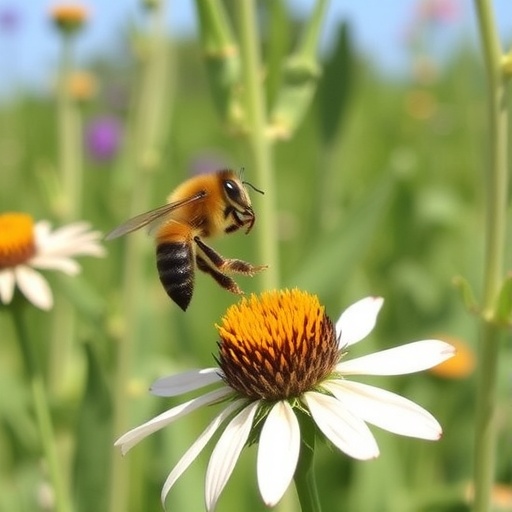
A groundbreaking new study spearheaded by researchers at the University of Bristol reveals a critical nexus between biodiversity, specifically insect pollinators, and human health and economic vitality. Published in the prestigious journal Nature, this research marks a pivotal advancement in ecological and nutritional science by elucidating, for the first time, the intricate mechanisms through which pollinator decline compromises essential ecosystem services that sustain global nutrition and livelihoods. The study underscores biodiversity not as a peripheral luxury but as an indispensable pillar underpinning human resilience and daily well-being.
Pollinators, particularly wild insect species, have long been recognized for their indispensable role in the production of fruits, vegetables, and pulses—primary sources of vital micronutrients including vitamins A, E, and folate. Yet, the direct, quantifiable impact of dwindling pollinator populations on human dietary health and economic sustenance has remained understudied until now. This research fills that critical gap by providing robust evidence connecting biodiversity loss with nutritional deficiencies and financial insecurity in vulnerable agrarian communities.
The study’s empirical foundation rests on comprehensive fieldwork across ten smallholder farming villages in Nepal, an optimal case study due to its reliance on subsistence agriculture intertwined with complex natural ecosystems. Researchers meticulously tracked the interaction between wild pollinator diversity and crop yields over an entire agricultural year. Simultaneously, they conducted detailed nutritional analyses of farm families’ diets alongside economic assessments of income derived from pollinator-dependent crops. This multidimensional methodology allowed the team to map the full causal chain linking ecosystem health to human well-being.
Results illuminate the profound importance of pollinators to these agrarian households, revealing that insect pollination supports nearly half—44%—of their agricultural income. Equally striking is the contribution of pollinators to dietary intake; over 20% of participants’ consumption of essential micronutrients such as vitamin A, folate, and vitamin E hinges on the presence of thriving pollinator populations. These nutrients are central to immune function and cognitive development, indicating that biodiversity loss directly threatens both physical health and socio-economic stability.
The pernicious effects of pollinator decline are not purely ecological but reverberate through human communities via “hidden hunger,” characterized by micronutrient malnutrition affecting nearly a quarter of the global population. Disrupted pollination leads to diminished crop yields and nutrient density, exacerbating vulnerabilities to illness, infection, and chronic poverty cycles. The compounded risks highlight the urgent need for integrative conservation and development strategies that reinforce ecosystem services while bolstering rural livelihoods.
Encouragingly, the study demonstrates tangible pathways for positive intervention. Local actions such as planting native wildflower habitats, reducing harmful pesticide usage, and conserving indigenous bee species emerge as effective, low-cost measures to stimulate pollinator population recovery. These biodiversity-friendly farming practices not only enhance ecological integrity but simultaneously improve crop productivity, nutrition security, and economic resilience in smallholder settings, presenting a compelling “win-win” paradigm.
The particular vulnerability of smallholder farmers to environmental degradation is glaring, as they depend disproportionately on ecosystem functionality for subsistence and income. The research highlights the feasibility of scaling nature-positive agricultural approaches that integrate ecological principles into commonplace farming practices. Such strategies represent a viable route to alleviating food insecurity and poverty among millions reliant on small-scale agriculture worldwide.
Dr. Thomas Timberlake, the study’s lead author, articulates a transformative conceptual shift underscored by the research: biodiversity is foundational, not optional, to human life. By decoding the ecological underpinnings of food production, the team spotlights dual risks and opportunities—biodiversity loss imperils human health, yet harnessing nature’s dynamics offers a powerful lever for improving social well-being through scientifically informed stewardship of natural resources.
Jane Memmott, Professor of Ecology and senior author, emphasizes the ecological and economic synergies attainable through evidence-based management. “A ‘win-win’ scenario exists where we can simultaneously improve conditions for both biodiversity and people,” she explains, underscoring the cost-effectiveness and ethical imperative of fostering ecosystem services as integral to agricultural sustainability and public health.
Nutrition expert Dr. Naomi Saville from University College London further contextualizes the human health stakes, drawing attention to the prevalence of stunting and developmental deficits among children reliant on pollinator-dependent crops. The decline in biodiversity deprives vulnerable populations of key vitamins and proteins essential for growth, making pollinator restoration not merely an environmental goal but a critical public health intervention.
The study profoundly alters the discourse around biodiversity loss, framing it as a dual environmental and medical emergency with tangible repercussions for global economic and food systems. This integrated perspective aligns with recent government policy frameworks, such as the UK’s national security assessment on biodiversity, which flags ecosystem collapse as an emergent threat to societal stability.
With an estimated two billion people dependent on smallholder farming for subsistence, the preservation and restoration of pollinator-friendly ecosystems are paramount to achieving global sustainable development goals. By integrating empirical research with practical field applications, this body of work offers a scalable blueprint for policymakers, agronomists, and conservationists alike to design regenerative food systems that nurture biodiversity and human health in concert.
The international research collaboration, spanning institutions in Nepal, the UK, the US, and Finland, is moving beyond academic publication towards active implementation of findings. Working closely with farmers and local stakeholders, the team is fostering a participatory approach that enhances awareness and adoption of pollinator-friendly techniques. This community-engaged model exemplifies how science can catalyze grassroots ecological restoration and socio-economic uplift.
Simultaneously, the evidence generated is informing the formulation of Nepal’s inaugural National Pollinator Strategy—a landmark policy integrating biodiversity conservation as a foundational element of agricultural development. By institutionalizing pollinator-friendly practices, Nepal seeks to mainstream ecosystem-based approaches within its broader food security and health agendas.
Together, these scientific insights and on-the-ground actions bring to light a compelling narrative: biodiversity loss is not an isolated environmental issue but a multifaceted crisis interwoven with global nutritional health, economic viability, and social resilience. The restoration and preservation of pollinators present a critical, actionable frontier in ensuring the stability and sustainability of human societies in an era marked by ecological uncertainty.
News Publication Date: 6-May-2026
Web References:
DOI: 10.1038/s41586-026-10421-x
Cite Scienmag News
Daisy Hatcher. (May 6, 2026). Pollinator Decline Threatens Crop Nutrition and Human Health. Scienmag. https://scienmag.com/pollinator-decline-threatens-crop-nutrition-and-human-health/
Daisy Hatcher. "Pollinator Decline Threatens Crop Nutrition and Human Health." Scienmag, 6 May 2026, https://scienmag.com/pollinator-decline-threatens-crop-nutrition-and-human-health/. Accessed 3 September 2026.
Daisy Hatcher. "Pollinator Decline Threatens Crop Nutrition and Human Health." Scienmag. May 6, 2026. https://scienmag.com/pollinator-decline-threatens-crop-nutrition-and-human-health/


