

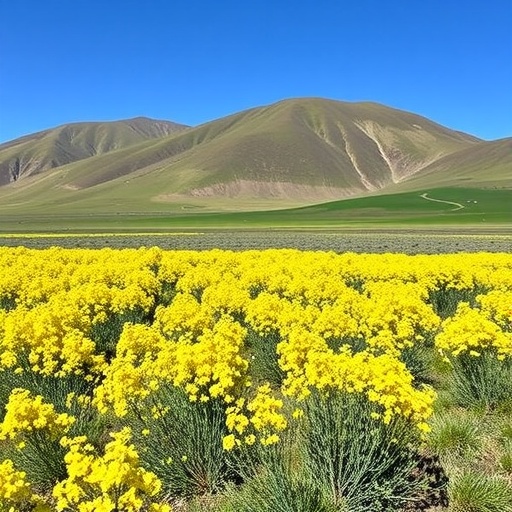
The Qinghai-Tibetan Plateau, often referred to as the “Roof of the World,” is renowned for its unique and delicate ecosystems. Stretching across an immense expanse of high-altitude grasslands, this region supports a wide array of biodiversity and plays a crucial role in the environmental stability of Asia. However, recent ecological studies have unveiled a disturbing trend: the alarming encroachment of poisonous plants into these grasslands. A groundbreaking study, led by Qi, Liu, Huang, and colleagues, published in Communications Earth & Environment, sheds light on the ecological thresholds that influence this encroachment. The findings carry significant implications for biodiversity conservation, rangeland management, and the livelihoods of local pastoralist communities on the Plateau.
The research reveals that the balance within these grassland ecosystems is more fragile than previously assumed. Poisonous plants, which historically remained at low densities, are spreading rapidly, leading to the degradation of forage quality and the displacement of native grasses. This encroachment threatens both wild herbivore populations and the grazing animals that local communities depend on for their sustenance and economy. Determining the ecological thresholds at which these poisonous species proliferate is essential to formulating mitigation strategies and sustaining ecosystem services on the Plateau.
At its core, the study employed a detailed analysis of multiple grassland sites across varying altitudes and climatic conditions within the Qinghai-Tibetan Plateau. By integrating vegetation surveys, remote sensing data, and soil chemistry measurements, the researchers identified key environmental variables that tip the balance in favor of toxic plant species. Factors such as soil nutrient depletion, altered precipitation patterns, and increased grazing pressures emerged as critical drivers of the invasive tendencies of these noxious plants.
One of the pivotal discoveries was the concept of “ecological thresholds,” defined as points at which small environmental changes lead to disproportionate increases in poisonous plant populations. For example, once soil nitrogen levels drop below a certain threshold due to overgrazing or climate-induced nutrient cycling alterations, invasive toxic plants become dominant, outcompeting native grasses. This threshold marks a critical transition in the ecosystem’s resilience, signaling a potentially irreversible shift toward degraded, less productive landscapes.
The study also documents how climate change exacerbates these threshold effects. Warmer temperatures and fluctuating precipitation patterns on the Plateau are altering plant phenology and growth dynamics. These climatic perturbations create microhabitats conducive to the establishment and spread of poisonous species, particularly those with adaptive traits such as frost tolerance and rapid reproductive cycles. Consequently, the interplay between climate variability and anthropogenic stressors compounds the challenge of managing toxic plant encroachment.
Importantly, the researchers emphasize that threshold identification is not only about ecological understanding but also about enabling actionable management. By monitoring environmental parameters and detecting when certain thresholds are approached or crossed, land managers can implement targeted interventions. These might include adjusting grazing intensity, restoring soil nutrients, or employing biological controls to curb the spread of toxic plants before they become dominant.
The implications extend beyond ecological concerns. The expansion of poisonous plants poses direct risks to herd health and local pastoral livelihoods. Livestock consuming toxic vegetation may suffer from poisoning, leading to reduced productivity, increased mortality, and economic losses. This dynamic creates a feedback loop where overgrazing reduces forage availability, reduces soil quality, promotes toxic plant growth, and further reduces livestock health and income security.
The team’s methodological approach combined traditional fieldwork with advanced modeling techniques, providing robust predictions of future encroachment scenarios under various climate and land-use conditions. Utilizing machine learning algorithms, they were able to parse vast datasets of vegetation cover, climate variables, and soil parameters to forecast regions at greatest risk. Such predictive capacity is invaluable for proactive ecological governance and policy-making.
Moreover, the study integrates indigenous knowledge and local expertise, acknowledging that herders possess nuanced understandings of grassland composition and changes over time. By involving these stakeholders in data collection and validation, the researchers ensured that their findings are grounded in real-world observations and that management recommendations resonate with those most affected.
The researchers call for a multifaceted response to this emerging threat. This includes improving sustainable grazing practices to maintain soil fertility and grassland productivity, enhancing surveillance systems for early detection of poisonous plant outbreaks, and investing in ecological restoration efforts. Furthermore, they recommend adapting national and regional rangeland policies to incorporate ecological threshold frameworks, enabling dynamic responses to ecosystem changes.
The study also prompts the scientific community to rethink how grassland resilience is conceptualized in high-altitude environments. Traditional models often focus on static equilibrium states, but the threshold approach acknowledges that ecosystems might shift rapidly and unpredictably once critical points are exceeded. This paradigm shift underscores the urgency of integrating threshold science into conservation planning.
One of the most striking aspects of this research is its broader applicability. While focused on the Qinghai-Tibetan Plateau, the insights gained about poisonous plant thresholds apply to many other grassland ecosystems under global change pressures. Regions worldwide facing invasive species proliferation, altered grazing regimes, and climate change can learn from this study’s integrative methodology and findings.
The study also contributes to advancing ecological theory by quantifying thresholds in real-world systems, which has long been a challenging objective. Identifying precise tipping points where ecosystems flip from one state to another allows for clearer risk assessment and targeted prevention measures. This advancement is critical for mitigating global biodiversity loss and ecosystem service decline under intensifying anthropogenic impacts.
In light of these findings, ongoing monitoring programs on the Plateau must be expanded. Long-term datasets tracking vegetation composition, soil health, and climate variables are essential to detect early warning signs of ecosystem shifts. Collaborative frameworks involving scientists, policymakers, and local communities will enhance data sharing and coordinated responses to emergent threats.
Finally, this research highlights the interconnectedness of ecosystem health, climate change, and human well-being. The Qinghai-Tibetan Plateau’s grasslands are not just a habitat for unique species but also a vital support system for millions of people. Protecting these landscapes from poisonous plant encroachment ensures ecological stability, preserves biodiversity, and sustains the cultural and economic fabric of the region.
The study by Qi and colleagues marks a significant step forward in understanding and managing the complex dynamics of grassland ecosystems under stress. By elucidating ecological thresholds, it paves the way for more informed and effective conservation strategies in one of the world’s most sensitive and important environmental frontiers. As environmental challenges mount globally, this research offers both a cautionary tale and a hopeful blueprint for safeguarding fragile ecosystems for future generations.
Subject of Research: Ecological thresholds of poisonous plant encroachment in grassland ecosystems of the Qinghai-Tibetan Plateau
Article Title: Ecological thresholds of poisonous plants encroachment in grassland ecosystems of the Qinghai-Tibetan Plateau
Article References:
Qi, L., Liu, Y., Huang, M. et al. Ecological thresholds of poisonous plants encroachment in grassland ecosystems of the Qinghai-Tibetan Plateau. Commun Earth Environ (2026). https://doi.org/10.1038/s43247-026-03581-1
Image Credits: AI Generated


