


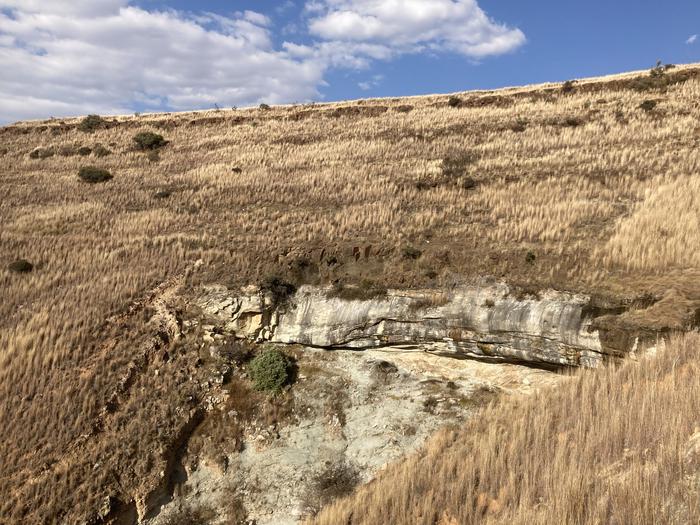
In a groundbreaking archaeological discovery, researchers have identified the earliest evidence of sustained human occupation within the highlands of Southern Africa, specifically at the Likonong Rock Shelter in Lesotho. This finding not only pushes back the timeline for human habitation in this region to approximately 242,000 years ago but also challenges longstanding assumptions about the adaptive capabilities of early Homo sapiens in harsh, high-altitude environments. The discovery reveals a critical chapter in human evolution, highlighting the emergence of sophisticated social collaboration and ecological adaptability during the Middle Pleistocene period.
Likonong Rock Shelter, nestled at an elevation of about 6,000 feet, offers a unique vantage point into human prehistory as it demands survival skills beyond those required in more temperate lowland regions. The site’s geological formation—a sandstone cliff with a collapsed roof—preserved human activity in exceptional detail. Unlike earlier sites in the region, which typically date back far more recently, Likonong extends the timeline of human occupation by more than threefold, situating initial human presence concurrent with the earliest emergence of anatomically modern Homo sapiens.
Through meticulous stratigraphic analysis and radiometric dating, the research team, comprising archaeologists from the University of Michigan and California State University, Stanislaus, determined a pattern of intermittent visitation during the site’s earliest occupation phase. These ephemeral visits suggest seasonal or opportunistic use of the shelter, with periods too brief for sustained fires, indicative of a highly mobile hunter-gatherer lifestyle. However, over the subsequent 200,000 years, evidence shows increasingly frequent and prolonged habitation phases, culminating in a significant intensification around 130,000 years ago during a warmer climatic phase.
The notion that such high-altitude settlements were limited by hypoxia—the reduced availability of oxygen at altitude—has been a prevailing hypothesis in paleoanthropology. However, Likonong’s sustained occupation during the Middle Pleistocene suggests that oxygen scarcity was not the primary limiting factor for early human settlement in mountainous regions. Rather, the research proposes that cold temperature extremes and fluctuating resource availability imposed greater selective pressures, requiring advanced cultural innovations such as cold-weather clothing technologies and strategic resource scheduling to mitigate environmental unpredictability.
Kyra Pazan, an assistant professor at California State University, Stanislaus and an alumna of the University of Michigan, underscores the importance of the site as more than a mere archaeological location—it is a temporal nexus marking the advent of complex social structures essential for human survival in hostile climates. The ability to endure Lesotho’s dramatic seasonal swings implies not only individual physiological adaptation but also the emergence of cooperative networks and knowledge transmission crucial to managing energy budgets and maintaining group resilience during periods of scarcity.
Co-author Brian Stewart, an associate professor at the University of Michigan’s Department of Anthropology, emphasizes that Likonong exemplifies the broader evolutionary trajectory of Homo sapiens’ niche expansion. As early humans began to inhabit diversified and challenging landscapes, novel social and technological adaptations facilitated this geographic spread. These adaptations possibly included sophisticated manufacturing of specialized tools, innovations in fire management, and advancements in food processing techniques aimed at maximizing caloric intake from scarce or seasonal resources.
The site’s intermittent occupation patterns invite speculation about early human social organization, suggesting that effective survival hinged on extensive social networks that could distribute risks across a landscape with variable resource availability. Such networks would have enabled information sharing regarding seasonal resource locations and fostered cooperative hunting and gathering strategies. This form of social complexity arguably set the stage for the cognitive and cultural developments that distinguish Homo sapiens from earlier hominin species.
Likonong also acts as a counterpoint to earlier high-altitude habitation sites associated with Homo erectus in Ethiopian highlands dating back two million years, which thrived in warmer environments. The Lesotho shelter’s colder temperatures, coupled with unpredictable ecological conditions, imply a different set of evolutionary challenges for Homo sapiens. The site demonstrates that successful colonization of such environments depended less on biological acclimatization to hypoxia and more on cultural innovations that buffered environmental stresses.
Moreover, the discovery invites reconsideration of how early humans interacted with and transformed their surroundings across diverse ecosystems. The ability to adapt to Lesotho’s highlands may have entailed new developments in clothing manufacture, fire technology, and mobility strategies, reflecting a broader trend of behavioral flexibility that is central to human evolution. Such behavioral plasticity was instrumental not just for survival but also for the expansion into new ecological niches that characterized the evolutionary success of Homo sapiens.
This research thereby sheds light on the intricate interplay between environment, technology, and social complexity in shaping the evolutionary path of our species. Likonong stands as a testament to the critical period when early humans developed enduring strategies to thrive amidst environmental constraints, emphasizing collaboration and innovation as foundational to human identity. The study encourages us to reflect on these ancient lessons of cooperation in the face of adversity, underscoring their relevance in contemporary discussions on human resilience and survival.
In sum, the Likonong Rock Shelter discovery illuminates a pivotal phase in human history, where emerging Homo sapiens not only expanded their habitat range but did so by cultivating sophisticated social networks and adaptive technologies. This evidence enriches our understanding of the behavioral and cultural milestones that underscored the rise of modern humans and opens new avenues for exploring the evolutionary context of human ecological success in mountainous regions.
The findings have been documented in the peer-reviewed journal Archaeological and Anthropological Sciences, underscoring the scientific rigor underpinning this transformative insight into human prehistory. Supported by grants from the National Science Foundation and California State University, Stanislaus, the research not only augments the fossil and archaeological record but also provides a compelling narrative about the origins of human cooperation and environmental mastery.
As subsequent excavations and analyses continue, Likonong promises to yield further revelations about the chronology of human occupation and the evolution of early social systems. Its exceptional preservation and stratigraphy offer a rare window into Middle Pleistocene human life, serving as a cornerstone for future interdisciplinary research aimed at unraveling the complexities of early Homo sapiens’ adaptive strategies and their implications for the broader saga of human evolution.
News Publication Date: 27-Apr-2026
Web References: https://dx.doi.org/10.1007/s12520-026-02459-9
Cite Scienmag News
Courtney Benton. (May 5, 2026). Early Humans Relied on Friendships to Thrive in Harsh Environments. Scienmag. https://scienmag.com/early-humans-relied-on-friendships-to-thrive-in-harsh-environments/
Courtney Benton. "Early Humans Relied on Friendships to Thrive in Harsh Environments." Scienmag, 5 May 2026, https://scienmag.com/early-humans-relied-on-friendships-to-thrive-in-harsh-environments/. Accessed 4 September 2026.
Courtney Benton. "Early Humans Relied on Friendships to Thrive in Harsh Environments." Scienmag. May 5, 2026. https://scienmag.com/early-humans-relied-on-friendships-to-thrive-in-harsh-environments/


