


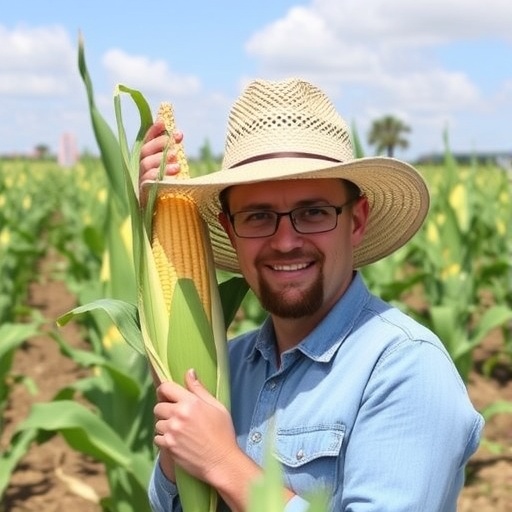
University of Missouri researchers are pioneering innovative irrigation techniques designed to enhance the water efficiency of sweet corn cultivation while preserving the crop’s prized flavor and quality. Sweet corn, a staple in American agriculture, is notoriously water-intensive compared to many other vegetables, necessitating smarter water application strategies to maintain sustainable production in the face of increasing environmental pressures. This breakthrough study, driven by the collaborative expertise of the university’s College of Agriculture, Food and Natural Resources and College of Engineering, offers a promising path for farmers to optimize irrigation without compromising yield or sweetness.
Sweet corn’s high water demand during its growth stages underscores the urgency for more precise irrigation methods. Traditional methods often rely heavily on rainfall or generalized weather data, but these approaches can lead to significant inefficiencies, including over-irrigation or insufficient watering during critical periods. The research team, led by Associate Professor Noel Aloysius and graduate student Moussa Theodore Yatta, systematically evaluated three distinct irrigation strategies: rainfed conditions, potential evapotranspiration-based irrigation, and a crop-specific evapotranspiration approach tailored specifically for sweet corn’s physiological water needs.
Initial comparisons revealed that depending solely on rainfall to irrigate sweet corn results in suboptimal yields due to inconsistent water availability. This rain-only approach fails to address the crop’s increased water requirements during developmental phases, particularly during reproduction, leading to stress and reduced productivity. Conversely, the potential evapotranspiration method, which calculates water needs based on environmental variables such as solar radiation, air temperature, humidity, and wind speed, typically causes an overestimation of water requirements, resulting in excessive water application. Such inefficiencies not only waste precious resources but also may harm soil and crop health over time.
The study’s most compelling findings emerged from the third irrigation strategy: crop-specific evapotranspiration. This nuanced methodology adjusts irrigation volumes precisely to the physiological demands of sweet corn throughout its growth cycle. Treating the crop as a dynamic system with variable water requirements, the researchers timed water application to conserve resources during early low-demand growth phases and increased watering to match the crop’s surge in water uptake during its reproductive stage. This targeted irrigation framework proved superior in balancing water conservation with high crop yield and quality metrics.
A key insight of the research centered on the water use patterns revealed through these irrigation experiments. When irrigation schedules are based purely on meteorological data, farmers frequently apply more water than necessary, often as a precaution against drought stress. The crop-specific evapotranspiration method counters this tendency by incorporating real-time physiological data, thus fostering smarter water stewardship. As Aloysius noted, this integrated approach holds transformative potential for regional agriculture by enabling farmers to reduce water consumption substantially without sacrificing output.
Beyond yield optimization, sweet corn’s sweetness is a paramount quality trait, directly influencing consumer satisfaction and market value. To assess whether reduced irrigation compromises this critical attribute, the research team measured sugar concentration across different watering treatments. The results were promising: despite utilizing less water under the crop-specific evapotranspiration protocol, sweetness levels remained consistent. This finding confirms that precision irrigation can meet both agronomic productivity goals and sensory quality benchmarks, preserving the defining characteristics of sweet corn that consumers expect.
The implications of these findings extend beyond technical irrigation management. Sweet corn holds a unique position within the American agricultural economy. Unlike field corn, which is harvested for grain at maturity, sweet corn is harvested earlier when a genetic disruption in starch biosynthesis preserves higher sugar content within tender kernels. This biological distinction underscores its economic value—ranking second among processed vegetables by farm value nationwide and securing a top-ten position for fresh vegetable production. Cultivated primarily in the Midwest and Northeast, sweet corn generates billions annually, contributing significantly to local and national economies.
Looking ahead, Aloysius envisions the broader adoption of these irrigation techniques by smaller-scale farmers who often lack access to sophisticated irrigation management technologies. Large commercial farms typically have the capital to invest in advanced infrastructure, but smaller producers may struggle with cost and technical barriers. The crop-specific evapotranspiration approach, with its emphasis on resource efficiency and adaptability, offers a viable, affordable pathway for these farmers to improve water use without jeopardizing crop quality or financial returns.
This study aligns with the larger research agenda in the Aloysius lab, which seeks to develop automated, data-driven irrigation technologies tailored to the needs of diverse agricultural operations. By integrating sensor data with advanced irrigation scheduling algorithms, the lab aims to empower small-scale farmers with actionable insights to optimize resource allocation, minimize environmental impact, and foster sustainable agricultural practices. These innovations are poised to play a critical role in addressing water scarcity challenges intensified by climate variability.
Graduate student Moussa Theodore Yatta plans to extend this work through his doctoral research. His focus will broaden to encompass multiple growing seasons and a wider range of environmental scenarios, including atypical wet or drought conditions. This longitudinal research will enhance understanding of the interplay between soil moisture dynamics, crop water demand, and irrigation efficiency, particularly for major grain crops such as corn and soybeans. The goal is to develop adaptive irrigation strategies that maintain resilience and productivity amid evolving climatic conditions.
Yatta’s forthcoming studies aim to produce robust, scalable models that can inform precision irrigation systems capable of responding dynamically to changing weather patterns and crop needs. By validating these approaches across spatial and temporal scales, the research promises to offer practical recommendations for farmers seeking to implement sustainable water management practices at farm and regional levels. This work has significant potential to promote agricultural resilience and food security in the face of mounting global environmental challenges.
The study, titled “Comparative yield response and sugar contents of four sweet corn varieties under different shallow subsurface drip irrigation treatments,” has been published in the peer-reviewed journal Irrigation and Drainage. The research includes contributions from several University of Missouri collaborators, including Allen Thompson, Tim Reinbott, Anthony Lupo, and Kerry Clark. This collaborative effort highlights the interdisciplinary nature of modern agriculture research, combining agronomy, engineering, and environmental science to develop solutions that address both economic and ecological imperatives.
In summary, the University of Missouri’s research on sweet corn irrigation offers a compelling case for the adoption of crop-specific evapotranspiration methods to refine water application schedules. This approach maintains crop yield and sweetness, reduces water consumption, and enhances overall sustainability in sweet corn production. As water scarcity intensifies and agriculture faces unprecedented climate stresses, such innovative water management strategies are increasingly essential for ensuring food security and supporting the livelihoods of farmers across the United States.
Web References: DOI link
References: Published in Irrigation and Drainage, an international water management journal.
Cite Scienmag News
Alan Morgan. (May 5, 2026). Maximizing Sweet Corn Yield: Innovative Water-Saving Technique Maintains Flavor and Boosts Efficiency. Scienmag. https://scienmag.com/maximizing-sweet-corn-yield-innovative-water-saving-technique-maintains-flavor-and-boosts-efficiency/
Alan Morgan. "Maximizing Sweet Corn Yield: Innovative Water-Saving Technique Maintains Flavor and Boosts Efficiency." Scienmag, 5 May 2026, https://scienmag.com/maximizing-sweet-corn-yield-innovative-water-saving-technique-maintains-flavor-and-boosts-efficiency/. Accessed 4 September 2026.
Alan Morgan. "Maximizing Sweet Corn Yield: Innovative Water-Saving Technique Maintains Flavor and Boosts Efficiency." Scienmag. May 5, 2026. https://scienmag.com/maximizing-sweet-corn-yield-innovative-water-saving-technique-maintains-flavor-and-boosts-efficiency/


