


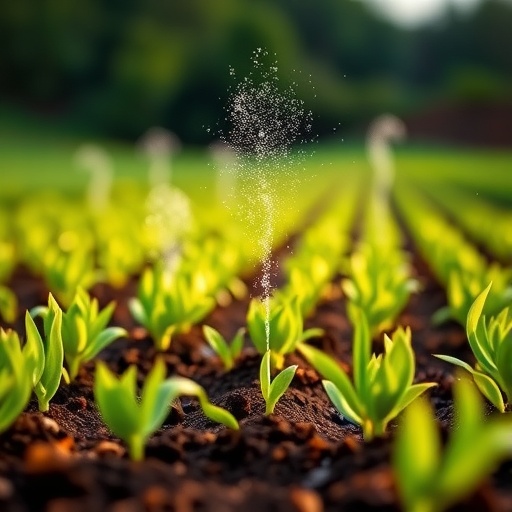
As global temperatures continue their upward trend, the impact of climate change on agriculture remains one of the most pressing challenges of our time. Researchers are striving to enhance the precision and predictive capabilities of crop–climate interaction models to better anticipate food security risks and develop adaptive strategies. A recent study by Rezaei and Nendel published in Nature Water underscores a critical shortfall in current crop–climate models: the simplistic and inadequate representation of irrigation practices under warming scenarios. This deficiency threatens to undermine the reliability of predictions for crop yields as water availability and temperature changes interplay in increasingly complex ways.
Crop–climate models serve as pivotal tools for policymakers, agronomists, and environmental scientists worldwide. These models simulate the growth of staple crops under varying weather conditions, soil types, and management practices, including irrigation. However, current models predominantly assume static or overly simplified irrigation schemes that fail to capture the dynamic and adaptive nature of water use in real agricultural systems. This simplification risks skewing projections—either overestimating or underestimating the buffering effect of irrigation against drought and heat stress.
Irrigation, as an agricultural management practice, plays a fundamental role in mitigating the adverse effects of warming on crop productivity. Many regions rely heavily on irrigation to sustain yields, especially under increasing evapotranspiration and shifting precipitation patterns. Yet, the intensity and timing of irrigation are not fixed; they are highly contingent on a complex network of socioeconomic, technological, and hydrological factors. Current crop–climate models often lack the granularity to simulate these nuances, leading to an unrealistic portrayal of how irrigation can be deployed and adjusted under future climate scenarios.
Rezaei and Nendel argue that integrating more realistic irrigation schemes into crop–climate models will significantly improve their predictive power. This involves parametrizing irrigation decisions based on farmer behavior, water availability, infrastructure constraints, and economic considerations. The authors highlight that ignoring these interdependencies can propagate substantial errors in estimating crop water use, irrigation demands, and yield outcomes. Consequently, risk assessments and agricultural adaptation strategies derived from these models can be fundamentally flawed or misdirected.
The study draws attention to the interactions between increasing temperatures and irrigation efficiency. Warmer climates generally amplify crop water demand while reducing water availability in many parts of the world. Irrigation efficiency may decline due to higher evaporative losses and infrastructural stress. By contrast, advanced irrigation technologies and adaptive management strategies could mitigate some negative impacts, but their adoption rates and effectiveness remain uncertain. Without incorporating these dynamic feedbacks into predictive models, assessments miss vital aspects of how agriculture may respond to climate change.
Critically, the research emphasizes the spatial and temporal variability of irrigation practices. For instance, in some regions, farmers might shift irrigation timing or intensity in response to heatwaves or drought spells, changes that static modeling frameworks cannot capture. Additionally, the competition for water resources among agricultural, urban, and ecological sectors further complicates irrigation water availability. Models lacking these considerations risk simplistically assuming unimpeded water access, which may not reflect future realities under stress.
The authors also discuss the role of socio-economic drivers in shaping irrigation patterns. Factors such as commodity prices, subsidies, labor availability, and policies influence farmers’ irrigation decisions and investments in technology. Moreover, climate change itself can shift these socio-economic landscapes, creating feedback loops that influence irrigation demand and crop choices. Incorporating such complexities into crop–climate models would necessitate interdisciplinary approaches bridging climatology, hydrology, economics, and social sciences.
Technological advancements in irrigation, including precision agriculture, remote sensing, and automated control systems, present opportunities to improve irrigation efficiency and adaptiveness. However, the uneven adoption of these technologies globally—often limited by cost and infrastructure—means that models must account for heterogeneous transitions rather than assume uniform technological progress. This nuanced portrayal is critical for assessing realistic future scenarios and for guiding targeted investments and policies.
Water resources management emerges as a key contextual factor in the authors’ call for revised modeling. Watersheds and aquifers, already strained in many hotspot regions, are susceptible to depletion when irrigation demands surge under warming. Crop–climate models traditionally decouple hydrological and agricultural systems, but this study advocates for their integration to depict feedbacks and constraints accurately. Such coupled modeling frameworks could better capture the trade-offs and synergies between food production and water sustainability.
Additionally, the interplay between changing precipitation patterns and irrigation requirements demands attention. With climate change altering the frequency, intensity, and seasonality of rainfall, the reliance on irrigation is expected to grow or shift geographically. Crop–climate models that overlook these evolving hydrological regimes risk misrepresenting regional vulnerabilities and adaptive capacities, leading to suboptimal agricultural planning.
Another dimension highlighted is the need to simulate the physiological responses of crops to combined heat and water stress under irrigation scenarios. Traditional models may underestimate the negative feedback of high temperatures on crop transpiration and growth, even when water supply is adequate. Advancements in crop physiology research should inform the parametrization of these stresses to enhance model realism and guide effective irrigation scheduling under warming.
The authors conclude by underscoring the urgency of improving irrigation representation in crop–climate models to inform robust climate adaptation pathways. As climate change accelerates, the margin for error in yield projections narrows, demanding more sophisticated modeling tools that integrate environmental, technical, and socio-economic dynamics of water use. This holistic approach is essential not only for safeguarding food security but also for balancing water resource allocation in a warming world.
The implications of this research extend to global agriculture policy and climate resilience planning. Enhanced models can support decision-makers in prioritizing investments in irrigation infrastructure, water-efficient technologies, and capacity building for adaptive management. They can also facilitate scenario analyses that reflect plausible future conditions, informing more resilient cropping systems that sustain livelihoods and ecosystems.
Ultimately, this study serves as a crucial reminder that irrigation—an often underestimated variable in crop–climate modeling—must be treated with greater complexity and realism. Ignoring the multifaceted nature of irrigation strategies risks perpetuating systemic blind spots in our understanding of climate impacts on agriculture. By integrating these insights, future models can better steer humanity’s response to the intertwined crises of climate change and food security.
Cite Scienmag News
Alan Morgan. (May 5, 2026). Improving Irrigation in Crop–Climate Models Under Warming. Scienmag. https://scienmag.com/improving-irrigation-in-crop-climate-models-under-warming/
Alan Morgan. "Improving Irrigation in Crop–Climate Models Under Warming." Scienmag, 5 May 2026, https://scienmag.com/improving-irrigation-in-crop-climate-models-under-warming/. Accessed 3 September 2026.
Alan Morgan. "Improving Irrigation in Crop–Climate Models Under Warming." Scienmag. May 5, 2026. https://scienmag.com/improving-irrigation-in-crop-climate-models-under-warming/


