


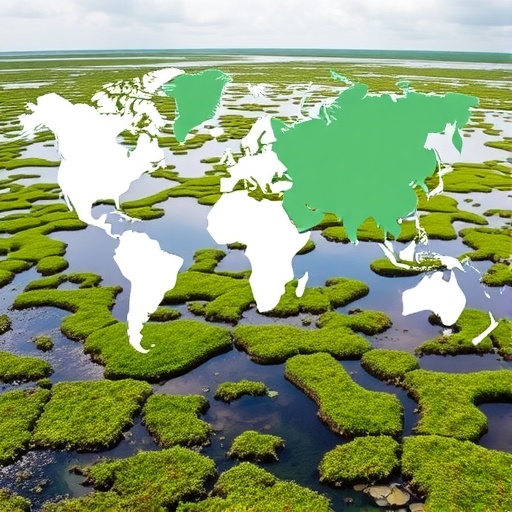
Peatlands, the soggy soils spanning over vast swathes of the Earth’s surface, have emerged as critical ecosystems demanding urgent scientific attention. A recent publication in Communications Earth & Environment spearheads this conversation by delineating the foremost research questions that focus on these globally vital carbon-storing landscapes. As climate change accelerates, understanding peatlands is more crucial than ever, considering their profound implications on the carbon cycle, biodiversity, and hydrological stability.
These peat-accumulating wetlands are nature’s unsung heroes, harboring immense reservoirs of carbon accumulated over millennia. Holding twice the carbon stored in all the world’s forests combined, peatlands can either be formidable carbon sinks or significant sources of greenhouse gases depending on their condition. The study by Milner et al. rigorously identifies research priorities that span multiple disciplines, emphasizing the intersection of ecology, geochemistry, hydrology, and socio-economic factors. This integrative approach is indispensable for developing robust peatland management and conservation policies.
One of the paramount challenges addressed by the article revolves around climate change’s dual role as both a driver and consequence of peatland dynamics. As temperatures continue to rise and precipitation patterns shift, peatlands face increased risks of drying, fire susceptibility, and altered microbial activity. These changes threaten to transform these carbon sinks into carbon sources, exacerbating global warming. The authors emphasize a need for predictive models that accurately represent peatland feedback mechanisms under various climate scenarios to better anticipate and mitigate such tipping points.
Hydrological regimes within peatlands form another research focus, as water availability directly governs peat accumulation and decomposition processes. The authors highlight unresolved questions regarding how altered hydrology—stemming from natural fluctuations or anthropogenic drainage—impacts carbon fluxes and ecosystem functioning. Developing precise hydrological monitoring techniques and high-resolution remote sensing tools are considered vital steps towards elucidating these complex interactions and informing restoration strategies.
Biodiversity within peatland ecosystems is uniquely adapted to acidic, waterlogged conditions, yet remains understudied relative to other habitats. The paper argues that conserving peatland biodiversity requires comprehensive knowledge of species assemblages, ecological niches, and functional roles. Understanding how shifts in climate and land-use affect these communities can aid the design of targeted conservation programs, ensuring that peatlands maintain both their biodiversity and their critical ecosystem services.
Soil microbial communities, the microscopic engines driving decomposition and nutrient cycling, present another frontier. Microbial responses to environmental change can significantly influence greenhouse gas emissions from peat soils. The authors call for integrative studies linking microbial ecology with biogeochemical cycles to unravel how shifts in microbial functions may accelerate or dampen climate feedback loops. Such knowledge could lead to microbial-based indicators or interventions to stabilize peatland carbon stocks.
Additionally, the human dimension of peatland science is foregrounded through questions about sustainable land use and Indigenous knowledge integration. Peatlands are often inhabited or used by local communities for agriculture, fuel extraction, and cultural practices. Understanding socio-economic drivers of peatland degradation, and incorporating traditional ecological knowledge, can enhance participatory management frameworks. This holistic perspective aligns ecological integrity with community well-being and resilience.
Technological innovation underpins many of the research agendas proposed. Advanced remote sensing, machine learning algorithms, and portable field sensors promise unprecedented spatial and temporal resolution in monitoring peatland dynamics. The synthesis calls for multinational research collaborations leveraging these tools to create standardized methodologies, fostering data comparability and knowledge exchange. Such coordinated efforts are critical for addressing peatlands’ global distribution and diversity.
Restoration and rehabilitation hold considerable promise but remain fraught with scientific uncertainties that the study addresses. Questions linger about optimal techniques for rewetting drained peatlands to restore carbon sequestration capabilities, and how restoration outcomes vary across different climatic zones and peatland types. The authors emphasize adaptive management approaches informed by ongoing research feedback loops to maximize restoration success.
Furthermore, the study probes the role of peatlands in mitigating natural hazards such as floods and droughts. The water retention properties of peatlands can modulate hydrological extremes, yet climate change and land-use pressures threaten these regulating services. Quantifying the extent to which peatlands buffer against such events is vital for integrating ecosystem-based approaches into broader disaster risk reduction policies.
Interactions between fire regimes and peatlands surface as an emergent area of concern, especially with increases in wildfire frequency and intensity under warming climates. Peat fires, often subterranean and persistent, release vast amounts of stored carbon and pose significant health and environmental risks. The study calls for enhanced fire ecology research tailored to peat landscapes, involving monitoring fire thresholds, post-fire recovery, and prevention strategies.
Carbon cycle science forms a central thread weaving through the entire research agenda. The intricacies of carbon input through plant productivity, storage in peat layers, and loss via decomposition, leaching, and gaseous emission remain areas needing deeper mechanistic understanding. The authors stress the importance of long-term data sets and experimental manipulations to unravel temporal and spatial carbon flux variability.
The global scope of the research questions reflects peatlands’ worldwide distribution, spanning boreal, temperate, tropical, and subtropical regions. Each geographic domain presents unique challenges and knowledge gaps, underscoring the necessity for region-specific studies coupled with global syntheses. Addressing this diversity demands international cooperation and equitable research partnerships.
Ethical considerations also arise regarding peatland research and intervention, particularly balancing conservation goals with local livelihoods and rights. The article advocates for transparent stakeholder engagement processes and ethical frameworks to ensure that research contributes positively to both ecosystem functioning and human communities.
In synthesizing these multifaceted questions, the study offers a decisive roadmap to direct future peatland science with urgency and clarity. Researchers, policymakers, and conservation practitioners are called upon to align efforts, innovate methods, and embrace interdisciplinarity to secure the future of these pivotal ecosystems. The stakes are high, with peatlands poised at a nexus where ecological preservation intersects planetary health.
This ground-breaking synthesis not only advances peatland science but also resonates across environmental research domains, emphasizing nature’s complex interdependencies under anthropogenic pressures. As the scientific community rallies around these priority questions, peatlands may finally get their deserved prominence in global climate and conservation strategies, heralding new hope for an often-overlooked landscape critical to Earth’s resilience.
Cite Scienmag News
Violet Maxwell. (April 28, 2026). Top Global Research Questions in Peatland Science. Scienmag. https://scienmag.com/top-global-research-questions-in-peatland-science/
Violet Maxwell. "Top Global Research Questions in Peatland Science." Scienmag, 28 April 2026, https://scienmag.com/top-global-research-questions-in-peatland-science/. Accessed 1 September 2026.
Violet Maxwell. "Top Global Research Questions in Peatland Science." Scienmag. April 28, 2026. https://scienmag.com/top-global-research-questions-in-peatland-science/


