


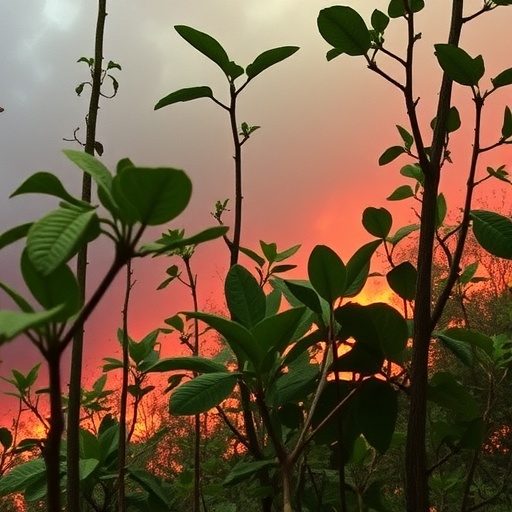
In a groundbreaking study recently published in the prestigious Proceedings of the National Academy of Sciences (PNAS), Brazilian researchers have unlocked new insights into the resilience and regeneration pathways of Amazonian forests subjected to severe environmental stressors such as fires, droughts, and windstorms. Over a comprehensive 20-year monitoring period, their rigorous field research reveals a nuanced narrative about the forest’s capacity to bounce back from disturbances while simultaneously undergoing shifts in ecological dynamics that challenge previously held assumptions about the region’s vulnerability and recovery trajectory.
The Amazon rainforest, often referred to as the lungs of the planet, has long been recognized for its unparalleled biodiversity and critical role in global climate regulation. However, the increasing frequency and intensity of extreme events like wildfires, prolonged droughts, and destructive windstorms have sparked widespread concerns regarding its long-term viability. This new study provides critical evidence that while the Amazon’s vegetation exhibits a considerable capacity for regeneration—even in severely degraded areas—the recovery process is complex and leads to altered ecological conditions that fundamentally reshape forest composition and function.
Central to the study is the observation that, following disturbances, the forest ecosystems do not simply revert to their original state. Instead, the researchers found that fire and drought selectively diminish vulnerable, specialist tree species, which are gradually supplanted by more resilient, generalist species capable of tolerating harsher environmental extremes. This ecological shift results in the emergence of more homogeneous forest landscapes that demonstrate increased resilience to future disturbances but also signify a reduction in biodiversity. Importantly, the researchers emphasize that this observed pattern does not support the notion of a widespread savannization process, a hypothesis previously entertained by some ecologists, which posits a transition of rainforest areas into savanna-like ecosystems.
The research team’s experimental work was conducted within the Tanguro forest site in Mato Grosso, a region situated at the critical transitional interface between the Amazon rainforest and the Cerrado biome. This location was deliberately chosen due to its sensitivity to climate variations and its susceptibility to anthropogenic pressures. The meticulous design involved monitoring large, 50-hectare plots subjected to varying fire regimes—including control plots free of fire, annually burned plots, and those burned triennially—enabling a comprehensive evaluation of disturbance impacts and subsequent regeneration patterns in comparison with relatively undisturbed areas.
A vital finding from the investigation is that forest regeneration progresses more robustly in the interior portions of forest plots, where the suspension of burning leads to rapid structural recovery and relatively stable species diversity. In contrast, forest edges exhibit a more protracted and vulnerable recovery phase characterized by a marked decline in species richness, ranging between 20% and 46%. This “edge effect” results from altered microclimatic conditions and increased forest exposure to external pressures like pasture lands and agricultural activities, which together exacerbate ecological stress and hinder the full recovery of native specialist species.
Further complicating this dynamic is the role of invasive and pasture-associated grasses in promoting high-intensity fires and impeding tree regeneration, particularly along forest edges. Species such as Aristida longifolia and Imperata, as well as the African-origin invasive Andropogon gayanus, initially proliferate following fire events, facilitating repeated burning cycles that can suppress tree canopy recovery. Notably, however, over time and with increased canopy closure, these grasses recede, suggesting that the forest retains an inherent capacity to regain dominance and resist permanent conversion to savanna-like environments.
The study also sheds light on critical physiological vulnerabilities underpinning forest resilience. Trees in these recovering areas often possess thinner bark and lower wood density, rendering them more susceptible to fire damage and mechanical harm from strong winds. Moreover, during intense drought conditions—often exacerbated by climate phenomena such as El Niño—many species operate perilously close to hydraulic failure thresholds, threatening their survival and the overall integrity of forest structure.
Significant in this recovery narrative is the role played by local fauna, with mammals such as tapirs and monkeys alongside various bird species acting as keystone agents in forest regeneration. These animals facilitate seed dispersal and promote the re-establishment of tree species considered “forest specialists,” which generally have denser wood and longer lifespans and are crucial for maintaining forest complexity and function.
Despite the gradual resting of fires in experimental plots and observable regeneration, the broader Amazon region continues to experience severe degradation linked predominantly to deforestation and recurrent fire events. The study cites alarming real-time data from the National Institute for Space Research (INPE) monitoring system showing that, between August 2025 and January 2026, forest degradation affected nearly 3,000 square kilometers of the Legal Amazon. This degradation significantly exceeds the area lost to outright deforestation, emphasizing the insidious nature of subtle forest weakening that creates lasting ecological scars.
The potential impact of climate variability looms large within the study’s context, particularly with the looming threat of a “super El Niño” event projected to begin later this year and potentially persist through 2027. Forecast models from the European Centre for Medium-Range Weather Forecasts suggest this phenomenon could be the most intense observed in the past 140 years, with profound implications for drought severity, fire risk, and forest health. These conditions underscore an urgent need for informed conservation policies and adaptive management approaches capable of mitigating the compounded threats of climate extremes and anthropogenic disturbance.
Ultimately, the researchers advocate a balanced perspective recognizing both the remarkable resilience of Amazonian forests and their continuing fragility. As lead author Leandro Maracahipes eloquently states, “the forests can recover even when severely degraded, but they remain highly vulnerable to new disturbances.” This nuanced understanding underscores a critical conservation imperative: preserving forest areas to sustain their regenerative capacities, ensuring that recovery does not come at the irrecoverable cost of biodiversity loss or diminished ecosystem functionality.
This seminal research not only challenges overly simplistic models that predict a binary fate for Amazonian ecosystems but also reinforces the importance of long-term, integrative field studies in illuminating ecological realities. By demonstrating that forest recovery pathways are more diverse and dynamic than previously thought, the study injects a cautiously optimistic note into the ongoing discourse surrounding Amazon conservation and climate resilience. It also highlights the importance of protecting key biomes on the planet’s frontline of climate change impact, offering a roadmap for future scientific inquiry, environmental policy, and international cooperation.
News Publication Date: 20-Apr-2026.
Web References:
https://www.pnas.org/doi/10.1073/pnas.2532833123
http://dx.doi.org/10.1073/pnas.2532833123
References: Proceedings of the National Academy of Sciences (PNAS), São Paulo Research Foundation (FAPESP).
Cite Scienmag News
Russell Cooper. (April 23, 2026). Fires, Droughts, and Windstorms Threaten the Diversity of Amazonian Vegetation. Scienmag. https://scienmag.com/fires-droughts-and-windstorms-threaten-the-diversity-of-amazonian-vegetation/
Russell Cooper. "Fires, Droughts, and Windstorms Threaten the Diversity of Amazonian Vegetation." Scienmag, 23 April 2026, https://scienmag.com/fires-droughts-and-windstorms-threaten-the-diversity-of-amazonian-vegetation/. Accessed 5 September 2026.
Russell Cooper. "Fires, Droughts, and Windstorms Threaten the Diversity of Amazonian Vegetation." Scienmag. April 23, 2026. https://scienmag.com/fires-droughts-and-windstorms-threaten-the-diversity-of-amazonian-vegetation/


