


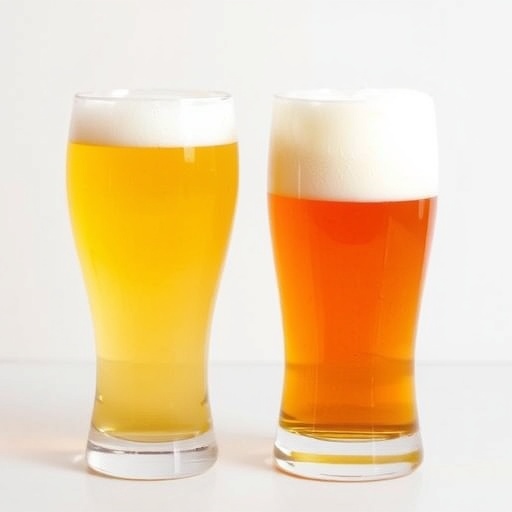
Beer, a beverage with millennia of history and a global footprint, continues to captivate scientists with its complex biochemical profile. Traditionally revered for its sensory and cultural dimensions within social and celebratory contexts, beer’s nutritional attributes, particularly regarding essential micronutrients, have begun to command scientific scrutiny. Recent research published in the Journal of Agricultural and Food Chemistry offers a compelling examination of vitamin B6 content across a diverse array of beers, including nonalcoholic (NA) variants. This study challenges preconceived notions about nutrient retention in alcohol-free brews and advances understanding of how brewing processes influence vitamin profiles.
Vitamin B6, or pyridoxine, plays an indispensable role in amino acid metabolism, neurotransmitter synthesis, and immune function in humans. Its presence in staple foods is critical for maintaining health, making the assessment of B6 in commonly consumed beverages pertinent. Intriguingly, the ingredients foundational to beer—chiefly barley, wheat, and brewer’s yeast—are recognized sources of this vitamin. Yet, the biochemical transformations inherent in malting, fermentation, and, critically, ethanol removal in NA beers raise questions about the fate of vitamin B6 during production.
The study, orchestrated by Michael Rychlik and his team, systematically analyzed 65 distinct German beers, encompassing conventional alcoholic styles such as bock, lager, and wheat beer, alongside their alcohol-free counterparts. The beers were procured from local German supermarkets, ensuring the selection reflected consumer-available products, thereby enhancing the applicability of the findings to real-world consumption.
Quantitative analyses revealed a stratification of vitamin B6 levels aligned with beer style and grain composition. Bock beers, characterized by their barley-rich base and extended maturation, exhibited the highest B6 concentrations. Lagers and dark lagers followed in descending order, with wheat beers presenting moderate levels, and rice-based beers lagging notably behind in their vitamin B6 content. This distribution underscores the contribution of malt and grain type to the micronutrient composition of the final product.
Among the most striking discoveries was the comparative vitamin B6 content between alcohol-containing beers and their nonalcoholic counterparts. The study unequivocally demonstrated no significant difference in B6 levels between standard lagers and alcohol-free lagers. This finding dismantles the assumption that the removal of ethanol necessarily depletes essential vitamins, a concern often cited by skeptics of NA beer’s nutritional viability.
Further nuance emerged when considering the production techniques of NA beers. Beers where ethanol was removed post-complete fermentation retained higher levels of vitamin B6 compared to those brewed with yeasts engineered or selected for lower ethanol production during fermentation. This suggests that the timing and method of alcohol removal are critical factors influencing nutrient preservation, with complete fermentation followed by ethanol extraction being more favorable for maintaining B6 integrity.
Nutritional impact calculations revealed that an average serving of standard lager provides approximately 20% of the U.S. recommended dietary allowance (RDA) for vitamin B6. Remarkably, one NA lager tested in the study delivered nearly 59% of the RDA in an equivalent serving size. Such data posit nonalcoholic beers not only as alternatives for those avoiding ethanol but potentially as superior vessels for B6 intake.
The implications of these results are manifold. From a public health perspective, NA beers enriched with vitamin B6 could emerge as functional beverages that contribute to micronutrient intake without the adverse effects associated with alcohol consumption. For consumers mindful of caloric intake or alcohol-related health risks, NA beers might offer a novel intersection between enjoyment and nutrition.
From a brewing science standpoint, the elucidation of vitamin retention dynamics invites refinement of fermentation and ethanol separation technologies to optimize the nutritional profile of NA beers. Breweries can employ these insights to innovate product lines that marry flavor, healthfulness, and consumer demand for nonalcoholic options.
The study also opens pathways for deeper biochemical investigations into the stability of water-soluble vitamins during various brewing stages. Understanding how factors such as pH, temperature, and yeast strain selection interact with vitamin stability could catalyze advances in both brewing methodology and nutritional science.
While this research focuses specifically on vitamin B6, it underscores a broader imperative to holistically characterize micronutrient profiles in fermented beverages. Constituents such as B vitamins collectively influence metabolic pathways, and comprehensive compositional analyses can guide informed dietary recommendations.
The funding and support from the Scientific Association for Brewing in Munich highlight the synergy between applied brewing research and academic inquiry. Such collaborations ensure that scientific findings translate into practical innovations, reinforcing the role of chemistry in enhancing everyday life through food and beverage science.
In conclusion, this study recalibrates the perception of nonalcoholic beers by validating their capacity to provide substantial vitamin B6 content comparable to traditional beers. As NA beer consumption escalates globally, these findings not only affirm their nutritional relevance but also position them within the discourse on functional foods and beverages. Future research will undoubtedly expand upon these foundations, examining other vitamins and bioactive compounds, thus enriching the scientific narrative surrounding this ancient yet ever-evolving beverage.
News Publication Date: 22-Apr-2026
Web References:
http://pubs.acs.org/doi/abs/10.1021/acs.jafc.5c14229
References:
Michael Rychlik et al., Journal of Agricultural and Food Chemistry, DOI: 10.1021/acs.jafc.5c14229
Cite Scienmag News
Daisy Hatcher. (April 22, 2026). Similar Vitamin B6 Levels Detected in Nonalcoholic and Conventional Beers. Scienmag. https://scienmag.com/similar-vitamin-b6-levels-detected-in-nonalcoholic-and-conventional-beers/
Daisy Hatcher. "Similar Vitamin B6 Levels Detected in Nonalcoholic and Conventional Beers." Scienmag, 22 April 2026, https://scienmag.com/similar-vitamin-b6-levels-detected-in-nonalcoholic-and-conventional-beers/. Accessed 3 September 2026.
Daisy Hatcher. "Similar Vitamin B6 Levels Detected in Nonalcoholic and Conventional Beers." Scienmag. April 22, 2026. https://scienmag.com/similar-vitamin-b6-levels-detected-in-nonalcoholic-and-conventional-beers/


