


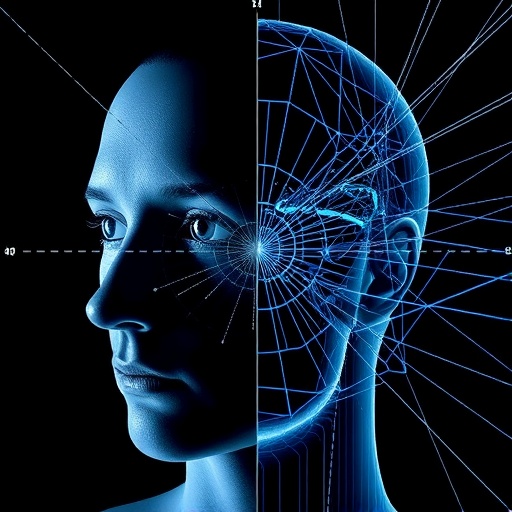
In the intricate dance of human vision, our eyes rarely come to rest. They dart, fixate, and scan the world around us with astounding fluidity, revealing much more than mere visual intake. Each movement, each glance, and each lingering pause encapsulates rich information about our cognitive processes—ranging from attention and memory to deeper layers of decision-making. A groundbreaking frontier in neuroscience and psychiatry is now harnessing the power of computational eye-tracking technology to delve into these subtle cues. This emergent field is redefining how scientists and clinicians interpret visual behavior patterns to better understand individual differences, particularly in psychiatric contexts.
Traditionally, eye-tracking research has been constrained by laboratory settings, employing highly controlled stimuli designed to isolate specific cognitive mechanisms. While this approach has produced invaluable insights, it often lacks ecological validity—that is, the degree to which findings generalize to everyday life scenarios. The human visual experience is inherently complex, dynamic, and multifaceted; thus, examining eye movements in naturalistic environments is critical for a comprehensive understanding. The latest advancements in computational methods and wearable eye-tracking devices are breaking these barriers, enabling high-dimensional data collection on a massive scale across diverse and realistic stimuli.
Central to these advances is the integration of powerful machine learning algorithms and sophisticated analytical techniques that transform raw gaze data into interpretable patterns reflective of underlying mental states. Researchers now leverage annotated stimulus features, spatiotemporal dynamics, and pattern recognition models to dissect how attention shifts over time and across varying contexts. This multi-layered analysis provides unprecedented granularity, allowing the identification of subtle individual differences that may inform more personalized approaches in psychiatry and mental health.
One notable approach emerging from this wave of research is saliency-based attention phenotyping. Saliency models predict which aspects of a visual scene automatically capture attention by analyzing features such as color, contrast, motion, and spatial configuration. Overlaying gaze data onto these salient features allows researchers to phenotype individuals based on their attentional biases or deviations. For instance, individuals with certain psychiatric disorders may exhibit atypical saliency-driven eye movement patterns, signaling potential alterations in sensory processing or cognitive prioritization.
Complementing this, data-driven gaze-pattern identification digs deeper into the raw eye movement traces without imposing preconceived hypotheses. This approach harnesses clustering algorithms and dimensionality reduction techniques to uncover naturally occurring patterns in gaze distribution and movement sequences. Through this lens, subtle yet stable gaze behaviors can be discerned, which often correlate strongly with individual traits—including cognitive styles and clinical symptomatology—thus providing a more data-informed framework for attention phenotyping.
Supervised machine-learning classification further enhances the applied potential of computational eye-tracking. By training classifiers on labeled datasets, researchers can categorize participants based on diagnostic labels or symptom severity with remarkable accuracy. These predictive models are increasingly sophisticated, integrating diverse features from fixation duration, saccade amplitudes, temporal gaze transitions, and more, to generate robust clinical predictions. Such tools could revolutionize psychiatric diagnostics, enabling objective, non-invasive, and scalable assessment methods that supplement traditional clinical evaluations.
In parallel, unsupervised subgroup clustering techniques interrogate the heterogeneity intrinsic to psychiatric populations by identifying distinct subgroups of patients based solely on their gaze behavior patterns. These data-driven subtypes may correspond to unique neurocognitive profiles, treatment responses, or risk phenotypes, thereby enriching the clinical landscape with nuanced categorizations and personalized intervention pathways.
The convergence of these four modeling frameworks—saliency-based attention phenotyping, data-driven gaze-pattern identification, supervised classification, and unsupervised clustering—opens a new chapter in psychiatric research. They collectively enable a more holistic understanding of visual attention and its alterations in mental illness, bridging the gap between basic cognitive neuroscience and clinical application. This fusion of technology and theory could redefine the way disorders such as schizophrenia, autism spectrum disorders, ADHD, and mood disorders are understood and managed.
Of course, these exciting opportunities do not come without challenges. Methodologically, eye-tracking data is highly sensitive to noise, measurement error, and subject compliance, particularly outside controlled laboratory conditions. Calibration consistency, artifact removal, and standardization of stimuli and protocols remain critical concerns. Moreover, the interpretability of machine learning models poses important questions for clinical trustworthiness, demanding transparent and explainable methods rather than black-box algorithms.
Looking ahead, the integration of eye-tracking with other neuroimaging and biomarker data promises even richer, multimodal insights. Fusion with EEG, fMRI, or genetic profiles can illuminate how gaze behavior relates to underlying neural circuitry and genetic predispositions. Longitudinal studies employing computational eye-tracking may track illness trajectories and treatment efficacy in real-time, paving the way for dynamic, adaptive clinical interventions tailored to individual neurocognitive signatures.
Crucially, large-scale data collection efforts, made feasible by mobile and wearable eye-tracking systems, will democratize research participation beyond specialized clinics or research institutions. This inclusivity can enable population-level mapping of attention phenotypes and psychiatric vulnerabilities, contributing to early detection and prevention strategies that are both scalable and cost-effective.
Equally exciting is the potential for translational innovations. Beyond diagnostics, eye-tracking analytics could be woven into digital therapeutics, cognitive training, and even assistive technologies that monitor and modulate attention in everyday contexts. Adaptive algorithms could provide real-time feedback to individuals, fostering self-awareness and compensatory strategies to mitigate cognitive deficits.
In sum, computational eye-tracking embodies a synthesis of technological innovation, analytical sophistication, and clinical ambition. The field stands at the cusp of transforming our understanding of the human mind, offering a window into the nuanced language of where and how we look. By capturing the subtle signatures of visual attention and linking them to individual differences and psychiatric phenotypes, researchers are charting a course toward a future of precision mental health care rooted in the very act of seeing.
This advancing frontier underscores that eyes do not just perceive the world—they reveal the mind. Through the lens of computational modeling and machine learning, the small, rapid movements of our gaze emerge as powerful biomarkers, narrating the complex story of cognition and mental health in a way never before possible. As these methodologies mature and proliferate, they promise to illuminate the shadows of psychiatric disorders with unprecedented clarity and open pathways to more personalized, effective treatments for those in need.
Cite Scienmag News
Glenn Wilkins. (April 22, 2026). Computational Eye-Tracking Reveals Psychiatric Disorder Differences. Scienmag. https://scienmag.com/computational-eye-tracking-reveals-psychiatric-disorder-differences/
Glenn Wilkins. "Computational Eye-Tracking Reveals Psychiatric Disorder Differences." Scienmag, 22 April 2026, https://scienmag.com/computational-eye-tracking-reveals-psychiatric-disorder-differences/. Accessed 3 September 2026.
Glenn Wilkins. "Computational Eye-Tracking Reveals Psychiatric Disorder Differences." Scienmag. April 22, 2026. https://scienmag.com/computational-eye-tracking-reveals-psychiatric-disorder-differences/


