


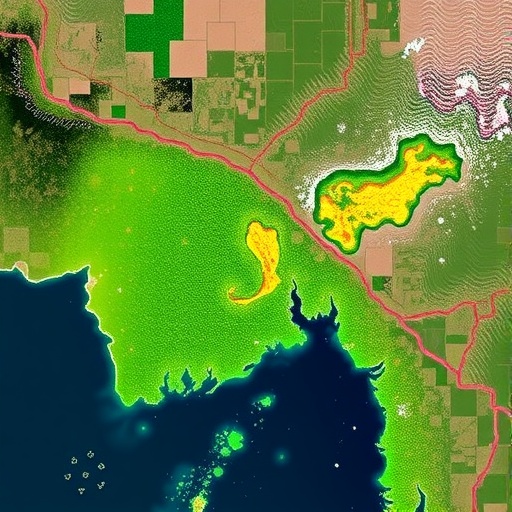
Bangladesh, a nation renowned for its extensive and dynamic wetland ecosystems, plays a critical role in regional biodiversity, climate regulation, and local livelihoods. Yet, despite their importance, these wetlands face severe threats from human encroachment, climate change, and natural disasters. Long-term monitoring and precise classification of these wetlands are thus vital to inform conservation efforts and sustainable resource management. Recent advancements in remote sensing technology and geospatial analysis have revolutionized how environmental scientists can observe and interpret wetland dynamics, offering unprecedented temporal and spatial resolution. A groundbreaking study, recently published in Communications Earth & Environment, leverages Google Earth Engine’s powerful cloud-based platform and introduces an innovative sample migration technique to refine wetland subclass extraction in Bangladesh over extended periods.
Remote sensing, the science of acquiring information about Earth’s surface without physical contact, has been instrumental in environmental monitoring. Traditionally, land cover classification relied on satellite imagery that, while informative, often struggled with the heterogeneity and seasonal variation inherent in wetland ecosystems. In the case of Bangladesh’s wetlands, which are influenced by monsoonal flooding, tidal actions, and human interventions, distinguishing between different wetland types presents a unique challenge. The novel approach adopted by Zhao et al. utilizes Google Earth Engine’s extensive repository of multi-decadal satellite data, integrating spectral, temporal, and spatial information to enhance classification accuracy. This methodology not only distinguishes wetlands from non-wetlands but further disaggregates wetlands into subclasses, offering granularity previously unachieved on national scales.
At the core of this study is the sample migration technique, a methodological innovation addressing the spectral variability of wetland subclasses over time. Traditional classification approaches may falter when training data, collected during a specific year or season, becomes obsolete as the landscape evolves. Sample migration circumvents this by dynamically updating the training samples to better represent temporal changes, enabling the classifier to adapt across years. This technique is particularly well-suited to Bangladesh’s wetlands, where seasonal floods and sediment deposition constantly reshape land-water boundaries. By allowing samples to migrate in the feature space based on temporal trends, the approach significantly improves long-term classification consistency and robustness.
The implementation of the sample migration algorithm within Google Earth Engine marks a notable advancement in operational remote sensing. Google Earth Engine’s capacity for large-scale data processing and machine learning integration accelerates analysis workflows, transforming what once took months of manual calibration into automated, scalable pipelines. In this study, the authors harnessed an extensive archive of Landsat imagery spanning several decades, ensuring comprehensive temporal coverage. This dataset, combined with phenological metrics such as vegetation indices and water presence frequency, facilitated the extraction of subclass signatures for wetlands, including permanent water bodies, seasonal floodplains, marshes, and other ecologically distinct units.
Bangladesh’s geography and climate exert profound influences on wetland dynamics. The country’s deltaic landscape, intersected by numerous rivers and prone to annual monsoon flooding, produces highly transient wetland environments. Furthermore, growing population pressures and land-use changes exacerbate these dynamic conditions, underscoring the need for updated spatial datasets to guide policy interventions. The long-term subclass mapping delivered by this study reveals not only spatial distribution patterns but temporal trends that highlight areas of wetland gain and loss. Such insights are critical for environmental managers and policymakers striving to balance development needs with ecological restoration goals.
The study leverages supervised machine learning algorithms, notably random forests, known for their robustness and capacity to handle high-dimensional data. By combining these classifiers with dynamic training datasets shaped by sample migration, the researchers achieved notably high classification accuracies across multiple wetland categories. This contrasts with earlier methods prone to confusion between subclasses, particularly in transitional zones where seasonal inundation blurs class boundaries. The nuanced spectral signatures captured via multi-temporal analysis substantially reduce misclassification, enhancing confidence in the generated wetland maps.
One of the most remarkable aspects of this study is its scalability and potential transferability to other complex wetlands worldwide. The integration of sample migration into widely accessible platforms like Google Earth Engine democratizes advanced environmental monitoring, enabling researchers and agencies in data-scarce regions to benefit from cutting-edge methodologies. The open-access nature of Earth Engine combined with the algorithmic transparency presented by the authors lays a foundation for future global wetland assessments, potentially informing global frameworks such as the Ramsar Convention on Wetlands and the United Nations’ Sustainable Development Goals.
Beyond classification, the newly derived long-term wetland maps provide essential baseline data for ecological modeling and climate impact studies. Wetlands serve as crucial carbon sinks, and understanding their spatial-temporal dynamics enhances estimates of greenhouse gas fluxes and vulnerability assessments under climate change scenarios. In Bangladesh, where flooding is a recurrent hazard intensified by rising sea levels, precise mapping of wetland subclasses informs flood risk management and adaptive planning. The insights gained from this study could be integrated into early warning systems, disaster response initiatives, and habitat conservation strategies.
The implications for biodiversity conservation are equally pronounced. Wetlands in Bangladesh host myriad flora and fauna, including endangered species reliant on specific wetland types. By distinguishing wetlands into accurate subclasses, conservationists can prioritize habitats based on ecological value and vulnerability. The dynamic nature of sample migration ensures that habitat maps remain current despite rapid environmental changes, a critical feature when managing species populations affected by habitat fragmentation or degradation.
Moreover, the study emphasizes the importance of inclusive data integration, incorporating ground truth points alongside remote sensing data. Field sampling conducted in collaboration with local authorities and communities strengthened model validation, enhancing the reliability of subclass boundaries. This interdisciplinary approach blending technology, ecology, and local knowledge sets a benchmark for future environmental monitoring projects aiming to balance methodological rigor with practical applicability.
The study’s success was also facilitated by advancements in cloud computing infrastructure. Processing high volumes of satellite imagery to extract and update sample points over multiple years and seasons demands substantial computational power. Google Earth Engine’s cloud-native architecture eliminates such constraints, enabling near real-time analysis over vast geographic extents. This technological leap fosters more frequent updates of wetland maps, allowing for proactive management rather than reactive responses to ecological degradation.
Looking forward, the authors suggest that integrating additional data sources, such as Sentinel-2 imagery with higher spatial resolution and synthetic aperture radar (SAR) data resilient to cloud cover, could further refine wetland subclass delineation. Combining optical and radar datasets would address limitations stemming from monsoon-induced cloudiness, maximizing temporal data availability. Enhanced algorithms incorporating deep learning better capturing complex temporal patterns also present promising research avenues, potentially elevating classification performance beyond current benchmarks.
Importantly, this research underscores the broader utility of Earth observation science in confronting global environmental challenges. Wetlands are vital ecosystems at the intersection of biodiversity, water security, and climate resilience. Accurate, scalable monitoring methods as demonstrated by this study enable evidence-based policies, conservation prioritization, and sustainable development planning. As climate change accelerates ecosystem shifts, adaptive, data-driven solutions like sample migration represent vital instruments in the scientific toolkit.
In summation, Zhao, Zhu, Zhang, and colleagues have delivered a landmark study that innovatively combines sample migration with Google Earth Engine’s computational prowess to extract detailed long-term wetland subclasses in Bangladesh. Their approach surmounts traditional obstacles posed by ecological variability and data temporal gaps, presenting a powerful methodology with global applicability. Beyond generating vital environmental datasets, this work paves the way for more resilient wetland management frameworks, positioning remote sensing at the forefront of ecological stewardship in vulnerable landscapes worldwide. The fusion of technology, science, and practical conservation forged in this research offers a compelling blueprint for harnessing geospatial intelligence to safeguard planetary health in the decades ahead.
Cite Scienmag News
Margaret Porter. (April 22, 2026). Long-Term Wetland Mapping in Bangladesh via Earth Engine. Scienmag. https://scienmag.com/long-term-wetland-mapping-in-bangladesh-via-earth-engine/
Margaret Porter. "Long-Term Wetland Mapping in Bangladesh via Earth Engine." Scienmag, 22 April 2026, https://scienmag.com/long-term-wetland-mapping-in-bangladesh-via-earth-engine/. Accessed 4 September 2026.
Margaret Porter. "Long-Term Wetland Mapping in Bangladesh via Earth Engine." Scienmag. April 22, 2026. https://scienmag.com/long-term-wetland-mapping-in-bangladesh-via-earth-engine/


