


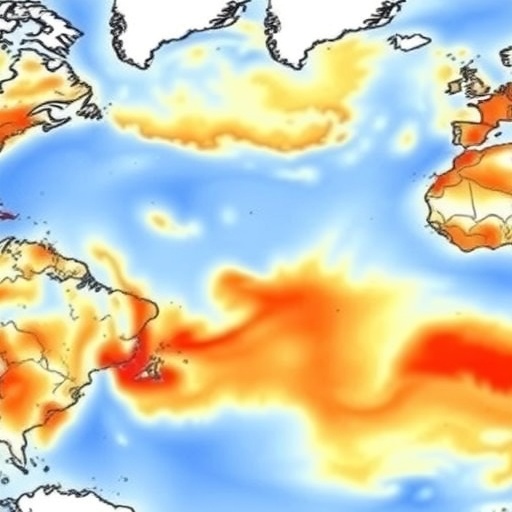
For decades, the El Niño-Southern Oscillation (ENSO)—a large-scale climate pattern known for triggering events like droughts, flooding, and marine heatwaves worldwide—has both fascinated and challenged scientists aiming to forecast its occurrence with accuracy. Traditional methods often come with considerable computational demands or rely heavily on historical datasets and complex artificial intelligence frameworks that complicate interpretation. Recently, a group of researchers at the University of Hawai‘i at Mānoa has shattered expectations by developing a remarkably effective ENSO forecasting model that relies solely on ocean surface observations, bypassing the need for intricate climate simulations or extensive AI training.
This innovative model celebrates simplicity without sacrificing precision. Grounded in fundamental principles identified over half a century ago by pioneering oceanographers Klaus Wyrtki and Klaus Hasselmann, the new approach leverages two distinct types of climate memory encoded in oceanic conditions. Wyrtki originally demonstrated how variations in sea level can indicate the accumulation of heat in the tropical Pacific. This “Wyrtki memory” reflects dynamic ocean processes that retain information about past climatic interactions. Meanwhile, Hasselmann’s work underscored the ocean’s capacity to harbor lingering imprints of global sea surface temperature anomalies, what is now termed “Hasselmann memory,” which can exert a delayed influence on ENSO’s evolution.
The researchers’ model, termed the “Wyrtki-CSLIM” (Cyclostationary Linear Inverse Model), is the first to marry these two core theories in a computational framework that is both elegant and efficient. It processes data from tide gauges—devices historically propelled by Wyrtki’s insights, now calibrated by satellite measurements of sea surface height—with global sea surface temperature observations to capture the dual climate memories critical to ENSO’s predictability. This data-driven method stands in stark contrast to conventional dynamical climate models that simulate physical ocean-atmosphere processes explicitly or AI models reliant on voluminous and sometimes opaque training datasets.
Over six decades of historical ocean observations served as a training ground and test bed for Wyrtki-CSLIM’s predictive power. When tasked with retrospectively forecasting the Niño3.4 index—a key metric denoting tropical Pacific sea surface temperature deviations indicative of El Niño or La Niña conditions—the model produced striking results. It showed skillful predictions up to 15 months in advance, a timeframe that surpasses many existing leading models. This temporal window is particularly valuable; enhancing long-term ENSO forecasts could revolutionize early warning systems and adaptive preparedness strategies in vulnerable regions worldwide.
Crucially, this leap in forecasting skill was achieved without resorting to the computationally intensive simulations characteristic of most state-of-the-art climate models. The Wyrtki-CSLIM’s parsimonious design allows for rapid, straightforward forecasts that are transparent and interpretable by climate scientists. This transparency fosters trust and comprehension, which are often elusive in AI-driven systems, thereby enhancing the model’s usability in policy and decision-making arenas.
The implications of this research extend beyond forecasting accuracy. By demonstrating that two quantifiable and historically recognized forms of oceanic climate memory underpin ENSO predictability, this work charts a clear path forward for future model development. It signals that improved forecasts can emerge from a focused understanding of core physical mechanisms rather than ever-growing model complexity. This paradigm shift could catalyze the creation of accessible, cost-efficient climate prediction tools, especially valuable for nations and communities with limited computational resources.
As a real-time testament to their model’s practical value, the Wyrtki-CSLIM forecast anticipates the development of a significant El Niño event by late this year, marked by sea surface temperatures exceeding 2 degrees Celsius above normal across the equatorial eastern Pacific. This projection aligns closely with outputs from sophisticated dynamical models, offering independent corroboration and confidence to stakeholders reliant on accurate ENSO outlooks. The forecast is publicly accessible via the University of Hawai‘i Sea Level Center, underscoring the team’s commitment to transparency and collaborative climate resilience.
The strength of the Wyrtki-CSLIM prediction relative to other statistical models highlights both its innovative methodology and the critical role of oceanic memory in climate systems. However, researchers caution that inherent uncertainties remain, and the eventual climate impacts of any given El Niño event can vary substantially. Variables such as atmospheric conditions, regional feedbacks, and ocean-atmosphere couplings complicate outcomes. Therefore, while the model sets a new benchmark in predictive skill, it doesn’t entirely eliminate the need for comprehensive, multidisciplinary climate monitoring.
This breakthrough also resonates with wider scientific efforts to demystify complex climate phenomena through interpretable, physics-based models. It suggests that embracing a “back-to-basics” approach, followed by nuanced integration of fundamental principles and empirical data, can yield operationally viable climate prediction systems. In doing so, it compels the research community to rethink the trade-offs between model complexity and accessibility in the era of big data and AI dominance.
In conclusion, the Wyrtki-CSLIM stands as a milestone in climate science, reinforcing the enduring relevance of foundational oceanographic discoveries. By skillfully integrating Wyrtki’s and Hasselmann’s concepts into a streamlined inverse model, scientists have unlocked a reliable tool for ENSO prediction that is not only scientifically robust but also pragmatically valuable for global preparedness. With climate variability ever more impactful in a warming world, such advancements in forecasting could be pivotal in safeguarding societies and ecosystems from the extremes wrought by El Niño and La Niña.
The research team behind this innovation emphasizes the model’s potential for democratizing climate prediction. By removing barriers linked to computational expense and complex data requirements, they envision a future where rural, island, and developing regions can also harness reliable ENSO forecasts to manage water resources, agriculture, and disaster risk. This democratization aligns perfectly with current global climate adaptation priorities, amplifying the societal relevance of their work.
Continued efforts are underway to refine the Wyrtki-CSLIM, incorporating emerging oceanographic and atmospheric datasets to enhance its resolution and lead time further. The team remains cautiously optimistic that their approach will not only transform ENSO forecasting but may also inspire analogous models for other climate oscillations and extreme events. As the frontier of climate science presses on, blending empirical elegance with technological progress offers a promising template for advancing our understanding and stewardship of the Earth’s dynamic climate system.
News Publication Date:
14-Apr-2026
Web References:
http://dx.doi.org/10.1029/2025GL119694
https://uhslc.soest.hawaii.edu/research/ENSOforecast/
References:
Wang, Y., Widlansky, M., et al. (2026). ENSO Predictability From Combined Wyrtki and Hasselmann Memory in a Cyclostationary Linear Inverse Model. Geophysical Research Letters. DOI: 10.1029/2025GL119694
Cite Scienmag News
Violet Maxwell. (April 21, 2026). Simple ocean model skillfully predicts El Niño, signals a strong event ahead. Scienmag. https://scienmag.com/simple-ocean-model-skillfully-predicts-el-nino-signals-a-strong-event-ahead/
Violet Maxwell. "Simple ocean model skillfully predicts El Niño, signals a strong event ahead." Scienmag, 21 April 2026, https://scienmag.com/simple-ocean-model-skillfully-predicts-el-nino-signals-a-strong-event-ahead/. Accessed 4 September 2026.
Violet Maxwell. "Simple ocean model skillfully predicts El Niño, signals a strong event ahead." Scienmag. April 21, 2026. https://scienmag.com/simple-ocean-model-skillfully-predicts-el-nino-signals-a-strong-event-ahead/


