


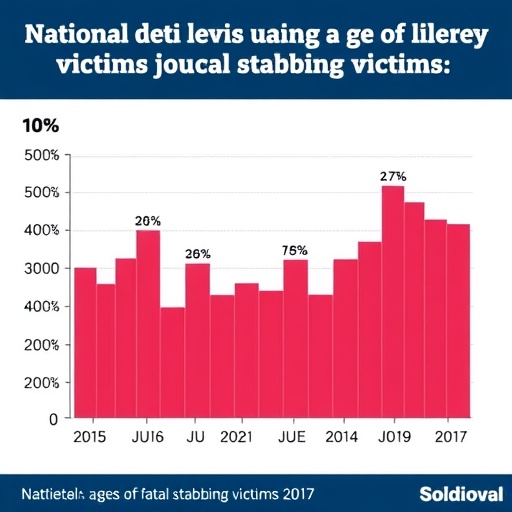
An in-depth analysis of fatal stabbing incidents among children and teenagers in England has revealed alarming trends and underlying factors contributing to this public health crisis. According to a study published in the Emergency Medicine Journal, the average age of young victims of fatal stabbings is now as low as 14 years, underscoring the urgent need for targeted intervention and prevention strategies. This research sheds new light on the demographic disparities, injury patterns, and social contexts that frame these tragic losses, utilizing data systematically gathered from the National Child Mortality Database (NCMD) between 2019 and 2024.
The NCMD, established in 2019, serves as the first comprehensive repository to collect data on all child deaths in England from birth through age 17. Researchers leveraged this database, integrating demographic data and health records with 2021 census information to adjust for population differences, thereby providing refined mortality rates. Over the five-year period studied, 145 children succumbed to knife wounds, with a sharp rise in incidents recorded since 2021. This spike highlights an intensifying crisis that disproportionately affects young males—who account for 90% of the fatalities.
Geographic analysis points to London as the epicenter of these knife-related deaths, representing 43% of the total cases. Urban centers like the West Midlands and the North West follow in incidence but far behind London’s elevated rates. These findings correlate with broader criminological and social data demonstrating the concentration of serious youth violence in densely populated metropolitan areas, where socioeconomic pressures are often acute. Contrastingly, regions such as the South East and East of England experience substantially lower fatal stabbing rates, indicating possible regional protective factors or differing social dynamics.
Ethnicity emerges as a significant determinant of risk, with children identified as Black being 13 times more likely to suffer fatal stab wounds compared to their White counterparts. This disparity is compounded by socioeconomic deprivation; children living in England’s most deprived areas face a fatality rate seven times higher than those in the country’s most affluent neighborhoods. These intersecting factors of race and poverty emphasize the structural inequalities underpinning youth violence and highlight a critical need for multifaceted public health approaches that address these root causes.
Detailed forensic and medical examination of 57 available case files reveals that the majority of fatal injuries target vital regions, with chest and neck wounds accounting for 76% of deaths. The lethality of such injuries is compounded by prehospital mortality, as over half of these victims (60%) died before reaching medical care. These findings underscore gaps in both emergency response and possible preventive surveillance mechanisms that might intervene before lethal injury occurs.
The study also delves deeply into the psychosocial dimensions preceding these deaths. A striking 75% of the children were known to social services prior to their fatal injuries, indicating existing vulnerability and contact with protective systems. Moreover, 59% of these children had documented experiences of domestic abuse, and 51% had endured the loss of an important adult figure—through death, separation, or bereavement—highlighting the critical role of trauma and adverse childhood experiences in the pathway to violence-related mortality.
Gang involvement is identified in over one-third of analyzed cases, affirming the connection between organized youth violence and lethal knife crime. Furthermore, illicit substance use was noted in 68% of the children before their deaths, implicating complex behavioral health issues that intertwine with violent outcomes. Concerns about knife carrying were documented in approximately one-quarter of cases, suggesting that early recognition of weapon possession might offer an opportunity for targeted preventive strategies.
Mental health and neurodiversity concerns were also prominent, with half of the children exhibiting such diagnoses, and just over a quarter (28%) having been referred to Child and Adolescent Mental Health Services (CAMHS). These statistics reveal significant intersections between cognitive, emotional health issues, and violent victimization and perpetration, demanding integrated responses that encompass mental health, social support, and violence prevention frameworks.
A troubling insight from the investigation is the dual role many victims played as both perpetrators and victims of violence—60% of cases involved children who were engaged in violent behavior themselves. This bidirectional involvement calls for nuanced understanding and interventions that address the cyclical nature of youth violence, emphasizing rehabilitation and support alongside law enforcement measures.
Researchers highlight critical gaps in preinjury identification and support for marginalized children, especially those exposed to domestic violence and other adverse experiences. Despite frequent contacts with social and statutory services, many children did not receive adequate targeted interventions to mitigate exposure to violence and trauma. This lack of early and focused intervention marks a failure point in safeguarding vulnerable youth populations and contributes to preventable loss of life.
The UK government’s commitment in 2024 to halving knife crime within the parliament’s lifetime is noted as a vital policy response. Nonetheless, this study signals that success will depend heavily on deploying resources toward early detection of risk factors, culturally sensitive outreach in racialized and deprived communities, and a concerted focus on social determinants of health. Holistic strategies incorporating education, mental health services, family support, and community engagement are essential to reversing these trends.
In conclusion, the comprehensive review of fatal knife crimes against children in England presents a stark portrait of contemporary youth violence—intertwined with racial, socioeconomic, and psychological complexities. The data compel public health officials, policymakers, and practitioners to reevaluate current intervention paradigms, prioritizing early, sustained, and multifaceted efforts to disrupt the trajectory from childhood adversity to deadly violence. Only through systemic changes and dedicated support to the most vulnerable can the tide of youth knife crime begin to recede.
News Publication Date: 20-Apr-2026
Web References: National Child Mortality Database (NCMD)
References: DOI: 10.1136/emermed-2025-215154
Cite Scienmag News
Ophelia Keating. (April 21, 2026). National data reveal average age of young fatal stabbing victims has dropped to 14. Scienmag. https://scienmag.com/national-data-reveal-average-age-of-young-fatal-stabbing-victims-has-dropped-to-14/
Ophelia Keating. "National data reveal average age of young fatal stabbing victims has dropped to 14." Scienmag, 21 April 2026, https://scienmag.com/national-data-reveal-average-age-of-young-fatal-stabbing-victims-has-dropped-to-14/. Accessed 4 September 2026.
Ophelia Keating. "National data reveal average age of young fatal stabbing victims has dropped to 14." Scienmag. April 21, 2026. https://scienmag.com/national-data-reveal-average-age-of-young-fatal-stabbing-victims-has-dropped-to-14/


