


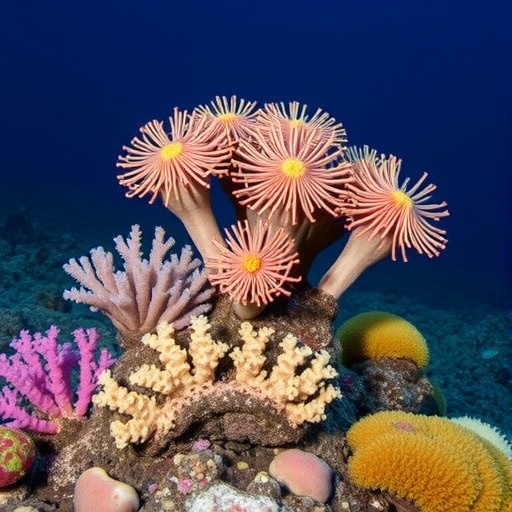
A groundbreaking study has revealed that deep-water coral ecosystems in the Galápagos region experienced a dramatic disappearance lasting over a millennium, only to eventually recover after thousands of years. This unprecedented research highlights the vulnerability of deep-sea coral habitats to subtle but sustained shifts in global climate patterns, challenging prior assumptions about their resilience to environmental change. The findings, published in the Proceedings of the National Academy of Sciences, shed new light on the complex interactions between oceanic climate variability and biodiversity in one of the most diverse marine areas on Earth.
Deep-sea corals, unlike their more widely studied shallow-water relatives, inhabit dark, cold environments often exceeding depths of 400 meters. These ecosystems serve as vital biodiversity hotspots, providing habitat and nursery grounds for a diverse assemblage of marine life including fish and invertebrates. However, due to the technological and logistical difficulties in exploring these extreme depths, our understanding of their long-term dynamics and sensitivity to environmental perturbations has remained limited. This study leverages advanced uranium-thorium radiometric dating to construct a continuous 117,000-year record from fossil coral samples, offering an unprecedented window into these ecosystems’ historical fluctuations.
The research team, led by Earth Sciences experts at the University of Bristol, meticulously analyzed over 900 fossilized deep-sea stony corals retrieved through submersible and remotely operated vehicle expeditions within the Galápagos Marine Reserve. These samples spanned depths approaching 1,000 meters, capturing coral growth patterns that chronicle environmental conditions and ecosystem responses over extensive timescales. Their synthesized record revealed persistence through significant climatic epochs, including glacial and interglacial transitions, before pinpointing an anomalous coral absence that began approximately 5,000 years ago.
This hiatus in deep-sea coral presence correlates strongly with a prolonged phase characterized by muted El Niño Southern Oscillation (ENSO) activity, specifically associated with extended La Niña-like conditions. ENSO, a dominant driver of climate variability across the Pacific Ocean, modulates ocean temperature, circulation, and nutrient dynamics, thereby influencing marine ecosystems at multiple depths. The study posits that intensified ocean circulation during this La Niña phase transported nutrient-rich but oxygen-depleted deep waters upward, effectively creating hypoxic conditions hostile to the survival of slow-growing deep-water corals.
Such oxygen limitation at depth, combined with altered nutrient fluxes, likely disrupted the delicate physiological balance of these coral species, leading to their disappearance from the fossil record for over a thousand years. This finding overturns the traditional paradigm that extreme warming events caused by El Niño episodes primarily stress coral ecosystems. Instead, it underscores that long-lasting, cooler ocean circulation states can similarly precipitate ecosystem collapse, particularly within the less understood and often overlooked deep-sea habitats.
The study’s implications extend beyond reconstruction of past ecological events, offering critical insights into how future climate dynamics might reshape deep ocean biodiversity. Climate models forecast modifications in ENSO frequency and intensity with ongoing global warming, yet the specific consequences for deep-sea coral refugia remain uncertain. By establishing a direct linkage between historic ENSO variability and coral ecosystem health, researchers emphasize that subtle changes in oceanic circulation and chemistry could trigger profound and lasting impacts on these fragile marine communities.
Despite the prolonged absence of corals, the historical record demonstrates that recolonization and habitat recovery were ultimately possible, albeit over timescales spanning several centuries to millennia. This remarkable resilience suggests that, given appropriate environmental conditions and mitigation of stressors, deep-sea coral ecosystems can re-establish, providing hope for conservation strategies aimed at preserving biodiversity hotspots amidst rapid anthropogenic environmental shift.
The collaborative project included contributions from the Charles Darwin Foundation and Galápagos National Park Directorate, underscoring the importance of integrating research findings into marine protected area management. Current marine conservation efforts often prioritize shallow coastal habitats; however, this new evidence advocates for expanded protections that encompass deeper seafloor environments, ensuring connectivity and robustness against climate-driven disturbances.
Fieldwork underpinning this study relied on cutting-edge exploration technology, including manned submersibles like Alvin and remotely operated vehicles such as SuBastian, enabling precise sampling in challenging deep-water settings. These expeditions were supported by research vessels Atlantis and Falkor, exemplifying the synergy of multidisciplinary teams combining geological, biological, and oceanographic expertise in service of unraveling ecosystem histories.
Principal investigators emphasize the necessity of continued monitoring and modeling to anticipate how evolving ENSO patterns will manifest throughout the water column, advocating for the integration of deep-sea ecosystems into climate resilience frameworks. The Galápagos Marine Reserve presents an ideal natural laboratory to observe ongoing changes and develop adaptive management approaches tailored for both surface and abyssal ecosystems.
This research fundamentally recalibrates our understanding of deep-sea coral vulnerability, firmly situating climate variability as a pivotal mechanism capable of inducing large-scale ecological turnover deep beneath the ocean’s surface. As ENSO remains an enigmatic climate driver with complex regional expressions, elucidating its multifaceted influence on marine biodiversity is essential for informed stewardship of oceanic resources in a warming world.
News Publication Date: 20 April 2026
Web References: http://dx.doi.org/10.1073/pnas.2532081123
References: Proceedings of the National Academy of Sciences
Cite Scienmag News
Russell Cooper. (April 20, 2026). Millennium-Old Galápagos Deep-Sea Corals Reveal Key Pacific Climate Shift. Scienmag. https://scienmag.com/millennium-old-galapagos-deep-sea-corals-reveal-key-pacific-climate-shift/
Russell Cooper. "Millennium-Old Galápagos Deep-Sea Corals Reveal Key Pacific Climate Shift." Scienmag, 20 April 2026, https://scienmag.com/millennium-old-galapagos-deep-sea-corals-reveal-key-pacific-climate-shift/. Accessed 4 September 2026.
Russell Cooper. "Millennium-Old Galápagos Deep-Sea Corals Reveal Key Pacific Climate Shift." Scienmag. April 20, 2026. https://scienmag.com/millennium-old-galapagos-deep-sea-corals-reveal-key-pacific-climate-shift/


