


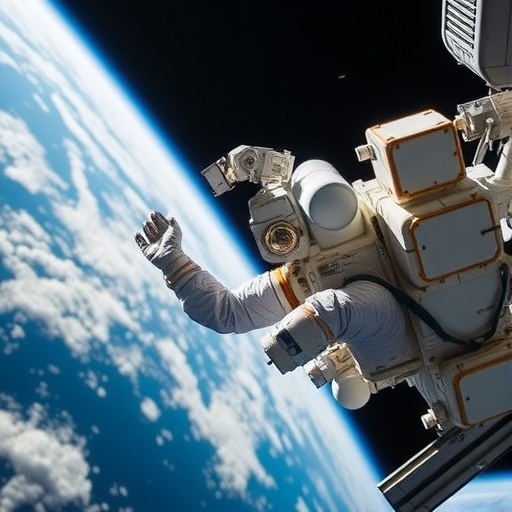
In the peculiar realm of space, where the familiar pull of gravity is absent, everyday activities such as gripping objects undergo profound changes. On Earth, gravity ensures that objects fall if not firmly held, guiding our hand strength and coordination. In the weightlessness of space, however, objects defy this fundamental force — they neither fall nor behave predictably when released, radically altering sensorimotor dynamics. In groundbreaking research published in JNeurosci, Philippe Lefèvre and collaborators from Université catholique de Louvain and Ikerbasque delve deeply into how astronauts recalibrate their grip and hand coordination when transitioning between Earth’s gravity and the microgravity of space.
Their investigation provides vital insights into the brain’s remarkable adaptability and how ingrained gravitational expectations persist, influencing motor control even in radically different environments. The study reveals that, despite months in space, where gravity’s influence is effectively nullified, the brain continues to anticipate Earth-like gravitational forces. This anticipation leads astronauts to overcompensate — applying excessive grip force during object manipulation. The grip becomes tentative and heightened particularly when objects are moved because inertia acts unpredictably without gravity to constrain motion, requiring more precise and adaptive manual control strategies.
This overcompensation is not merely a reflex but rather a manifestation of the brain’s predictive coding framework, where sensorimotor control is based on prior experiences and expectations about the environment. The persistent “gravitational prior” — an internal model developed over a lifetime of living under Earth’s constant pull — clings to neural circuits, creating a lag in adaptation. As a result, astronauts’ initial interactions with objects in space become fraught with overcautious grip and awkward motor adjustments.
Upon returning to Earth, a reverse adaptation is observed. Astronauts initially misjudge the forces needed to handle objects under Earth’s gravity, reflecting that their sensorimotor system remains tuned to a microgravity context. These maladjustments gradually diminish, showing a progressive neural recalibration to Earth’s familiar gravitational environment. This dynamic reshaping of motor control underscores the plasticity but also the inertia of our sensorimotor systems when faced with drastic environmental shifts.
The implications of these findings reach far beyond astronaut training. Understanding how the nervous system adapts—or struggles to adapt—to changing gravitational contexts may inform rehabilitation practices for patients learning motor skills after injury or neurological diseases. Additionally, it exposes the delicate balance between sensory input, motor output, and internal models the brain continuously refines to maintain optimal interaction with the surroundings.
Technically, the researchers studied a cohort of astronauts over extended periods, leveraging sophisticated motion capture and grip force measurement devices during pre-flight, in-flight, and post-flight sessions. They systematically analyzed grip dynamics during different object manipulation tasks, isolating the effects of movement, grip steadiness, and predicted inertial forces in zero-gravity. This longitudinal approach allowed them to observe not only immediate adjustments but also the temporal evolution of sensorimotor adaptation driven by altered environmental constraints.
Interesting to note is how this phenomenon illustrates the brain’s reliance on Bayesian inference principles, where prior knowledge (gravity expectations) weighs heavily against current sensory feedback. When sensory feedback in microgravity contradicts these priors, the nervous system initially errs toward what is historically reliable—Earth’s gravity—leading to the observed overshooting in grip strength. Only with time and repetition does the brain recalibrate its internal model, reducing the mismatch and optimizing motor commands for the new gravitational context.
Philippe Lefèvre expressed enthusiasm about the publication of these findings, highlighting how the project embodies decades of collaboration, coordination with space agencies, and meticulous data analysis. The work actually spans close to twenty years, marking a significant milestone in sensorimotor neuroscience research, particularly in the challenging context of spaceflight experiments where logistical and technological hurdles are immense.
Looking ahead, the research team is optimistic about disseminating further data addressing other facets of sensorimotor coordination in space. These include astronauts’ accuracy in point-to-point movements while handling objects, compensation mechanisms following unexpected collisions or disturbances, and the nuanced role of skin friction variations in grip adaptation. Such data promise to enrich our understanding of how multi-sensory integration and motor control evolve when gravity is no longer a constant.
This research also sheds light on the practical challenges astronauts face during space missions. Tasks that are trivial on Earth—like moving tools, handling experiments, or repairing equipment—require substantially more cognitive and motor effort in space as astronauts consciously and unconsciously adjust their grip forces. These adaptations potentially impact mission efficiency, safety, and ergonomics, emphasizing the need for targeted training protocols and assistive technologies.
The persistence of gravitational priors despite prolonged absence poses fascinating questions about entrenched neural encoding of environmental constants. How deeply are these models sculpted during early development, and what limits their flexibility? Addressing these questions could spur advances not only in neuroscience but also in the design of adaptive robotic systems and prosthetics that interact seamlessly across vastly different physical contexts.
As humanity prepares for extended space travel — from lunar bases to Mars missions — understanding the sensorimotor adjustments necessary for fluid, safe interaction with the environment becomes crucial. This work lays essential groundwork for developing countermeasures against motor control errors, designing user-friendly tools, and potentially tailoring individualized astronaut training to accelerate neural adaptation.
In sum, Lefèvre and colleagues’ study illuminates the complex interplay between environment, brain, and motor behavior. It reveals that sensorimotor coordination and grip control are not simply reflexive but depend heavily on brain predictions shaped by lifelong gravitational experience. Even in the absence of gravity, the echoes of Earth’s pull linger strongly within our neural circuits, guiding and sometimes confounding our motor actions in the final frontier.
News Publication Date: 20-Apr-2026
Web References: https://doi.org/10.1523/JNEUROSCI.2036-25.2026
References: Available through JNeurosci publication.
Keywords
Sensorimotor coordination, grip strength, spaceflight, microgravity, gravitational priors, neural adaptation, astronaut motor control, inertia, Bayesian inference, neuroscience, motor plasticity, space research
Cite Scienmag News
Cassandra Pierce. (April 20, 2026). How Astronauts Adjust to Life Between Earth and Space. Scienmag. https://scienmag.com/how-astronauts-adjust-to-life-between-earth-and-space/
Cassandra Pierce. "How Astronauts Adjust to Life Between Earth and Space." Scienmag, 20 April 2026, https://scienmag.com/how-astronauts-adjust-to-life-between-earth-and-space/. Accessed 4 September 2026.
Cassandra Pierce. "How Astronauts Adjust to Life Between Earth and Space." Scienmag. April 20, 2026. https://scienmag.com/how-astronauts-adjust-to-life-between-earth-and-space/


