


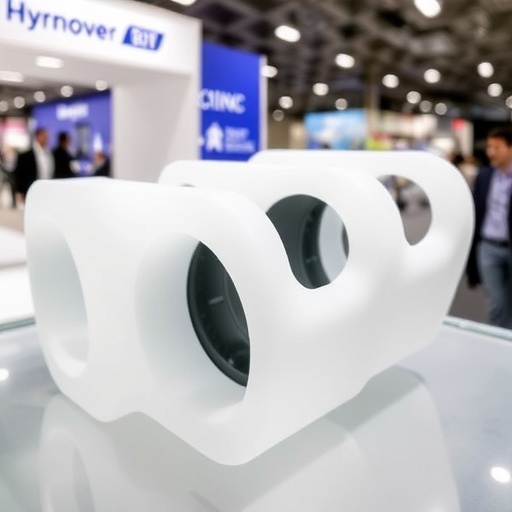
Visitors to Hannover Messe 2024 are set to encounter a groundbreaking demonstration of cooling technology that relies on a fascinating physical principle rather than traditional refrigerants or fossil fuels. At the core of this innovation is elastocaloric technology, which harnesses the unique properties of a shape-memory alloy—nickel-titanium—to achieve energy-efficient cooling and heating. By simply stretching and relaxing specially designed metal elements, this technology induces dramatic temperature changes, promising a revolutionary approach to thermal management that could reshape industries and everyday living environments.
Elastocaloric cooling represents a compelling alternative to conventional systems plagued by environmental and efficiency drawbacks. Unlike refrigerants that contribute to climate warming or combustion-based heating methods, elastocaloric devices operate purely on the mechanical deformation of nickel-titanium alloys. These alloys undergo reversible phase transformations that absorb or release heat in response to applied stress, enabling heat to be effectively transported without harmful emissions. This innovation is spearheaded by Professor Paul Motzki and his multidisciplinary team at Saarland University, in collaboration with 3D printing experts led by Professor Dirk Bähre.
The metallic structures showcased at Hannover Messe at Hall 11, Stand D41, are more than decorative curiosities; they embody the next generation of cooling elements engineered for maximal thermal exchange. By leveraging additive manufacturing, the researchers have developed intricate 3D geometries from nickel-titanium alloys, designed to drastically increase surface area. This enhancement in contact between the cooling element and heat-transfer media like air or water significantly boosts heat flow efficiency, moving elastocaloric technology closer to industrial and consumer viability.
Nickel-titanium, the alloy at the heart of these systems, is well-known for its shape-memory effects and superelasticity. Under mechanical stress, this alloy shifts from a high-temperature crystalline phase to a lower-temperature phase, releasing heat as it transitions. Conversely, when the stress is relieved, the material cools due to an endothermic phase shift back to its original structure. This cyclic transition, achieved through careful tensile and compressive loading, drive the elastocaloric effect, wherein the cooling and heating events are intrinsic to the alloy’s phase mechanics rather than generated by external refrigerants.
The research spearheaded in Saarbrücken builds on over 15 years of exploration into the thermomechanical behavior of nickel-titanium. Initially focusing on bundles of ultrathin wires and thin sheets, the team’s innovation has rapidly evolved into complex lattice structures fabricated through 3D printing. These porous and meticulously optimized architectures maximize heat transfer by enabling greater fluid interaction across the material, facilitating swift and effective energy exchange. Experimental testing continues to refine these structures to identify the most efficient geometries.
Using resistance measurements intrinsic to the nickel-titanium wires, the researchers can monitor deformation and the corresponding phase transformation in real time. This self-sensing ability means the materials act as their own detectors, obviating the need for external sensors and resulting in highly precise, self-regulating thermal control components. Such embedded intelligence opens avenues for smart cooling systems adaptable to dynamic conditions without intricate electronic controls.
As the technology matures, the research team is tackling practical challenges to propel elastocaloric systems from laboratory prototypes toward real-world applications. Key considerations include material durability under cyclic stress and maintainability. Elastocaloric devices must endure millions of loading cycles to be commercially viable, necessitating rigorous materials engineering aimed at fatigue resistance. The team is also designing modular components for swift replacement, ensuring downtime is minimized in future commercial units.
The potential impact of elastocaloric cooling transcends environmental benefits; the technology promises significant gains in energy efficiency. Cooling and heating currently account for large proportions of global electricity consumption, with demands projected to rise amid climate change-induced extremes. Elastocaloric systems, powered solely by electricity—and compatible with renewable sources—offer a pathway to reducing dependence on greenhouse gas-intensive methods. The European Commission and the World Economic Forum have recognized this technology as a leading candidate among emerging thermal management innovations.
Saarland University researchers are developing applications across various domains, from household refrigerators to electric vehicle air conditioning. Notably, their recent collaboration with Volkswagen AG and industry partners aims to create lightweight and energy-saving cooling solutions tailored for electric vehicles, a sector where efficiency gains translate directly into extended driving range and reduced emissions. Additional projects focus on scalable residential cooling and heating, positioning elastocalorics as a versatile, sustainable alternative within smart building technologies.
A significant stride is demonstrated through the first functional elastocaloric mini fridge unveiled at Hannover Messe. This prototype uses rotating bundles of thin nickel-titanium wires that alternately stretch and relax around a cooling chamber, cooling the air inside and showcasing the practical feasibility of the technology. The integration of mechanical motion with thermal cycles in this system exemplifies how the elastocaloric effect can be harnessed efficiently for everyday cooling needs, emphasizing both innovation and operability.
Financially underpinned by major funding initiatives from German federal ministries and the European Innovation Council, this research embodies a concerted effort to accelerate commercialization and regional economic growth. The DEPART!Saar project, supplied with nearly €18 million, aims to create infrastructure for elastocaloric technology transfer. European collaboration further extends the technology’s reach, with multi-million-euro investments supporting air conditioning prototypes and the integration of shape-memory materials with complementary smart actuators enhancing system performance.
Looking ahead, the Saarland team’s multi-disciplinary approach—combining materials science, mechanical engineering, additive manufacturing, and applied physics—models a holistic paradigm for pioneering sustainable cooling technologies. As climate and energy pressures intensify, innovations like elastocaloric cooling not only promise cleaner and more efficient thermal management but also offer fresh momentum toward a resilient, low-carbon future for cooling and heating worldwide.
News Publication Date: 2024
Web References:
https://mediasvc.eurekalert.org/Api/v1/Multimedia/f02e6789-f113-43bd-bab1-17db129f753a/Rendition/low-res/Content/Public
Keywords
elastocaloric, shape-memory alloy, nickel-titanium, sustainable cooling, additive manufacturing, 3D printing, energy efficiency, thermomechanics, phase transformation, Hannover Messe, smart materials, thermal management
Cite Scienmag News
Denise Maddox. (April 20, 2026). Innovative Elastocaloric Cooling Components from 3D Printing Featured at Hannover Messe. Scienmag. https://scienmag.com/innovative-elastocaloric-cooling-components-from-3d-printing-featured-at-hannover-messe/
Denise Maddox. "Innovative Elastocaloric Cooling Components from 3D Printing Featured at Hannover Messe." Scienmag, 20 April 2026, https://scienmag.com/innovative-elastocaloric-cooling-components-from-3d-printing-featured-at-hannover-messe/. Accessed 5 September 2026.
Denise Maddox. "Innovative Elastocaloric Cooling Components from 3D Printing Featured at Hannover Messe." Scienmag. April 20, 2026. https://scienmag.com/innovative-elastocaloric-cooling-components-from-3d-printing-featured-at-hannover-messe/


